
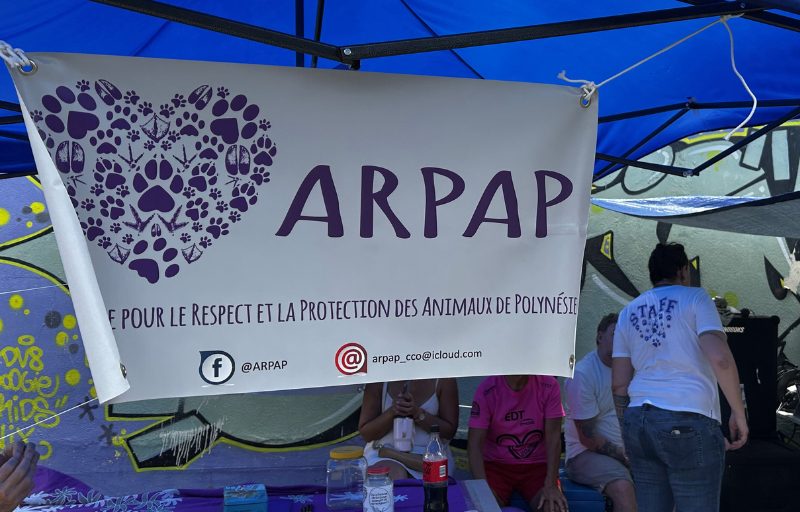
The Territory’s animal protection bill has not yet been made public, but it is already prompting reactions. Notably regarding the idea of limiting the number of animals per household, depending on housing conditions and neighborhood. “Completely unfair” and legally questionable, says Carole Couturier, president of ARPAP, who warns of a risk of conflating financial means with the ability to care for an animal. The Alliance for Respect and Protection of Animals in French Polynesia, however, welcomes Cesec’s motion, which brings together “all the associations’ demands from the past 10 years.”
Read also: Cesec wants to move the needle on animal abuse, the Government unveils a bill.
This Wednesday, October 14, even as Cesec was voting on a long-awaited motion on animal welfare, the government communicated about the approval of a Territory bill “aimed at modernizing the regulations governing animal protection in French Polynesia.” The text, not yet made public, will be studied by Cesec and Tarahoi in the coming weeks, and its aim is to “better protect animals and hold owners accountable.” The current regulation, dating from 2001, recognizes animals as sensitive beings and forbids mistreatment of animals, the executive had explained, but it does not always allow the administration to impose corrective measures in cases of negligence or abuse, the government notes.
The Territory bill notably strengthens the obligations for owners of dangerous animals and for sellers, tightens controls, and authorizes the “competent services” to order the provisional withdrawal of an animal, as well as creating administrative sanctions that can reach nearly 1.8 million francs. It also aims to combat canine overpopulation, despite around 209 million francs mobilized between 2023 and 2026 to sterilize about 12,000 dogs.
Taking care of an animal is not a matter of money, it’s a matter of the heart.
But one measure in particular already faces opposition from associations: the possibility for the country to cap the number of animals per household, “according to species, breeds, housing conditions and the risks to neighbors or public health.” A proposal “completely unfair” for Carole Couturier, founder and president of the Alliance for Respect and Protection of Animals in Polynesia (ARPAP), who held her general assembly this weekend. “That means we’re saying people who can afford to have animals should be allowed to have them, whereas those who cannot afford it cannot have animals.” She is convinced that having pets is “not a question of money, it’s a matter of heart.”
For Carole Couturier, judging the limit on animal ownership by the animals’ needs and living conditions risks blurring the line between financial means and the ability to take good care of them: “We who intervene in cases of abuse, I can intervene just as much with the homeless as in the Lotus’s nice neighborhoods. If we don’t have the means and we own 20 dogs, it’s the animal that will suffer, she acknowledges. But that doesn’t mean people who don’t have money are bad owners.” According to her, the solution does not lie in a numerical cap but in “educating owners to raise awareness.” An “infringement on free possession” for the ARPAP president, who mentions “some doubts about the constitutionality” of the bill.
Limiting the number of animals per household is not illegal.
“Today, the law regards the dog as moveable property, even if it has feelings. It’s like a dresser with feelings,” laments the volunteer. The Civil Code indeed subjects domestic animals to the regime of property, but it has also recognized since 2015 them as living beings endowed with sensitivity. The question of legality—or “constitutionality”—of limiting their keeping can be raised.
In Metropolitan France, the Rural Code, not applicable in Polynesia, limits hosting in “foster families” to 9 weaned dogs per household, whether kept or merely hosted, as the SPA notes. Beyond that, specialized facilities must be approved. In the rest of the world, and notably in some major European, American, or Asian cities, it is local or municipal regulations that limit the number of domestic animals per dwelling, or set a threshold above which a special authorization is required.
The Cesec’s motion: “everything we’ve been asking for for years”
Carole Couturier thus prepares to clash with the Government’s Territory bill, but she welcomes the motion adopted by Cesec on Wednesday, which was co-reported by Alain Theurier, a representative of animal-protection associations on the council and a member of ARPAP. The four-page text outlines a state of play on abandonments, abuse, and the roaming of dogs and cats. It specifically calls for the country to complete the animal protection legal framework, to generalize sterilization and identification, to develop shelter capacities, and to sustain associations in the long term. It also asks the State to strengthen sanctions and facilitate access to national funding for shelters and sterilization campaigns.
“From Cesec’s motion, what comes out are basically everything we’ve been asking for for years, what the associations are asking for,” notes Carole Couturier. The president maintains that ARPAP had already proposed to the Territory, about ten years ago, to develop a master plan for animal management and the animal cause. “That remained unanswered. Unfortunately, it never saw the light of day.” She states that the country today has a strategic plan, but it would appear that it was presented to only a few institutional actors, not to associations. But above all, the founder of ARPAP regrets the lack of concrete measures showing how and when objectives will be reached: “It’s, once again, a strategic plan and not an action plan. We have no schedule.” She therefore hopes that with Cesec’s motion, “we’ll finally have real coherence.” A hope that echoes the council’s main recommendation: to move from a succession of initiatives to an organized and sustainable public policy, involving the Territory, the State, the municipalities, and the associations.