
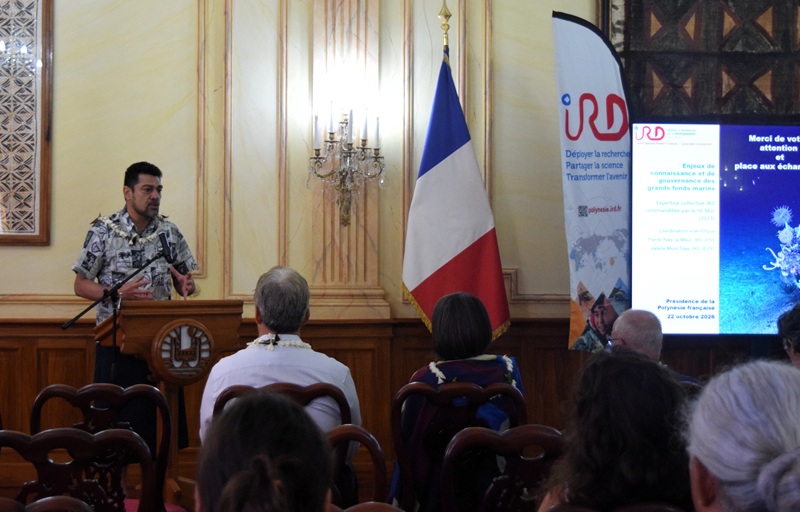
The results of IRD’s Collective Scientific Expertise on the deep seas were presented to the presidency for the first time this Thursday. The study reinforces Moetai Brotherson and his government in their opposition to deep-sea mining, calling it an “announced catastrophe” for both the environment and the economy. The recommendations from this expert assessment are mainly intended to help the state, which has shifted its stance on the issue in recent years, update its strategy for the deep seas. But the country could also draw inspiration from it.
On Thursday morning, the Collective Scientific Expertise (ESCo) “Knowledge and governance issues of the deep seas: what knowledge, what uses and what governance for the Pacific?” was presented to the presidency of French Polynesia for its first briefing. Led by the Institute of Research for Development (IRD) and commissioned by the French secretariat for the Sea, this expertise emerged from the work updating the 2015 National Deep-Sea Strategy.
For three years, thirteen international experts — anthropologists, biologists, economists, geologists, oceanographers, philosophers and jurists — held numerous workshops and exchanges to establish the state of knowledge on the deep seas by integrating scientific, traditional and local understandings. This work yielded ten recommendations aimed at informing public decisions and improving governance, while taking into account the uses and environmental impacts of these marine spaces. Seventeen Pacific countries and territories were involved in the dialogues.
The exclusive economic zones of French Polynesia, New Caledonia and Wallis and Futuna, as well as international waters, were at the center of this regional briefing, first conducted in the fenua and then in New Caledonia. Attending were representatives of the country and the High Commissioner, as well as the CEOs of Ifremer and IRD, invited for the occasion. Among the themes that emerged were the controversies surrounding seabed mining.
Deep-sea mining, “an announced catastrophe”
On this topic, the head of the country did not mince words. For Moetai Brotherson, the briefing is “absolutely essential,” because it is up to science to illuminate political decisions with the involvement of the entire population, so that everyone understands the stakes. Environmental concerns first: he regards deep-sea mining as “an announced catastrophe.” Economically, too: “All these studies show that we lose money by pursuing deep-sea mining.”
The head of the government also underscored the ocean’s importance to Polynesians and the country’s position in favor of a moratorium on deep-sea mining, a stance voiced as early as 2022. The presented work, he noted, invites greater involvement of populations and local knowledge in reflections on preserving and using the ocean.
The government therefore reaffirmed its opposition to any exploitation of the deep seas in Polynesia. “We have been very clear about the country’s desire to ban deep-sea mining by issuing a decree defining the marine protected areas of the Society, Gambier and coastal zones,” explains Taivini Teai. “All of this has been validated and voted by the Assembly,” notes the Minister of Environment and Marine Resources. It is true that the assembly expressed its opinion in 2025 on transforming the Tainui Atea–managed marine area into a marine protected area, with a de facto prohibition on exploitation across the nearly 5 million square kilometers it covers. Yet these protections sparked debate: in the assembly, which is still awaiting consultation on the creation of two new highly protected areas around the Marquesas and south of the Austral Islands, the Tavini group opposes “fencing off” submarine mineral resources, arguing they should be exploited once economic and environmental conditions are met. In the government, there is a push to continue strengthening arguments to oppose such exploitation. “Given the evolution of the national and international context, it is important to have this expertise, which allows us to consolidate scientific knowledge in all fields, but also to have these elements of reflection on the recommendations, to advance our understanding of the deep-sea,” Taivini Teai reiterates.
The country can also count on the international chair on the deep seas hosted in Polynesia by Ifremer, which is also meant to strengthen research and scientific cooperation in the Pacific. Indeed, mining exploration projects planned near Polynesian maritime space raise questions about their environmental impacts.
“France was rather in a pro-mining position and has changed its mind since then.”
While the 2015 strategy leaned toward exploitation, the State now aligns with the precautionary principle. A shift formalized in 2022 with Emmanuel Macron’s proposal to adopt an international moratorium on the issue. “In the beginning, France was more in favor of mining, and it has changed its mind in the meantime,” notes Tamatoa Bambridge, an anthropologist and the only Polynesian expert involved in the ESCo’s work.
For the researcher, the group of scientists had to stay neutral. Without neutrality, it would be impossible to listen to Pacific countries that favor mining, such as the Cook Islands, Nauru or Tonga. The recommendations, spanning scientific, political and civil-society domains, thus apply to those who want to exploit. “We don’t have to say ‘we are for it, we are against it,’ even if we have an opinion, but we must say: ‘If you proceed, be mindful of certain consequences.’”
The report can thus support a conservation strategy like Tainui Atea, just as a policy of exploring these depths, “I am not yet talking about exploitation,” he specifies, with recommendations that will have to be taken into account.
A Public and Citizen Debate, First and Foremost
The first of these ten recommendations proposes organizing citizen forums to bring the question of the deep seas into the public debate. The other recommendations emphasize the need to complete and consolidate knowledge, and to make it accessible. Three recommendations particularly stand out for the country: these citizen forums, the debate on current and future uses of the deep seas, and the development of a knowledge policy that brings together different forms of knowledge.
A crucial clarification remains: this expertise was commissioned by the State to underpin its national policy for deep waters. It is not meant to be adopted wholesale in Polynesia, which is autonomous and capable of defining its own approach. And circumstances differ from one territory to another. In Wallis and Futuna, the mining code falls under the State. Tamatoa Bambridge expects, for example, that Wallisians and Futunians will lead this struggle: they have realized that what is culturally meaningful to them is entirely outside its legal framework.
Polynesia nonetheless intends to work with its scientific and institutional partners to implement some of these recommendations. It will be necessary to define how populations participate, the topics to be debated regarding deep-sea uses, and the priority research needs. With a clear message: for the country, protecting the deep seas does not mean renouncing development, but choosing a model that preserves ecosystems and the future of coming generations.