
The Polynesian health system is breathing, but remains under close watch. Ten days of strikes at CHPF and the Health Directorate, and a week at ARASS, ended this Friday, following what officials called constructive meetings the day before at the Assembly. The unions now expect to see whether the elected representatives’ promises will be reflected in the 2027 provisional budget, to be voted in mid-November. If not, the movement could resume. CHPF teams are now organizing to restart their activities, which is expected to be complicated, with many patients who were postponed or rescheduled.
Following their “very positive” meetings with representatives and the president of the Assembly on Thursday afternoon, the CSTP-FO and A Ti’a i mua inter-union decided on Friday morning to suspend the strike affecting CHPF and the Health Directorate for eleven days, as well as the Agency for Regulation of Health and Social Action (Arass) since Monday.
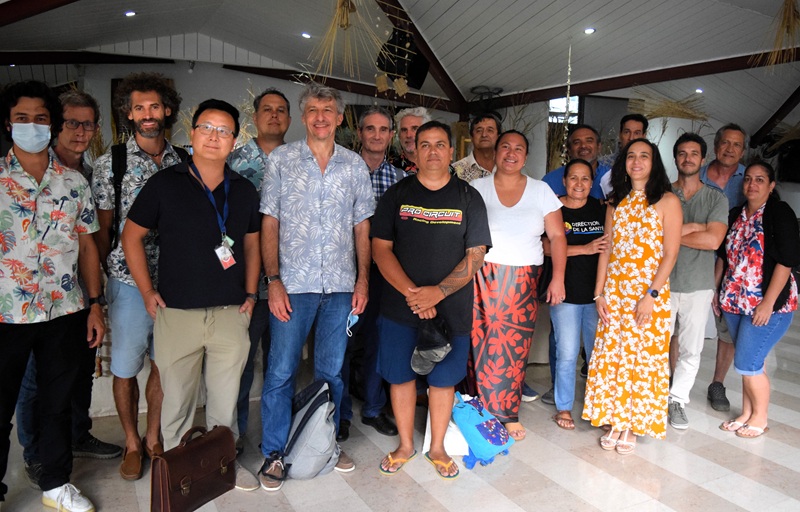
“We have confidence in our elected officials to ensure that the health system does not collapse,” reacted Patrick Galenon, secretary-general of the CSTP-FO, at the close of discussions in Tarahoi that lasted three hours on Thursday. After consulting the strikers in the morning, the inter-union thus made this decision, effective from today, in order to send “a strong message to the members of the Assembly of French Polynesia. It’s ‘we talked with you, you heard us, we trust you’,” explains Dr. Jonathan Larson, secretary-general of the hospital practitioners’ branch of A Ti’a i mua. “The representatives told us that during the sessions on the 2027 provisional budget, they would pay particular attention and would support us in implementing the necessary measures to revive our Polynesian health system. Of course, we also remain open to discussions with the government, but at the moment we have not yet received an invitation.”
A unified practitioner status promised from January 1, 2027
The inter-union emphasizes that special attention has been given to creating, as of January 1, 2027, a single professional status for practitioners in public health facilities, whether they work at CHPF, in peripheral hospitals, at ARASS, or with the Health Directorate—“because we all work in the same way and we all hold a Doctor of Medicine degree,” says Dr. Jonathan Larson, who serves at CHPF as the coordinating physician of the Ambulatory Surgery Unit.
In a communiqué, the inter-union adds that it “will remain vigilant, because the vote on the 2027 provisional budget, mid-November, will be the true test of the commitments expressed.” “Without a concrete translation of these commitments into the budget, caregivers reserve the right to resume the movement,” it notes. The inter-union must now transmit, “without delay,” its projected figures for these statutory reforms to Tarahoi, so that the Economy and Finance Committee can study the issue.
A revival that looks “complicated”
As for the administrative resignations filed the day before by 23 department heads of the hospital, as well as by the president and the vice-president of the hospital’s Medical Establishment Commission (CME), the representative body of the hospital medical community, they remain in place. While awaiting whether they will be accepted or rejected as in May 2024, the various CHPF services and other health structures affected by the movement are reorganizing to resume activities as before.
“The resumption will be complicated because we will need to reprogram patients who were postponed and deprogrammed. But we will do what is necessary so that the population does not bear all the consequences of this lack of attractiveness. There are reprogramming cells currently assessing which patients are ready for next week,” concludes the ATIM-PH secretary-general.
At the same time, another strike was averted on Friday at the hospital through the signing of a conflict-ending protocol between the Federation of Interprofessional Health Service Professionals in Polynesia (Fissap) and the Government on Thursday night. Following a negotiation meeting at the presidency, the Government announced it would “propose a meeting open to all concerned trade unions.” A meeting that “will address access to care across the five archipelagos and the patient journey, but also the needs of teams, their working conditions and the sustainability of funding,” the government stated in a communiqué. The government also pledged to finalize the work on revising employment frameworks, profession by profession, before June 30, 2027, for adoption by the end of the following year.