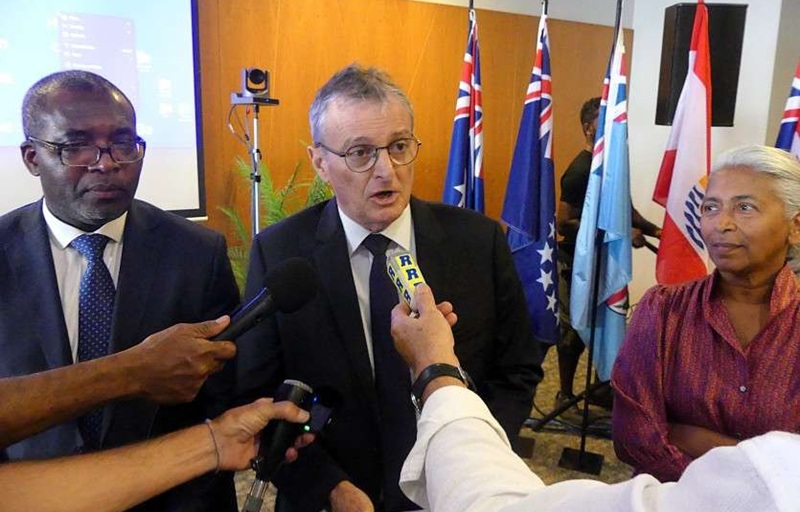
The seminar dedicated to fighting drug trafficking on the sea brought together representatives from fifteen countries in Nouméa on November 4 and 5. Seen as the starting point for regional cooperation against drug trafficking, the event mainly highlighted the scale of the phenomenon, which now directly affects island states, and shed light on the new operational modes of traffickers. Details from our partner Les Nouvelles calédoniennes.
The figure is telling: during the first five months of 2026, 17 tonnes of narcotics — chiefly cocaine — were seized in the Pacific, revealed High Commissioner Jacques Billant on Thursday, November 5. It is four times the volume seized in 2025. “Narcotrafficking is no longer a distant threat for the Pacific,” the high commissioner concluded. “It is a reality that directly concerns our maritime spaces, our territories and also our populations.”
A finding reinforced at the seminar dedicated to the fight against narcotrafficking at sea, held in Nouméa on November 5–6. The event brought together fifteen countries, twelve of which were Pacific nations, at the initiative of Jacques Billant and Camille Miansoni, the Attorney General at the Nouméa Court of Appeal. While it did not “aim to halt decisions” and no treaty was signed, it helped kickstart the building of a more effective regional cooperation among countries in combating the movement of drugs. “We exchanged, we compared our methods, our difficulties, our successes, we got to know each other and in our professions, all investigations that lead somewhere often begin with a handshake,” praised Jacques Billant in his closing speech.
Distant Networks
The strengthening of this collaboration has become essential, as narcotrafficking has surged in recent years in the Pacific. The region sits astride routes highly prized by traffickers, attracted by “the lucrative markets that Australia and New Zealand have become” in order to move their narcotics produced in Central and Latin America. The work of these two days also highlighted an evolution in methods.
“We have seen that the operating methods of criminal organizations are diversifying, becoming more professional,” said Jacques Billant. The drugs used to hide on sailboats, merchant ships or in containers. Going forward, they are also dropped at sea, near the coasts, in bales or loaded aboard semi-submersibles that are difficult to detect.
This “
“What we are facing is organized, mobile and patient. It would be truly illusory to think that a single country, a single service can respond to it,” insisted Jacques Billant. “There is a need to cooperate, on operational and judicial levels,” added Camille Miansoni, recalling that the narcotrafficking problem “does not necessarily pose itself in the same way everywhere.”
Three Systems to Reconcile
“We understood, during these two days, that three systems exist: the Westminster English-speaking system, the Napoleonic French-speaking system and the customary systems,” noted Véronique Roger-Lacan, France’s ambassador to the Pacific. Their representatives “do not know each other well” and “do not cooperate sufficiently,” she said. “We have a duty to know each other, to unite and to fight narco-trafficking together.”
Facing smaller nations worried about being made invisible by regional powers, the ambassador sought to reassure: “Our objective is not to create a parallel Francophone platform exclusively led by France. We want to integrate into the regional system, which was endorsed by heads of state and government at the Pacific Islands Forum in August last year.”
France will notably provide its Pacific Academy, created in 2023 on New Caledonian soil at the request of Emmanuel Macron, to train the Pacific’s security forces. “We adapt to the region’s needs and use the resources we have in our territories,” explained Commissioner Grégory Cornillon, attached to internal security at the French Embassy in Australia. Five training actions were organized in 2026.