
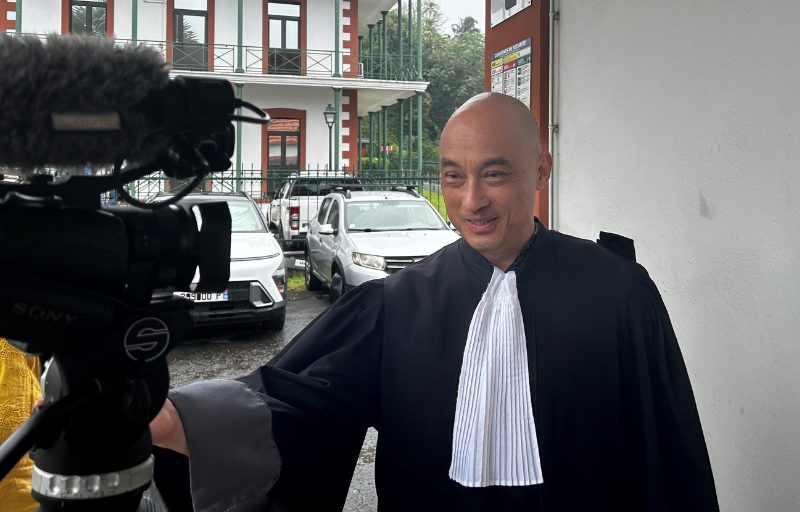
Airline strikes continue at the court. After Air Tahiti, it was Somstat’s turn to face CSIP this Friday morning before the urgent-relief judge. At issue is the use of two temporary workers during the social movement. The fuel-handling company Justifies long-planned hires, while the unions point to a suspicious calendar coincidence. But threatening calls, threatening, according to the CSIP’s lawyer, from the director Fabien Soupé could also weigh in.
Lire aussi : Grève à Air Tahiti : la CSIP déboutée par le juge des référés
After being dismissed on Thursday by the urgent-relief judge in its procedure against Air Tahiti, CSIP was back on the benches of the labor court this Friday morning. The union accuses Somstat of having used two temporary workers during the social movement. A new attempt to “break the strike,” according to the union’s lawyer, Me Usang.
The file notes three contracts between Pro Intérim and Somstat, including one that began on October 23, the day after the strike started, for a first assignment. Cyril Le Gayic’s confederation argues that these hires allowed activity to be maintained by replacing the striking workers, who were in the majority within the company. This is denied by the aircraft fuel-handling company. On the contrary, it argues that these were replacements linked to sick leaves and paid holidays filed nearly ten months before the conflict. It seeks the dismissal of CSIP’s claims, as well as 450,000 francs to cover defense costs.
Une « curieuse coïncidence »
A reading quite different from that of Me Usang, who spoke of a “coincidence”: “These interim contracts were signed between Pro Interim and Somstat on October 21, the day before the start of the strike. Curiously, these are contracts that do not target the employee who is being replaced. Because the principle of temporary employment is to specify whom one is replacing. The generality of these contracts clearly shows that these temporary workers are being recruited the day before, I should add, to come perform the tasks of the striking employees.”
And although one of these temporary workers is a former employee who resigned from Somstat, Me Usang “raises the question of safety.” According to the former lawyer at the International Criminal Court, “these two temporary workers were trained in 2-3 hours, while such training usually lasts several weeks,” he asserts.
Des « menaces de blacklistage »
A central element of his argument, Me Usang reveals “calls that were made to the home of employees, and to their spouses”. According to him, it was the director of Somstat himself, Fabien Soupé, who would have made these calls, connected, according to the plaintiffs, to “pressure to tell employees not to go on strike.”
If he asserts that a complaint has been filed with the Labour Directorate, the lawyer has “no more details in the investigation” of the case. He, however, hints that “the facts are half-admitted”.
Somstat’s attorney, Me Moratto, indicated that she contested the threats in her written conclusions submitted to the urgent-relief judge.
« Un parallélisme qui n’a pas lieu d’être »
Me Moratto asserts that the three interim contracts corresponded to absences not related to the social movement: one sick leave and paid holidays. Two of these leaves would have been taken as early as December 2025 and January 2026, several months before the start of the strike. For the defense, the use of temporary workers was therefore anticipated and did not aim to replace the strikers, something CSIP has not managed to prove, according to her. During her pleadings, the Somstat’s lawyer notes “no evidence” provided by the union that could demonstrate that the temporary workers actually performed the strikers’ work. A point that had already persuaded her colleague Me Piriou, representing Air Tahiti, the day before.
Furthermore, she notes that CSIP also contradicts itself in what it argues. While Me Usang mentioned the lack of clear tasks in the temporary contracts, illustrated by hiring a driver to carry out handling maneuvers, the defense’s lawyer notes a certain versatility among the employees. In a document produced by the union itself, a female employee describes herself as “driver, refueler and ramp agent.”
Finally, Me Moratto maintains that the interim-relief procedure is no longer justified. Indeed, the two temporary workers’ contracts are due to end this Friday for one and next Monday for the other. The urgency and the palpable upheaval that would have justified interim relief would thus no longer be current. She goes even further: if the ruling sides with CSIP, it would mean that no company could hire temporary workers during a strike, even for long-standing justified absences.
The labor court’s decision will be issued on Thursday, November 12 at 3:30 p.m.