
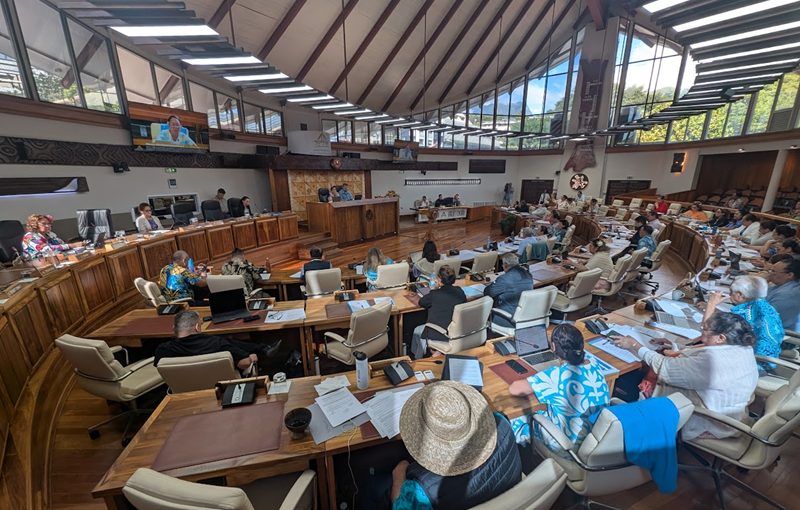
After being presented for the first time by Oscar Temaru in 2025, the resolution on the sovereignty of the Polynesians over the country’s resources was back on the agenda of the assembly session this Thursday. The autonomists criticized the proposal, arguing that it “will not change anything” and distrusted the political intentions of the independence advocates. Reassured by an amendment requiring a population consultation before any exploration or exploitation of seabed resources, and by Tony Géros who spoke of a “a simple alignment with the principles of the UN”, the representatives adopted it unanimously.
Also read:
- Marine resources: a complaint to the ICJ that highlights the Tavini’s divisions
- The Tavini wants to place the resources of the depths at the heart of the municipal elections
- Deep-sea resources: Moetai Brotherson’s position counts for little against France’s interests
The “proposal for a resolution aiming to proclaim the permanent sovereignty of the people of French Polynesia over its natural resources” was adopted unanimously on Thursday by the assembly. Initially presented by Oscar Temaru and then withdrawn in December 2025, the text returned to the agenda, this time carried by Tavini Tevaipaea Hoiore and representative A Fano Tià Allen Salmon. Precisely, it proclaims “the permanent, inalienable and imprescriptible sovereignty of the people of French Polynesia over all of its natural terrestrial, marine, lagoon resources, as well as over the soils and subsoil of the seabed located in the Polynesian Exclusive Economic Zone”.
An amendment by Hinamoeura Morgant-Cross conditions “any decision relating to the exploration or exploitation of seabed resources” to an independent and public environmental impact study, to a debate and to a consultation of the people. An amendment that “changes nothing at all” from the independence side, but which helped reassure the autonomist benches.
Independentists want “to extend the country’s control over strategic materials, with a view to exploiting them”
Nicole Sanquer asserts that discussions in committee went beyond the mere question of sovereignty: “Tony Géros spoke of an initial study on mineral resources, Oscar Temaru presented seabed exploitation as a sovereignty issue and mentioned cooperation with Rarotonga and other Pacific countries, Steve Chailloux explained that the matter of extracting these minerals would be debated later”. The representative therefore asks the rapporteurs to be clear: “Will adopting this resolution commit us to this path?” In the session, she also lamented the absence of Oscar Temaru “who has never hidden that he wanted to finance independence with seabed resource exploitation”.
For Nicole Sanquer, everyone shares the belief “that it is up to the Polynesians to decide the future of these resources and the use they wish to make of them,” and she specifies that “the mining regime already falls under the Country” within the limits of strategic materials. The Ahip leader thus sees in this proposal “a clear political intent”: “to extend the country’s control over strategic materials, in order to exploit them”, and its authors are therefore seeking “political support to embark on this approach”.
From the Tavini side, Ueva Hamblin specifies that Temaru’s intention “has never been to sell the soul of the Polynesians, but to guarantee that the decision remains in the hands of our people”. “Proclaiming our sovereignty is to refuse that the future of our ocean be thought of elsewhere, by others and for others.” This principle does not close the door to dialogue with the State but sets “the starting point.” “Every decision concerning our resources must be taken with the people of this country and never on their behalf. Let us be clear, this resolution does not decide to exploit or to ban, it states who holds the decision. The Tavini group therefore requests that every public power decision touching these resources be accompanied by complete, clear, and accessible information for all,” argued Ueva Hamblin.
Even the same message from A Fano Tià with Allen Salmon. The representative specifies that “sovereignty is not the right to exploit but first the right to protect and to say no. Especially as the mining race around us is accelerating.”
“It’s just another proclamation”
For Lana Tetuanui of Tapura, “it’s just another proclamation” that will not bring any real change in the lives of the Polynesians. Moreover, since “this right is already recognized”, she notes, in Article 47 of the status and in international law, as also mentioned in the resolution. The Tapura representative wonders: what more will we obtain with this proclamation? Nothing, according to her:
“Will this resolution modify our autonomy status? No. Will it transfer new competences from the State to the Country? No. Will it give us new financial, technical, or human resources to exploit and protect our resources? No. Will it guarantee a better distribution of the wealth derived from these resources for the benefit of our families and our municipalities? No. This resolution therefore does not change the existing legal framework.”
Lana Tetuanui also regrets not seeing any concrete proposal in this resolution: neither a strategy, nor scientific studies, nor an assessment of the economic potential of these resources, nor investments or investors, nor a timetable for actions to be taken. The representative also mocks this Tavini- and A Fano Tià-backed proposal: “With you, no one knows anymore who is for or against seabed exploitation, or who is for or against a moratorium on seabed resources.”
Tony Géros eventually left his seat to speak in the session and clarified that this resolution was merely a text to “align with the principles of the UN” which recognize “the rights of indigenous peoples to the lands, territories and resources they own, occupy, or use.”