
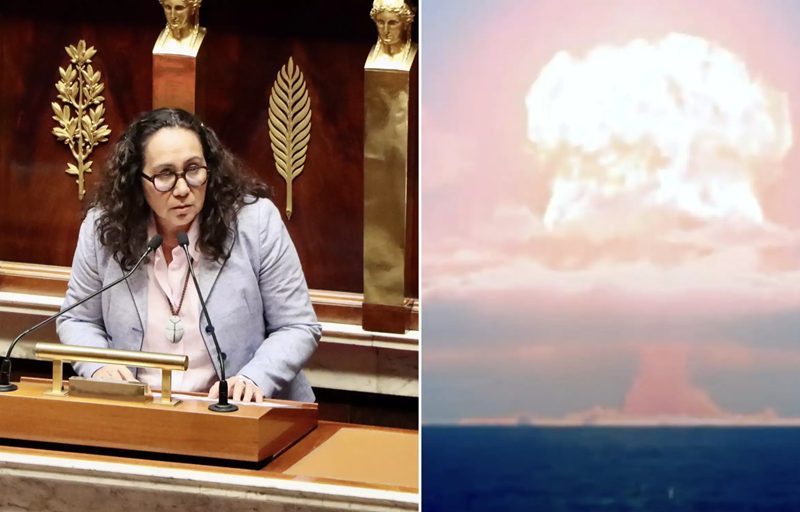
The bill aimed at improving compensation for victims of nuclear tests could be reviewed in a second reading at the start of December, during the National Assembly’s cross-partisan week. The conference of group presidents is due to meet on November 10 to decide whether to place it on the agenda. Details from our partner Outremers 360°.
Passed unanimously at the end of January by the National Assembly, the text championed by Mereana Reid Arbelot, a deputy from French Polynesia (GDR), and Didier Le Gac, a deputy from Finistère (EPR), had been amended by the Senate in May and subsequently adopted as well. This amendment therefore forced the bill to go back through the scrutiny of the Palais Bourbon.
It could be examined in the second reading at the start of December, during the cross-partisan week. Its fate will be decided by the conference of the presidents of groups in the National Assembly, this Tuesday, November 10. The team of the Polynesian deputy notes that this would be the only text presented by the Democratic and Republican Left group. The private member’s bill could also be examined in January if its timetable does not allow it to fit within the December cross-party week deadlines.
As a reminder, the bill notably proposes a paradigm shift in the method of compensating victims, moving from a “presumption of causality” to an “irrefutable presumption.” The 1 mSv threshold, introduced into the processing of claims in 2017 after the removal of the “negligible risk,” and considered a “lock” on compensation by victims’ associations, is removed.
“The person will be entitled to compensation if they meet the conditions of time, place, and pathologies with no possibility of counter-evidence,” explained Senator François-Noël Buffet, the bill’s rapporteur in the upper chamber. Such a change also implies a reorganization of the Committee for the Indemnification of Victims of Nuclear Tests (Civen).
The bill also opens compensation to heirs or “victims by ricochet.” Another advancement: “the State must reimburse the costs incurred by the Social Welfare Fund in Polynesia for the treatment of radiogenic diseases,” added François-Noël Buffet. “The reality is that the cost of these coverages is hard to estimate. It could be around 350 million euros.” The text provides for the creation of a commission to assess this “debt.”
If scheduled on the parliamentary agenda for the December or January cross-party week, and if a vote occurs without further amendments, the bill would then be definitively adopted.