
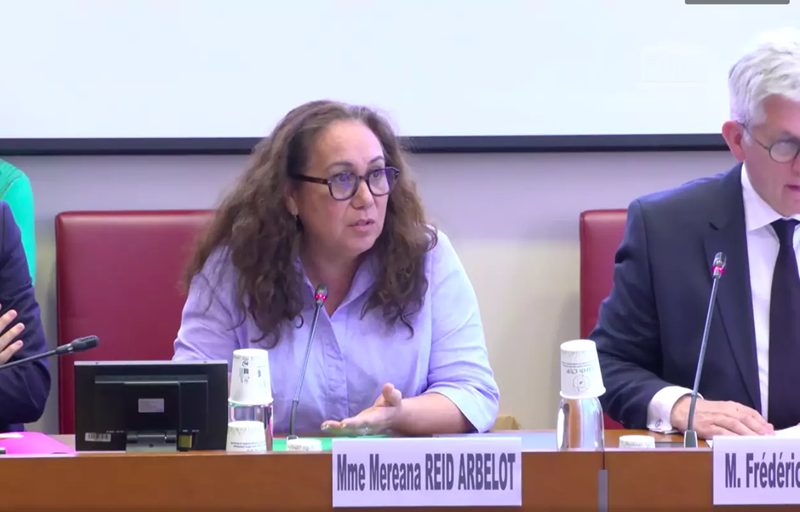
As the text enters its second reading, on December 1, Mereana Reid Arbelot states with certainty that the Morin Law reform “will not return to the Senate.” And to secure its rapid adoption before the National Assembly’s work ends in February, the Polynesian deputy agrees to let pass the six-month minimum stay, which she regards as unjustified “scientifically, and even less ethically.”
- Lire aussi : La réforme de la loi Morin pourrait être définitivement adoptée le 1er décembre
It may be the final stretch for the Morin Law reform. The bill, carried by Polynesian MP Mereana Reid Arbelot and by Didier Le Gac, a deputy from Finistère, aims to improve compensation for victims of nuclear tests by replacing the presumption of causality with an irrefragable presumption and by removing the 1 millisievert threshold. It will be examined in second reading at the National Assembly on Tuesday, December 1. The deputies had adopted it unanimously at the end of January, then the Senate voted on it with amendments, which necessitates this second reading.
For final adoption, the text must be voted conform in December, meaning without any changes compared to the Senate version. “I am very happy, very glad that this text is on the National Assembly’s agenda. It wasn’t a given,” reacted Mereana Reid Arbelot. “We know the constraints of the parliamentary calendar. This inclusion is to be welcomed. We are working double-time so that this text is voted conform, despite small imperfections that seem important. But given the advances of this text, we have decided to ensure that it passes conform at the Assembly, to avoid a return to the Senate, with all the risks it entails, and so that this law is adopted now, definitively and quickly.“
« The stakes were too high, we had to secure the text as it stood»
The main “imperfection” that has drawn concern is the amendment by Lana Tetuanui, which imposes a six-month minimum stay during the atmospheric testing period from 1966 to 1974. The senator says she defends this duration to combat windfall-type compensations, but for the deputy, “this amendment has no scientific justification, and even less ethical justification, since the risk was the same for people passing through Polynesia, for tourists, but also for missionaries or veterans who came for the firing campaigns lasting two, three or four months.” Polynesians born less than six months before the end of the atmospheric phase are also excluded, but this could be refined “in the decrees,” according to Mereana Reid Arbelot.
“We have gone through the associations to explain that the stakes were too high, that the text needed to be secured as it stood, and then, in a second step, to see if we could eliminate the six months, in another legislative vehicle,” continues the deputy, who adds that the Moruroa e tatou association is “completely satisfied with the advances of the text,” while being “a little disappointed” on this point.
The text must first pass through the Defense Committee before its examination in December. The deputy insists she remains “confident.” “We are here to fight and to pass this text, and that finally a more just recognition and an improved compensation be offered to the Polynesians and the veterans,” continues Mereana Reid Arbelot, who states that “the text will not return to the Senate. We will vote conform and it will be adopted. It is my certainty. It is absolutely necessary. Otherwise, we risk disaster.”