
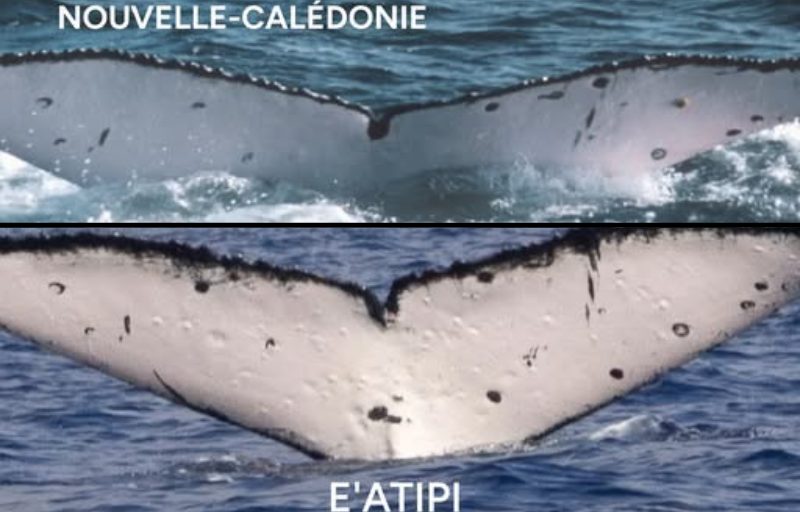
A single photograph of a tail fin was enough: by cross-referencing data from the collaborative platform Happywhale, researchers identified in Tahiti a whale that had previously been observed in New Caledonia in 1998. A “rare connection,” notes the Oceania association, and one that sheds light on the movements of cetaceans across the Pacific.
It is a reunion that could astonish scientists. A whale photographed in 1998 in New Caledonia was observed in Tahiti twenty-six years later, the Oceania association announced on its Facebook page.
The story begins on September 1, 1998. That day, the Opération Cétacés team in New Caledonia photographed an individual and recorded it under the code HNC145. The animal was then seen three times within groups known as “competitors,” those assemblies where several males vie for the company of a female.
On September 28, 2024, a photographer affiliated with Oceania, Spoon Ocean Photography, captured a whale in Tahiti. The individual was then added to the Oceania-Diren database under the name E’atipi.
It was the cross-matching of observations on Happywhale, the collaborative photo-identification platform, that made the link possible: HNC145 and E’atipi are one and the same whale. The identification rests on the tail fin, whose pattern is unique to each individual.
This discovery adds to a small handful of cases already documented between New Caledonia and French Polynesia, whether through genetics or photo-identification. These links remain exceptional, but this concrete case illustrates, according to Oceania, the major value of a regional and shared use of these tools to better understand the movements of cetaceans across the Pacific. The association thus invites the public to share their tail-fin photos taken this season on the site happywhale.com because “these shots can also help advance research.”