
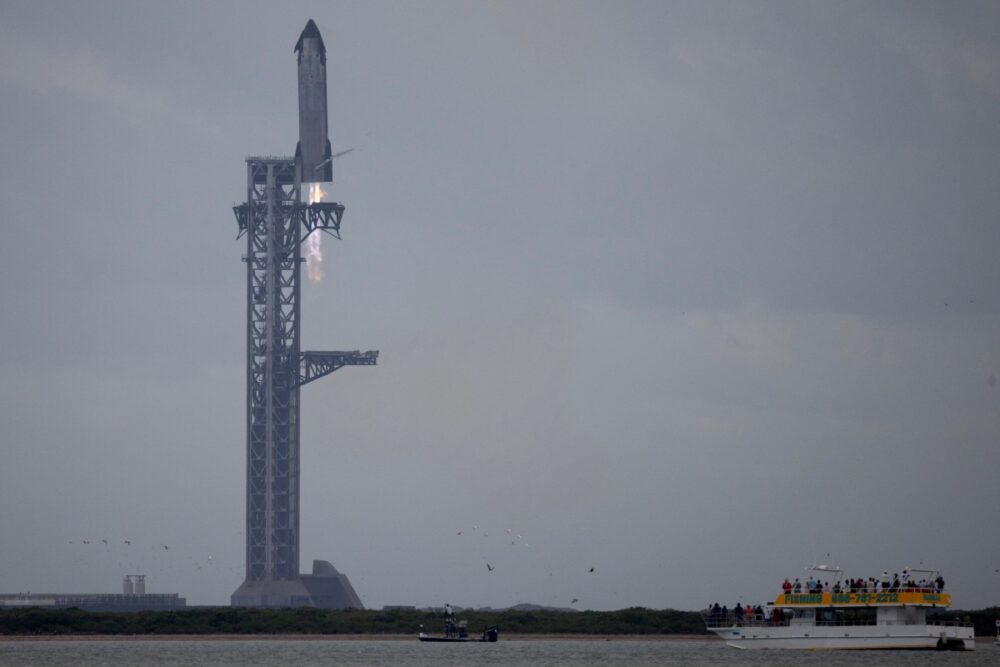
After completing about 14 orbits around Earth, this craft, over 50 meters tall, re-entered the atmosphere at full speed to return to the Texas space base from which the launch had taken place.
Piercing through the cloudy sky, it descended with control and nestled between gigantic metal arms that closed around it, before the astonished eyes of company employees as well as onlookers who had flocked to the site for the occasion.
“It was exhilarating, incredible,” recounts Allison Bunning, 61, who came from California to AFP: “I’m still in shock.”
Others, like Shawn, had even made the trip from Hawaii. “I’m over the moon,” says the enthusiast, smiling broadly.
This spectacular maneuver was far more complicated and risky than a similar one previously performed by SpaceX to recover the rocket’s lower stage, because the upper stage fell from a much higher altitude and at a much greater speed.
“The big day has arrived,” reacted Elon Musk on X, thanking his teams.
This achievement indeed marks a considerable advance in the development of this rocket, the largest and most powerful ever built, which is designed to undertake journeys to the Moon and Mars and to send data centers into space.
“It is an exceptional technical feat,” praised Clayton Swope, an expert at the Center for Strategic and International Studies (CSIS), to AFP.
“Almost magical”
It “proves that the idea of making Starship a fully reusable rocket can work,” he says.
While the world’s richest man’s company has already disrupted the global market with its Falcon rockets, partly reusable, it aims to go further with Starship, intending to reuse both of its stages, which would allow for large savings and a faster flight cadence.
This objective is a long-standing dream of the space sector and is technically extremely challenging, especially since SpaceX aims to relaunch its rockets very quickly.
To do this, it will need to ensure that the vessel was not too damaged by its re-entry into the atmosphere and is capable of being reused without major work as was the case for NASA’s former Space Shuttles.
NASA also plans to use a modified version of Starship as a lunar lander in its Artemis program, which has faced delays.
Saturday’s success is thus “one more step” toward Americans returning to the Moon, NASA administrator Jared Isaacman noted on X, thanking the company for this moment that was “almost magical.”
– “More work to do” –
SpaceX, however, did not manage during this 15th test flight to recover as planned the rocket’s lower stage, the booster named Super Heavy, in a similar maneuver.
Although it had done so three times in the past, it chose not to attempt it Friday shortly after liftoff due to a technical issue. The craft thus fell back into the waters off the space base, where it exploded.
If catching the upper stage represents “a tremendous achievement,” it seems that “SpaceX still has a lot of work to do to make Starship a fully reliable and reusable system,” notes Kathleen Curlee, a space analyst at Georgetown University, to AFP.
The upper stage did manage the second time to deploy 26 large Starlink satellites into orbit, but “several repeated successes will be required to prove that the system is ready to handle” commercial satellites or even “sensitive missions,” she notes.
And other technical challenges remain before Starship can be considered ready for journeys to the Moon or Mars.
Among them are complex in-orbit refueling operations, which SpaceX has indicated it intends to begin testing soon.