
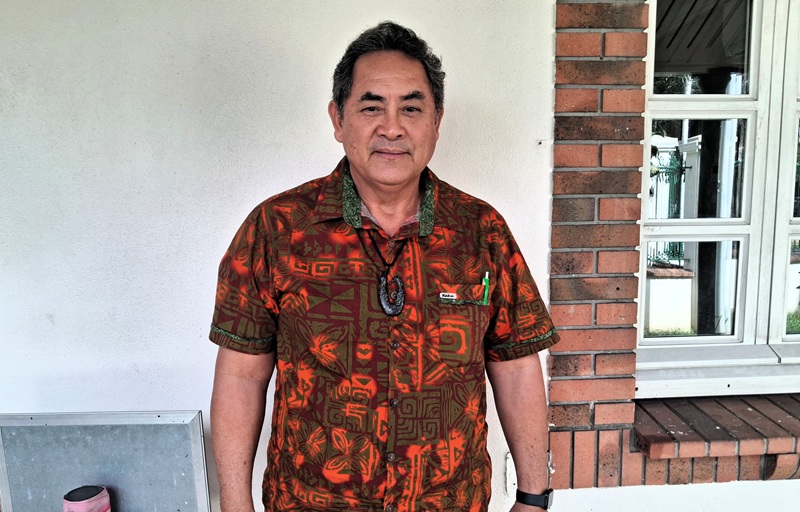
In about ten days, around a hundred tavana will participate in the Congress of Mayors of France, where the Syndicat for the Promotion of Municipalities intends to make the voice of the homeland heard. The agenda will notably address overseas issues, as well as funding under threat in the forthcoming state budget. In matters of security, Simplicio Lissant, president of the SPC and mayor of Punaauia, specifically wants to weigh in on the bill that would extend the powers of the mutoi. Elected officials must also meet several animal-protection associations to help them combat the proliferation of stray dogs.
Une centaine de tavana vont bientôt se rendre à Paris, afin de participer au Congrès des maires de France, organisé du 24 au 26 novembre au Parc des expositions de la Porte de Versailles. Placé sous le thème « Regagnons nos libertés », pour appeler à renforcer la décentralisation, il s’agit du premier congrès pour de nombreux maires nouvellement élus. Certains d’entre eux vont aussi profiter de leur déplacement en métropole pour se rendre au congrès de l’Association des communes et collectivités d’Outre-mer (ACCD’OM), organisé à Montpellier du 16 au 19 novembre.
The Congress of Mayors of France is an “very important annual meeting” for tavana, notes Simplicio Lissant, president of the Syndicate for the Promotion of Municipalities of French Polynesia (SPC), because it “allows meeting colleagues from mainland and overseas and sharing experiences,” but also to engage with institutions so that texts concerning municipalities are “adapted to the reality of Polynesians” and to their geography.
Challenges Specific to Ultramarine Territories
The overseas elected officials will first come together on a special day, November 23, which precedes the congress each year. As part of these Rencontre des élus des Outre-mer, there will be discussions unique to ultramarine territories, such as demographic transition in the face of an aging population, rising sea levels, or the issue of ice, which “concerns mainly the overseas territories,” notes Simplicio Lissant, who also serves as mayor of Punaauia, who adds that the tavana “need to exchange together on how to manage this problem.”
During the Congress of Mayors, which opens its doors the day after the overseas day, the SPC plans to carry the voice of Polynesian municipalities on several dossiers: sanitation and waste, intercommunality, the status of the local elected official, or the revision of the General Code of Territorial Collectivities.
The finances issue will also be on the agenda, as the communes fear drastic cuts in the 2027 state budget. The energy transition as well: the tavana worry about the post-2027 period, the date on which the current financing plan ends. “We are very committed in this area and we are far from having achieved our objectives. We want to discuss there the possibility of sustaining this action to help our communes to take this step, in Tahiti and Moorea, but especially for our islands which are completely dependent on fossil fuels,” continues the SPC president.
The Prerogatives of Municipal Police Among Priority Dossiers
The SPC also wants to make its voice heard during the congress on the bill relating to the extension of the prerogatives of the municipal police. Adopted by the Senate in February and then by the Legal Affairs Committee of the National Assembly at the end of April, this text, which provides adaptations for Polynesia, is still awaiting examination in a public session. It would allow, for communes that choose to broaden the judicial powers of their officers, to enable them to observe new offenses, such as illegal fishing in protected zones or the mooring of ships in regulated waters.
On the arming of mutoi, a decree, in force since October 9, also changes the dynamic in the communes. While it does not grant access to firearms for the island’s municipal police, unlike those in New Caledonia, the text does, however, extend authorization and training for tear gas bombs of more than 100 ml. The decision to equip the agents remains with the mayor, with the authorization of the high commissioner.
Simplicio Lissant assures that there is no plan for communes to “rush to arm themselves.” “The advantage of this text is that we give freedom to each municipal council and to each tavana to adapt, to pick from its provisions, especially in arming, what suits. I believe it is important because for 4–5 years we have been asking, for example, for the carrying of portable cameras and telescopic batons, and an increase in the volume of tear gas, because today we are often confronted with group dynamics. When you are in a group, you are more likely to exchange blows with the mutoi, and we do not hesitate. These new means will allow us to prevent action and disperse people without resorting to blows.”
New measures that nonetheless require substantial funding, according to the SPC president. Equipment, maintenance, training of officers… these new prerogatives will incur costs, recalls the tavana of Punaauia, who plans to urge Polynesian lawmakers to ensure the text provides provisions on functioning, funding and training.
Stray Dogs: Seeking Financial Backing in Mainland France
Another public-safety topic, the management of stray dogs, also features on the exchanges’ program. At the request of several municipalities involved in the issue, the SPC has planned meetings between mayors and several major French animal-protection associations, such as the Brigitte Bardot Foundation and 30 Millions d’Amis, to explore partnerships, “notably funding. Today, we see it is a real problem that municipalities are taking on. It is important to have financial backing. Of course we have the backing of the country, but if we can also obtain external support for our associations, even just to assist owners in identifying their dogs or sterilization…”
Far from Paris and dependent on resources that are partly beyond their reach, the Polynesian communes intend to use these few days to be heard, ahead of looming budgetary and legislative deadlines.