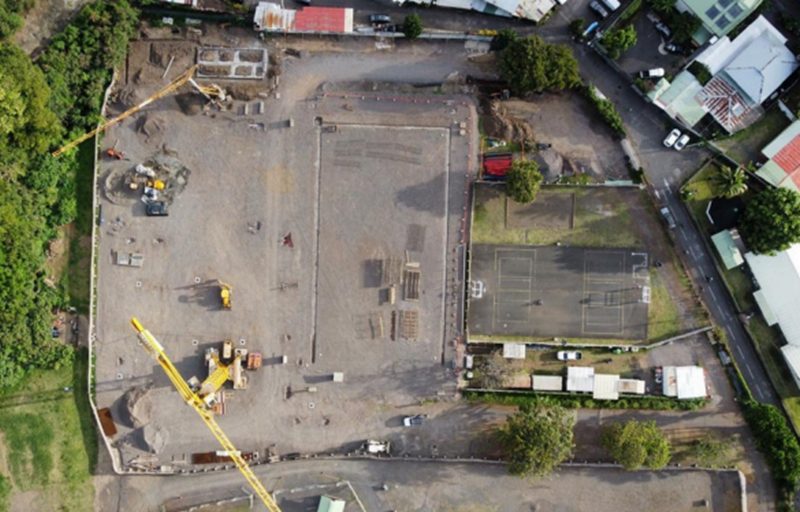
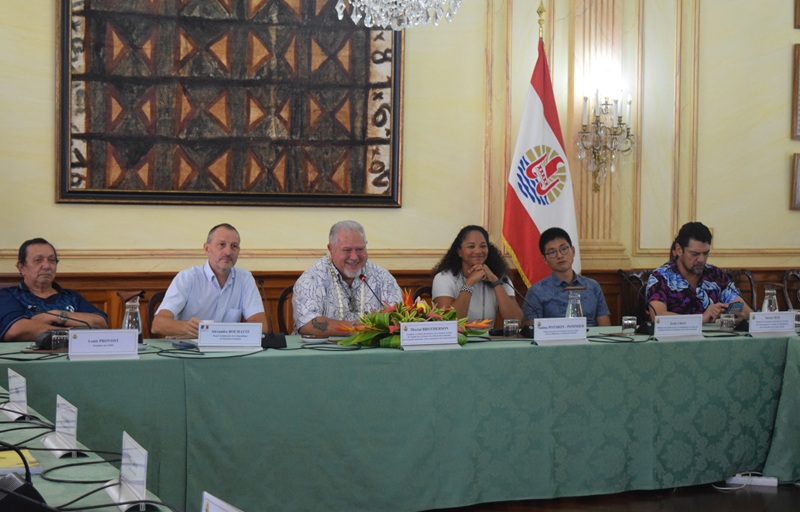
Gathered Friday morning at the Presidency, the stakeholders in charge of organizing the 2027 Pacific Games reviewed the progress of ongoing works. It was an opportunity to share photos and highlight a few points of attention. Among them, the delay of the Hitia’a athletics track, the shift of works between Pater and Punaru’u, and the delivery delay of the swimming pools in Mama’o. After the meeting, the Minister of Sports once again assured that all these contingencies had been anticipated and that the priority and essential infrastructures for Tahiti 2027 would be delivered on time.
- Lire aussi : “Il vaut mieux avoir une compétition sans public que pas de compétition du tout”
The Pacific Games 2027 Strategic Committee met this Friday morning in the Presidency’s ceremonial lounge. This quarterly gathering brings together the government, the Organizing Committee for the Games (COJ), the French Polynesian Olympic Committee (COPF), and all stakeholders involved in organizing the Games to define major orientations and the strategic course adopted, as well as to take stock of progress to date for each infrastructure required to host the Games. Under the convention signed with the Pacific Games Council, the country is responsible for funding, sites, accommodation facilities, and permits, while the COJ handles organization (catering, transport, management of villages and sporting events).
During this meeting, essential for the collective advancement of Tahiti 2027 preparations, Vanina Pommier, Minister of Sports, highlighted several points of attention.
Two months of delay for the Hitia’a track
The Hitia’a track will host football and athletics during the Games. Although construction was due to be completed in January 2027, supplier lead times pushed the deadline to February. So a delay, but a completion well before July does not worry the organizers. The on-site program includes rehabilitating the field and bringing the track up to standard, renovating and upgrading the building and the stands, and also replacing existing masts.
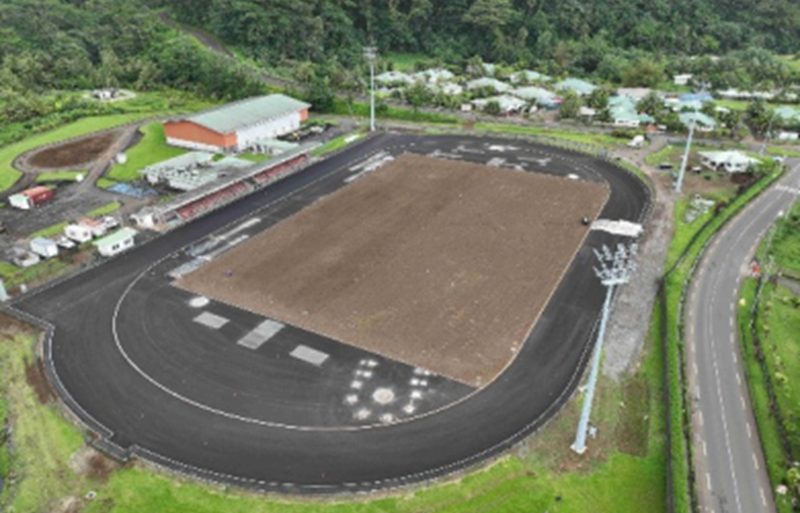
“The Hitia’a track, instead of being delivered in November, will be delivered in February. But either way, this remains feasible within the schedule since the Games take place in July. On the other sites, we have Pater. The transition Punaru’u–Pater, in terms of equipment, has been completed. Punaru’u now goes into works to allow work on the football field and the athletics track. What is certain today, at least, is that our athletics federation and our athletes have a track they can train on,” explains the minister.
Shuffling between Pater and Punaru’u
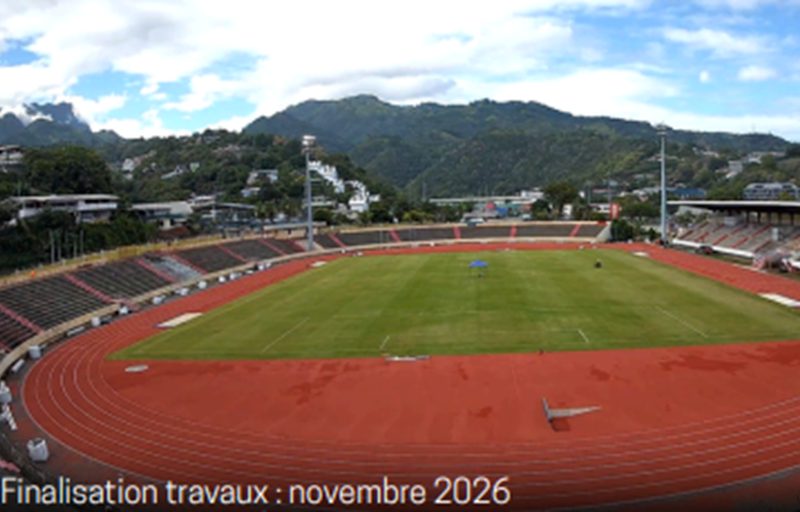
Following the renovation of the athletics track and the football field, the Pater stadium will reopen to provide access to the Tahitian Athletics Federation and the preparation of the Games’ athletes. The Minister of Sports confirmed that the transition of equipment between Punaru’u and Pater could be completed. It is now the Punaru’u stadium where rehabilitation and compliance works will take place to host the football and athletics events. The priority will be given to the football pitch, the official competition site, as well as the bringing up to standard of the restrooms and change rooms. If time is short, a phased approach can be used for upgrading the bleachers, which are already able to host spectators in their current state.
The Mama’o pools slated to arrive on the territory in the coming months
Work is also underway in Mama’o, where the swimming events will take place. The delivery of an initial portion of containers carrying the 25-meter mobile pools (to be used for warm-up and recovery) and the 50-meter Olympic pool is in progress and expected by the end of November, while the second portion should arrive in early 2027. The company responsible for their assembly is expected on the territory in February. In a move to cut timelines, decision-making bodies chose to “prioritize what enables performance.” If the stands are among the priorities, they will move to the second phase in case of weather-related setbacks.
To meet the deadlines, decisions had to be made and rely on existing assets as well as the involvement of all concerned bodies: “On the operation, we came to fund in order to reduce delays. Above all, we focused only on the pools, the stands, and the scaffolding. For everything else, we will rely on what was acquired as part of the Olympic Games, i.e., the legacy portion, and we are working with the COJ to deploy everything that will be changing rooms and sanitary facilities. But our aim was, of course, to prioritize what will allow our swimmers to perform and for delegations arriving from abroad to meet the minimums required for the Olympic Games,” explains the Minister of Sports.