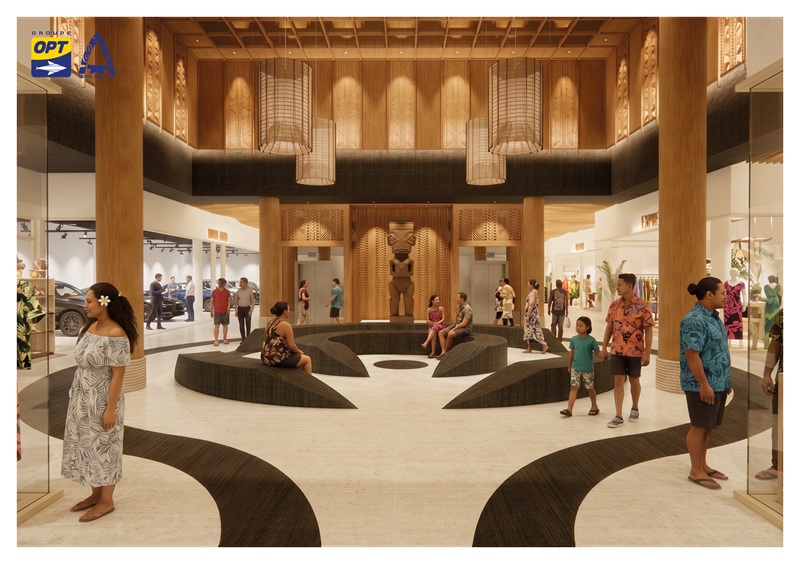
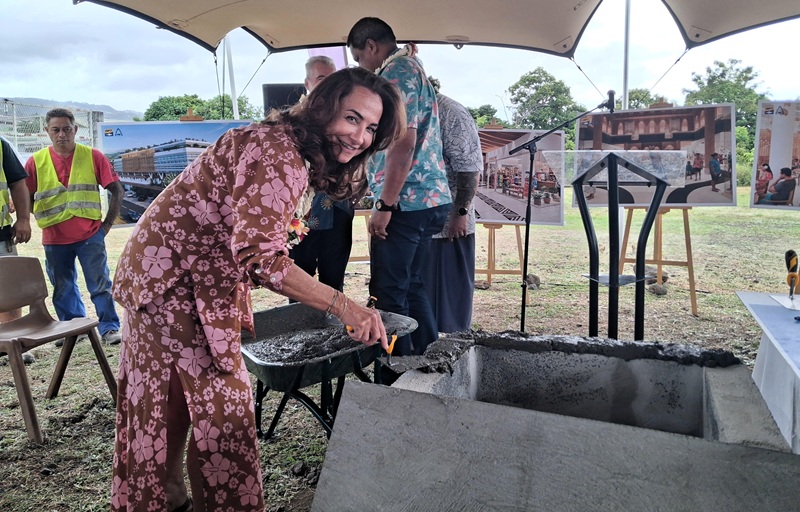
OPT laid the cornerstone this Friday for its forthcoming Fare Hinoi building, on the avenue of the same name. Featuring five floors of offices, retail spaces, and restaurants that can be leased or purchased, the group — currently running a deficit — aims to diversify its income by leveraging its real estate assets. The construction is estimated at 8.4 billion francs with a planned delivery in 2030. Other similar projects will be presented next year, the group’s CEO has already announced.
A new real estate project is taking shape on Prince Hinoi Avenue. It is the Fare Hinoi building, located between Hyper Brico and Easymarket, on land that the OPT group acquired in 2020. The CEO, in office for two and a half years, wanted to valorize it in order to diversify the group’s activities, which are currently in deficit.
“Unfortunately, the OPT group is engaged in declining activities. There is less mail, customers use the landline less. We are seeking new growth levers to achieve a much higher turnover and profitability that is significantly greater,” explains Hinatevahinetureiariki Delva. “For this reason, OPT is fortunate to own a substantial real estate portfolio. We bought this land in 2020 and have never done anything with it. Going forward, on all bare assets, the goal is to work on projects that are profitable and not necessarily intended for internal use. The aim is really to find new profitability for the OPT group.”
A cornerstone laid this Friday
The cornerstone for this five-story building was laid this Friday afternoon, in the presence of the country’s president, the Minister of the Economy, and the mayor of Papeete. Covering an area of 9,561 square meters, the building is intended to host offices, shops, and restaurants that the group is offering for sale or lease. The structure will also house a food court, a conference room, and nearly 500 parking spaces. Some spaces will be dedicated to the group’s entities, including Onati, Marara Paiement, Tahiti Nui Telecom, and Fare Rata.
Designed by architect and manager of Tropical Architecture, Charles Pascal-Lacombe, the complex features motifs inspired by marae and the Polynesian flag. The approach is eco-friendly: it prioritizes solar energy, thermal comfort, and rainwater harvesting to irrigate the green spaces, which span over 3,500 square meters.
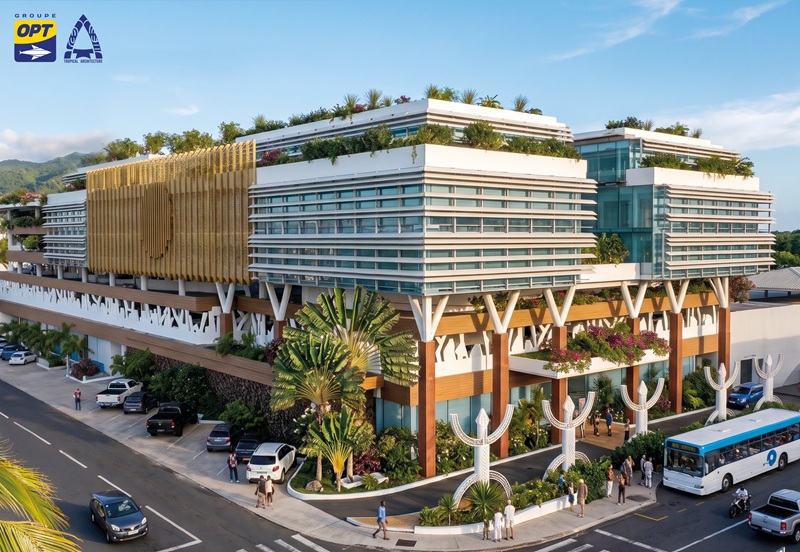
8.4 billion francs for a delivery planned in 2030
The works, estimated at 8.4 billion francs, are financed by equity, bank loans, and tax incentives. The complex is slated for delivery in 2030.
In the meantime, and to reduce its deficit, the group is looking to cut costs. The deficit stems from OPT’s presence even in distant archipelagos where there are very few customers, notes Hina Delva. “We are examining our activities to see how we can lower our charges and identify growth levers. It isn’t the profitability created by this project alone that will allow me tomorrow to close the deficit of the public service in the remote archipelagos, but rather a multitude of projects that will subsequently enable me to generate a bit more revenue.”
The CEO already has numerous other projects in mind, which she will present in 2027. “I have asked to inventory all bare lands and to work on profitable projects for the group,” she explains, unwilling to say more for now.