
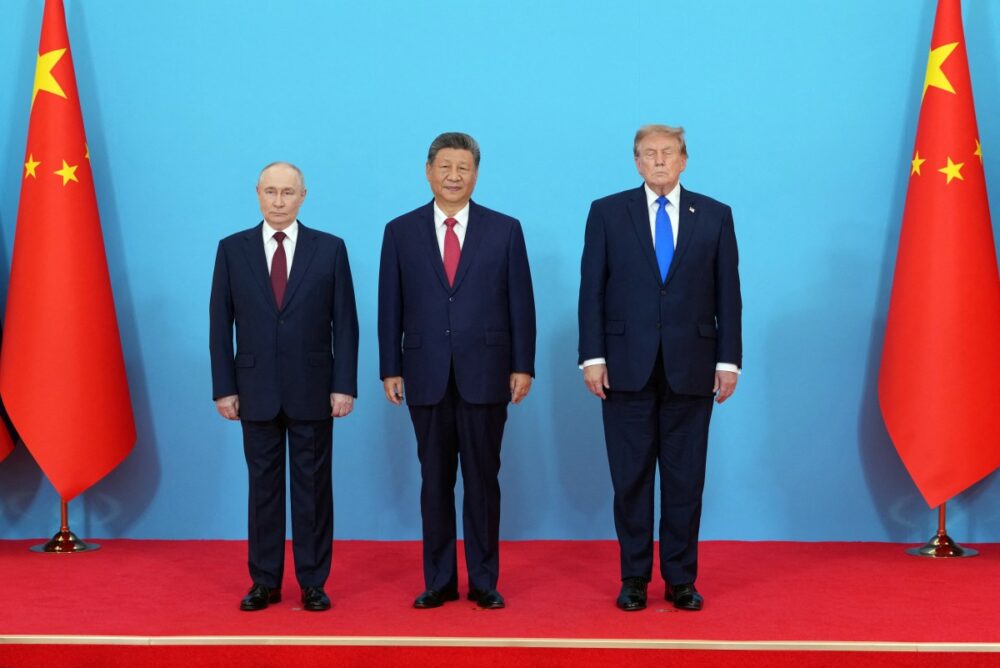
The American, Russian, and Chinese presidents spent about 1 hour and 20 minutes gathered around a large dark table in a residence set amid green surroundings, on the margins of a meeting of Asia-Pacific leaders in Shenzhen, in southern China. They stressed to journalists the historic nature of this gathering, which Ukraine, Europe, and Taiwan watched with suspicion.
Once their discussions—concluded after nearly five years of a broad Russian push in Ukraine and about nine months of conflict in the Middle East—were wrapped up, China, the United States, and Russia, the three permanent members of the United Nations Security Council, pledged themselves to “strategic stability” in a concise one-page, four-point declaration issued by the three nations.
They announced the initiation of “a dialogue on reducing nuclear risks and preventing nuclear proliferation.” They called for UN reforms, criticized the International Criminal Court (ICC), which has issued an arrest warrant for Mr. Putin, and expressed their intent to increase supplies of petroleum products, whose prices have surged in recent months.
The United States and Russia are major players in the market, and China holds substantial reserves that helped it weather the shock triggered by the crisis.
“We are truly writing history,” declared Mr. Trump at the outset of this meeting, which had raised concerns about deals among the great powers at the expense of other international actors like Ukraine and Europe.
Mr. Xi spoke of a gathering with a foundational scope while Mr. Putin spoke of a new page in the history of diplomacy.
Over their two days of interactions, the three heads of state offered a series of demonstrations of goodwill, from handshakes and embraces to compliments.
New Yalta
This unprecedented meeting drew comparisons with the 1945 Yalta conference, where the American, British, and Soviet leaders of that era laid the groundwork for Soviet hegemony in Eastern Europe and sketched the future lines of the Cold War battles.
For China, it was a chance to present itself as a key actor in major global affairs. Donald Trump, for his part, sought to offset his defeat in the midterm elections with diplomatic gains.
Mr. Putin, meanwhile, could project an image of Russia being welcomed as an equal by the two great world powers, despite Western economic sanctions that he called ineffective and “a thing of the past” on Wednesday.
For the first time since Russia’s invasion of Ukraine in February 2022, he appeared on Wednesday and Thursday in the family photo of a major diplomatic event, alongside Western leaders beyond the United States (Canada, Australia, Japan).
Mr. Trump did not stint on expressions of friendship toward Mr. Putin and Mr. Xi. He called the Russian president an ally with whom he has maintained “an excellent relationship for many years.”
Regarding his Chinese host, “President Xi and I have formed an exceptional personal relationship,” he asserted. Xi himself had gone to meet him on his arrival from the plane on Wednesday, something no Chinese leader had done before for a foreign leader in decades.
AI Control
The summit took place at a moment when the Russian offensive in Ukraine is approaching its five-year mark, with no prospect of a quick settlement.
Just after the publication of the “peace declaration,” Putin warned at a Shenzhen press conference that Russia would respond to Ukrainian strikes against the bridge linking Russian territory to the annexed Crimean peninsula, seized in 2014 by Moscow. He promised retaliatory measures “even more painful than what Kiev’s regime inflicted on the bridge.”
But he also asserted that he had invited European officials to discussions in Moscow before any potential direct talks on resolving the war in Ukraine.
The Europeans did not hide their skepticism toward the Shenzhen summit.
“These three leaders do not agree on anything, and therefore nothing will come out of this meeting,” commented the French foreign minister Jean-Noël Barrot.
Another attentive observer, the island of Taiwan, which China claims as part of its territory, noted the remarks attributed by state media to Xi that Trump should “continue to do what is necessary” to avoid “turmoil.”
Between Washington and Beijing, trade tensions persist despite a ceasefire reached in October 2025 but set to expire in January 2027. China and the United States remain engaged in a high-stakes strategic and technological rivalry. The advances in artificial intelligence (AI) spark as much anticipation as international concern.
During the morning plenary session of APEC leaders, Trump reiterated his opposition to “any form of globalist regulation” of AI. Xi Jinping reaffirmed that AI must remain “always under human control” and expressed a desire for cooperation between China and the United States to achieve this aim.