
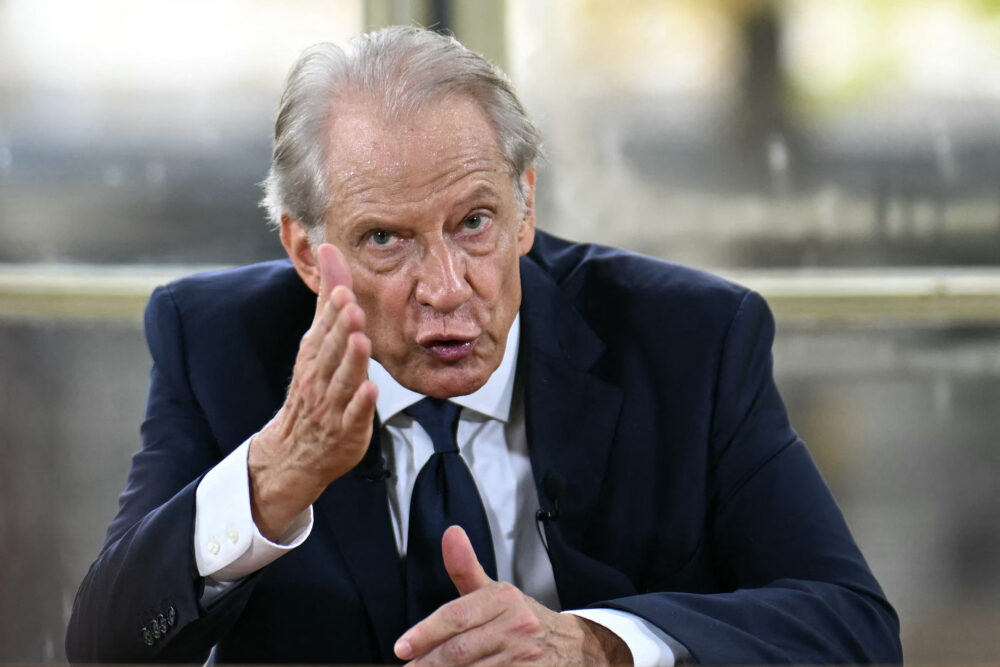
He accused the National Rally (far-right) and its “heritage” of racism and antisemitism, the Macronists (supporters of President Emmanuel Macron) who have “driven the French one against another” and La France insoumise (radical left) with its “taste for constant division” of being responsible for a “decay” of the country.
For now, polls show the RN’s Marine Le Pen as the frontrunner in the election and the head of La France insoumise, Jean-Luc Mélenchon, qualified for the second round. Dominique de Villepin’s support hovers between 1 and 3% in opinion polls.
In a long speech, Dominique de Villepin, 73, sketched a portrait of a France in peril and a democracy “in crisis,” asserting that he was presenting himself to carry “the fight for the Republic.”
True to his flamboyant style and his Gaullist convictions, he repeatedly invoked the memory of General de Gaulle, president (1958-69) and founder of the Fifth Republic.
“What If We Loved Each Other Again”
To accompany this message, his team published on Friday the first campaign posters, on which his face does not appear and which bear the words: “What if we loved each other again?”.
Dominique de Villepin said on Friday that he had been preparing “in the shadows” for years his program, intended, he said, to correct inequalities and solve the ecological and financial “debt.”
The former right-wing figure had emerged from relative political exile two years ago with his firm condemnation of the Gaza war, a position that earned him the appreciation of a younger and more left-leaning electorate.
Former foreign minister (2002-2004), he sees himself as credible on international issues and has sought in recent months to develop his national stature.
His critics, however, reproach him for lucrative activities and lectures abroad over the past two decades, notably in China.
Mr. Villepin rejected any conflict of interest. Just as in the matter of the statuettes he received when he was foreign minister, which he has since donated to the Quai d’Orsay.
His team sees his electorate centered around the center and the social-democratic left. Asked on Friday, he said he refused to throw himself into this “political swamp.” “I do not have a partisan spirit,” he declared.
He has nonetheless refused to participate in the right and center primary to avoid mixing with those he regards as direct heirs of Macronism. Probably also because the configuration would not have been favorable to him.
One who has been navigating politics since the 1980s but has never yet been elected will have to prove he can win over voters. And mayors.
During his first Elysee bid, in 2012, Dominique de Villepin had stumbled on the hurdle of the 500 endorsements from elected officials required to run. This time he has deployed a team of about fifty people to persuade the officials, with whom he organizes regular videoconferences.
He has collected around 300 pledges, according to his entourage. His allies believe this figure will take off with his candidacy, just as polls do. And they are convinced that his profile as a “statesman” matches the moment.