
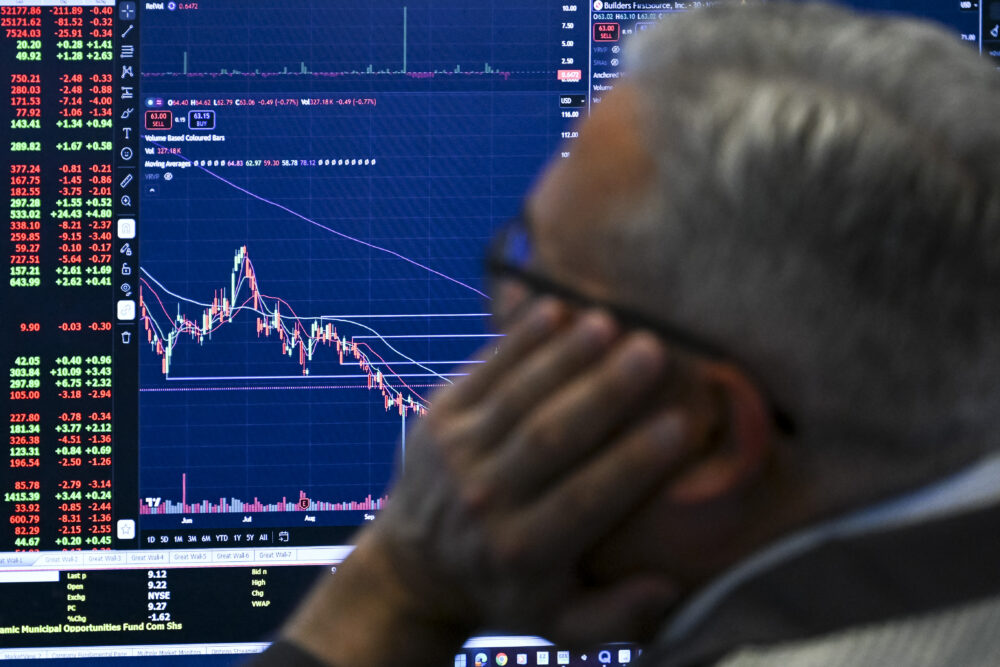
On Friday, the Nasdaq index — which gathers technology stocks on the New York Stock Exchange — plunged by 5.28%, wiping out all its gains accumulated since the start of the year.
“Markets were euphoric” about AI until recently, but “we are currently witnessing a massive reassessment” of that mindset, Steve Sosnick, a financial analyst for Interactive Brokers, told AFP.
The “Magnificent Seven” (Apple, Microsoft, Google, Amazon, Meta, Nvidia and Tesla), the market’s locomotives, saw their combined market capitalization shrink by more than $4 trillion in a month and a half, according to AFP’s calculation based on Bloomberg data. An amount larger than France’s gross domestic product (GDP).
“The AI bubble has already deflated (…) it happened at a slow pace,” says Adam Sarhan, head of the MarketTerminal.com financial platform, interviewed by AFP. “It remains to be seen how far the correction will go.”
Stock indices do not move in a straight line, even in a bull market. But hard blows have multiplied recently.
Midterm Effects and Nvidia
The U.S. midterm elections in early November “truly marked a turning point, because they showed that American voters were not in favor of artificial intelligence,”判 judge Mr. Sosnick.
In a series of local elections, Americans voted in large numbers to curb or ban the establishment of data centers, essential infrastructure for AI development.
For chip designers, whose costly products equip these facilities, the fear is that demand could dry up. Moreover, Washington has announced new export restrictions on chips to avoid them falling into China’s hands.
The leading semiconductor player, Nvidia, has also been severely affected in recent days by the departure of its longtime chief, Jensen Huang, amid a scandal involving extramarital relations, espionage suspicions and chip smuggling.
For Wall Street, this is a sequence of setbacks, the chip sector being the only one profitable in AI, with dizzying profits.
An “Absurd” Delay
OpenAI’s launch of ChatGPT at the end of 2022 kicked off the AI wave, which later transformed into a stock-market tsunami.
Soon, “the AI investment boom shifted from a promising technological story to a real exuberance in financial markets,” with billions of dollars pumped into the development of the technology, notes Stephen Innes, manager at SPI Asset Management.
Nevertheless, “as capital needs grew, we saw operators begin to question the profitability of all these investments, wondering whether all that money was being spent wisely…,” Mr. Sosnick recounts. He nonetheless considers it “absurd” that these reflections arrived so late.
Meanwhile, the indebtedness of AI players has risen markedly.
Despite a record fundraising ahead of its Thursday IPO — more than $91 billion — the AI giant Anthropic, creator of the Claude agent, acknowledged that its financial needs could lead it to borrow in the future.
“The opacity of AI-related debt is further amplified by circular ties, in the form of reciprocal commitments and cross-holdings among AI-related companies,” warned the European Central Bank in a recent report.
The sector’s decline goes beyond corporate boundaries. Financial markets have a significant impact on wealth — and thus purchasing power — for many Americans.
A large portion of the population holds stock assets, notably through retirement plans.