
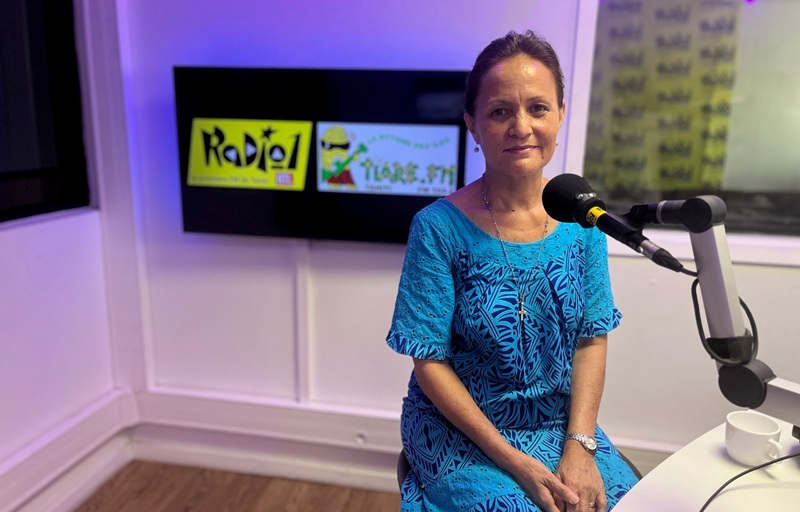
Her departure from the executive branch is a “resignation” and not a dismissal, insists Vannina Crolas. She speaks to Radio1 about several clashes with the presidency, including the Peperu file and the matter of hospital practitioners. While the former minister regards Moetai Brotherson as a “hard worker” generally “attentive,” she laments the influence on decisions by the president’s aides. Including her chief of staff Te Haurii Taimana, even though she does not name him directly. A proponent of a “common work program” within the independence bloc, she questions both A Fano Tià’s stance on political sovereignty and Tavini’s own stance on seabed exploitation, of which she remains an active member.
Radio 1: Last Friday, President Moetai Brotherson ended your duties as Minister of Public Service, Labor and Employment. Your decision to leave the government had already been discussed for three weeks, but the country’s president nonetheless specified that it was a “mutual agreement.” So, resignation or removal?
Vannina Crolas: A resignation. A resignation that was formalized, yes, three weeks later, but a resignation nonetheless. It wasn’t an easy decision because I loved what I did. I did it with a lot of passion, commitment.
What happened? Why did you leave?
First, because of an impediment to my reforms, already since 2024. And then interference, especially in the exercise of my duties, notably during negotiations with hospital practitioners.
When you say impediment to your reforms, do you mean the president didn’t agree with you?
It wasn’t really him, but he followed the advice of his advisers. The Peperu project was approved in 2024 by the Council of Ministers. Right after the first meeting with the department heads on this project, with the presentation of the context justifying the reform of our administration, I received a letter from the president telling me to stop this reform project, that there were other priorities. We had a debriefing meeting with the president; he wasn’t aware that the priorities he had mentioned had already been addressed. And he finally gave the green light. But restarting was very difficult because we had to remobilize the teams that had been somewhat discouraged by the halt. This file led to a meeting of public services in September 2025, then work by a group of administration experts.
The Peperu reform project is therefore on track, but you encountered a setback during negotiations with hospital practitioners…
This reform project of hospital practitioners’ status underwent a technical study. It involves significant financial, but also technical and organizational stakes. We sought the expertise of the director of CHPF and the Director of Health, and also of the DTI, to assess what we could concede or not given the context. This project, adjudicated by the Council of Ministers, was the starting point of discussions with hospital practitioners, while remaining open to the arguments of health professionals to move the lines.
And in the end, did these lines move without you?
We were still in discussions about an additional envelope, how to fund it, since these are permanent expenses and require permanent resources. The Minister of Finance did not agree to increase contributions or taxation. And during this third meeting with the hospital practitioners, an envelope of 1.5 billion francs was proposed.
A government proposal, did you learn of it live?
Yes, we learned about it in the meeting, even though there had been discussions before; I learned it in the meeting.
The 1.5 billion envelope for the practitioners? “I learned of it in the meeting.”
Who ultimately decided this within the government?
It was the president, but it wasn’t him who announced it. The person who announced it during that meeting did so with the president’s agreement, as far as I understood.
So the presidency (specifically the president’s chief of staff Te Haurii Taimana, since that’s who it is) announces things before the ministers, without consulting them?
Yes. I spoke to the Finance Minister about it; I asked whether he was aware of this 1.5 billion, and he said no. I told the president that this wasn’t normal, that we had not been involved. And then the president tasked me with leading the discussions. So I conducted the talks on behalf of the government. This announcement challenged the previously made arbitrations, threatened the sustainability of public finances, and affected the balance of the civil service. I had a discussion with the president, and I told him that it was out of the question for me to bear the consequences of a decision I hadn’t been involved in.
You therefore presented your resignation, but it took three weeks to formalize. What happened during those three weeks?
Immediately after, I asked to withdraw from the discussions with hospital practitioners. It was the president who then led the discussions. He proposed 1.5 billion as he had pledged during the third meeting. But the hospital practitioners still went on strike.
What were the discussions between you and the president like? Did he apologize for announcing something without involving you?
Not really; he tried to justify his position.
In the Assembly, the opposition regularly accuses the country’s president of stubbornness on certain files. Do you also reproach him for the way he works with his ministers?
No, not with us. He tends to adopt a trust-based approach. And here, I did not understand. Except on three occasions, with the Peperu project, the choice of the DTI head, and the envelope proposed to hospital practitioners. But that is not his usual way of doing things.
“Oscar Temaru strongly encouraged me to stay.”
He did say, while presenting your successor, “at a certain point, we do not agree on how to handle certain files, and the president presides.”
I fully agree with him. The president presides; the president decides. But for portfolios that fall under the respective ministers, the least thing is to discuss them, to review them together, and then to jointly own the consequences of such a decision. And in this case, I was not involved. It’s not so much the decision itself, even though there were enormous consequences behind it. For me, it was a social bomb. But it’s the manner of doing it, not being involved in a decision that concerns my portfolio.
Your resignation has been talked about since April, with Tavini’s split. What made you stay?
I had considered it during Tavini’s split, with the creation of the A Fano Tià group. And indeed, I told the president I could not stay, that I had not worked in 2023 for this. But I discussed it with Oscar Temaru and Tony Géros. Oscar Temaru strongly encouraged me to stay. For him, Tavini’s program had been carried into the elections and it was necessary to remain in government to implement that program. For him, Tavini ministers were needed in the government. And for President Moetai, it was really no problem.
You were caught between two sides for several weeks. That must have been tough. Tony Géros on one side and Moetai Brotherson on the other…
Yes, it’s very complicated. Sometimes I didn’t understand President Moetai’s position, and sometimes I didn’t understand President Tony Géros’s position either. But I was there to defend Tavini’s ambitions within the government. For example, regarding opening dialogue with the State on decolonization, Tony Géros had filed a petition with the administrative court to request opening dialogue with the State. I mostly represented the Country’s President at the Assembly’s Special Decolonization Committee. We had prepared a request of support for Tony Géros’s approach, but Moetai refused to sign it. I was there within the government to defend Tavini’s ambitions and ideals. I did my best.
“I continue to believe in reconciliation among independence movements. If A Fano Tià is indeed an independence movement.”
You also advocated reconciliation, but it didn’t work. We will head into territorial campaign in a few months. What will happen to you?
I joined Tavini in 2006, I have never left, and it’s not now that I will leave. I continue to believe in reconciliation among independence movements. If A Fano Tià is indeed an independence movement, because in the very purpose of the party—and that’s why I did not join A Fano Tià—political sovereignty is not part of its platform.
What will Chantal Minarii Galenon, the last Tavini representative in the executive, do? It must have been hard for her to see you leave?
Oh yes, it was very difficult; she told me so. But I think she may have a much more flexible approach than mine. And she has the president’s attentive ear. I trust her to continue to carry the Tavini’s voice within the government. She does it well, perhaps in a more flexible and less sharp way.
This split has nonetheless made government action more complicated. The opposition says they remain constructive; is that really the case?
I see the Tavini group in the Assembly proposing many texts that align with the program we defended in 2023. They no longer wait for the government to push forward certain files they deem useful to the independence struggle.
That is the role of representatives to propose texts, to legislate…
But up to now, the proposed texts came mainly from the government. Today, there are more and more country-level bills. That’s very good. The Tavini group is moving, seeing that the government does not move on certain points expected by the population.
“The rejection of Collective 2 was a hindrance to government action; it was not constructive at all.”
But can a government without a majority really progress?
With difficulty. With difficulty, but that is what I fought for for some time. Trying to reach an agreement on a common work program, Tavini and A Fano Tià, if we aim for the same objectives, except that political sovereignty is not in A Fano Tià’s objective. So to what extent is it possible? It all depends on the goodwill of each party. I attended Tavini’s seminar last Saturday. And President Géros is fairly open to discussion. Then there were many ups and downs. And for me, the rejection of Collective 2 of the 2026 budget was a hindrance to government action. And it was not constructive at all.
There have been ups and downs between the government and the Assembly, but there have also been tensions within Tavini itself—between Oscar Temaru, who is backing his petition for a unilateral declaration of independence of Maohi Nui, and Tony Géros, who prefers to continue pushing for the opening of decolonization dialogue under the UN.
Yes, indeed. But since Saturday, I am reassured. President Oscar Temaru was there, and President Géros as well. We have made things clear. Temaru’s petition is a personal petition, like a testament he leaves to the country. It does not bear the Tavini header. So it is a parallel démarche to the one provided by the party statutes, namely the decolonization process under the United Nations. But for me, they are not contradictory.
“There is still a concern about seabed exploitation; I am not very in tune with that.”
And can these two approaches really go hand in hand?
They will work together, and I think they are both useful. Since French Polynesia has been on the UN list of territories to decolonize since 2013. Yet France has not moved in 13 years. The petition could be a solution, and I support it, provided it secures the signatures of the majority of our population. There is nonetheless a concern about seabed exploitation; I am not fully aligned with that. I lean more toward Moetai’s view, which is to ensure there are no environmental consequences for future generations.
A technocratic government: “Not a bad thing.”
Back to the government, it is therefore your former chief of staff, Christelle Lecomte-Sanford, who succeeds you. What do you think of that?
I thank the president for this choice. It is a decision of continuity and competence. She is an expert, a jurist. She was my chief of staff. She knows the files very well. She knows the teams, the ministry’s program since 2023. What has been done, what remains to be done. She knows the social partners. I have full confidence in her.
Moetai Brotherson spoke in Tahiti Infos of a technocratic government. It’s true that we’ve seen Warren Dexter become minister, Vanina Pommier, Samantha Bonet-Tirao, Raihei Ansquer… All former technical collaborators appointed after the dismissal or departure of their minister
That’s not a bad thing.
Moetai Brotherson seemed tired of politicians. He said there were too many and that he didn’t need politicians with their own political agenda. Do you agree with that, ultimately?
When you have technicians who are aligned with the program and there to implement it… I too am more of a technician than a politician. Even if I am identified with Tavini. I think President Moetai Brotherson is not wrong on this point, provided that the political philosophy is embodied by the president.
Moetai Brotherson, “He is a worker. He listens. He makes decisions when he must, except when he is under pressure. He listens to some people more than others.”
One last question about Moetai Brotherson. Some say he doesn’t work, that he’s always on Facebook. What goes on behind the scenes?
He is often on his phone, but not necessarily on Facebook. I know he discusses many dossiers using his phone. He is a hard worker. He listens. He makes decisive calls when necessary, except when he is under pressure. He listens to some people more than others.
What you regret.
Yes, that’s what I told him.