
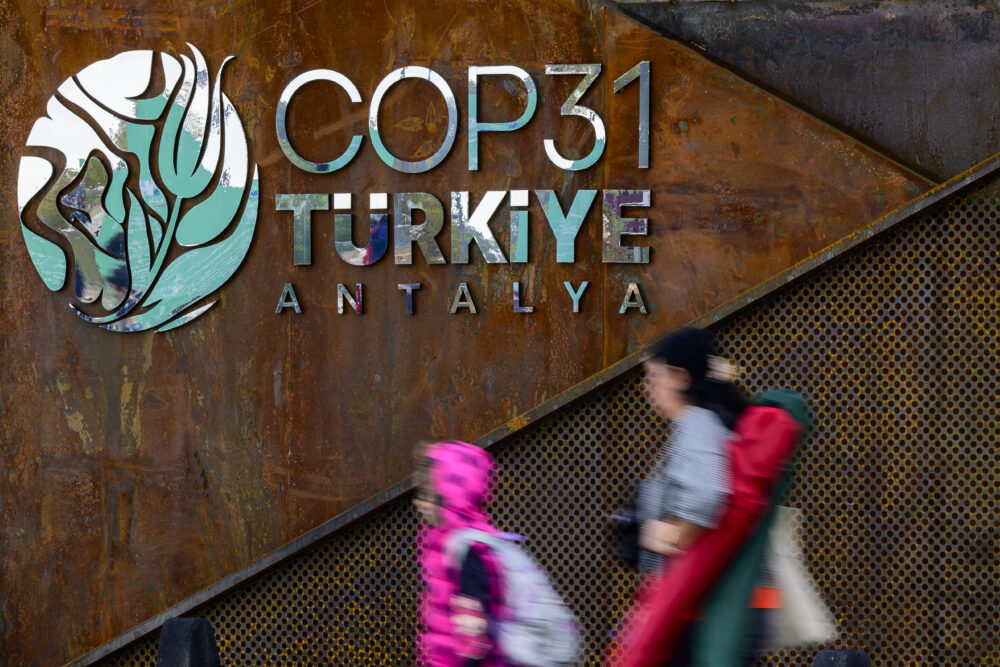
There is “no compromise yet” at this stage, the European Union noted in the late afternoon. In the midst of a standoff with Saudi Arabia, Europeans are trying to secure a reference to the phase-out of fossil fuels in the final decision.
“It’s better not to have an agreement than to sign a bad one,” said European Climate Commissioner Wopke Hoekstra, who is holding back-to-back meetings in Antalya.
“Time is running out,” also insisted Maina Talia, Tuvalu’s Environment Minister, an archipelago in the Pacific threatened by rising sea levels.
If there is no “mention of fossil fuels” in the draft agreement, “we are wasting our time here,” he warned.
Countries are also wrangling over whether to mention in the text the technologies for carbon capture, utilization and storage (CCUS), promoted by oil-and-gas companies as a way to reduce polluting emissions.
Turkey’s Call
Turkey, which co-chairs COP31 with Australia, urged countries to act “in a responsible manner” in order to find “a compromise.”
This COP has already run well beyond its planned hours, and the site, being dismantled, takes on a ghostly appearance. Some ministers, such as France’s Monique Barbut and Dutchwoman Stientje van Veldhoven, have already departed, leaving their teams to carry on with these difficult negotiations.
At heart, the battle continues over oil, gas and coal, the phase-out of fossil fuels absent from the latest proposed draft.
On Friday, about a dozen countries including France, Panama and Côte d’Ivoire, demanded that the final decision mention “a clear transition away from fossil fuels“.
On social media, the OPEC group of oil-producing countries indicated that its secretary-general, Haitham al-Ghais, had met the Russian climate envoy Ruslan Edelgeriev on the same day, to underline “the importance of inclusive and balanced approaches in multilateral environmental forums“.
Expectations had been limited ahead of this major UN gathering, but Turkey hopes to conclude with progress in the face of the climate emergency, the planet continuing to suffer more from human-caused warming.
A substantive agreement remains far from assured in Antalya, in a difficult geopolitical context, marked by energy price surges linked to the war in the Middle East. And once again, the United States is absent.
Among the key themes, Turkey wanted to foreground “electrification” of uses, without saying whether this electricity should come from renewables and nuclear or from polluting coal.
Thursday’s provisional text called for “raising the share of electricity in the global final energy consumption to 35% by 2035” from just over 20% currently.
Another hotly debated question: the financing that developed countries, historically responsible for most emissions, have pledged to provide to developing countries to help them cope with the impacts of climate change.
The African continent “will not accept a result that is limited to statements without the resources necessary to implement them,” warned Ghana’s Environment Minister Zanetor Agyeman-Rawlings.
Europeans had warned before the COP that they did not intend to provide additional funding, but merely to secure existing commitments.
Parasitic Negotiations
The negotiations were also plagued by a disagreement over the schedule for the IPCC’s publications, the international body of climate experts.
The European Union, the Least Developed Countries (LDCs) or small island developing states want the next IPCC report series to be available before a global stocktake of efforts to cut greenhouse gas emissions, planned for 2028.
But countries such as Saudi Arabia and India are pushing for 2029. The provisional document also underscores the importance of capping the warming to 1.5°C above the 1850-1900 level, a major demand of the small island nations threatened by rising seas.