
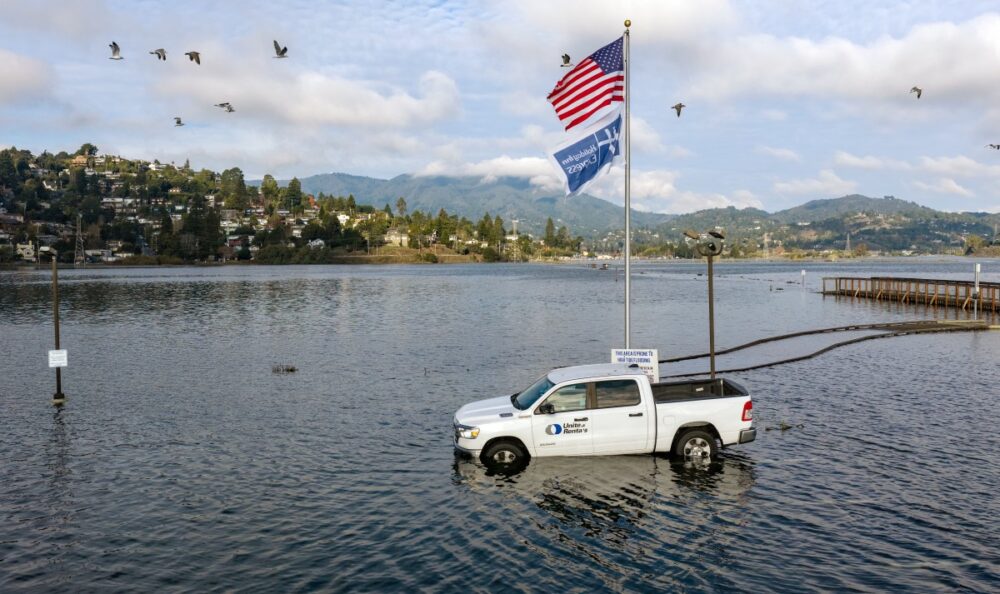
San Francisco Bay is at the forefront according to forecasters, who warn that water could surge into low-lying areas, including the Silicon Valley airports.
San Francisco Mayor Daniel Lurie said on Monday evening that the city “no longer expects a disruption of operations,” even though strong winds may still disrupt flights.
The mayor, who has issued warnings for a week, asked residents to plan their travel ahead of Wednesday, Thanksgiving Eve, a public holiday in the United States.
Waymo, the robotaxi company, suspended its service from Monday, a week after viral footage on social media showing its cars stranded in torrents of water.
The year’s biggest tides had been anticipated for a long time. They occur when the positions of the Earth, Moon and Sun align, intensifying the ocean’s attraction.
This week, winds and the drop in pressure related to the storm will alone cause a surge of up to 45 centimeters, according to the National Weather Service (NWS).
These high tides are amplified by the warming of the Pacific Ocean, which causes the waters to expand and thus lift sea levels.
Global oceans have been recording record temperatures for four years as heat from burning coal, gas, and oil accumulates.
This reality is further intensified this year by the exceptionally strong El Niño event. This cyclical phenomenon, which warms surface waters in the equatorial Pacific, drives major changes in wind, pressure and precipitation patterns worldwide, leading to floods and droughts.
Dial Hoang, a meteorologist with the NWS, told AFP that some shores of San Francisco Bay could be flooded by nearly three feet (91.5 cm) at the peak of high tide on Wednesday.
In its latest bulletin, the service warned that sudden waves up to 30 feet (9.1 m) could break on Wednesday, and conditions would remain dangerous along beaches through Sunday.
Record Set in 1983
In San Francisco, tides could approach or even surpass a record more than four decades old (2.6 meters in 1983).
At the time, the tides—already coinciding with violent storms linked to El Niño—had catastrophic consequences.
“It was chaos,” recalls Reinhard Flick, oceanographer at the Scripps Institution of Oceanography in San Diego: “There were 13-foot waves offshore (about 4 meters) and hundreds of millions of dollars in damage,” across northern to southern California.
This week will thus test the improvements to the infrastructure in the most populous state in the United States.
Even if the storm proves less intense than forecast for the San Francisco Bay Area, danger remains.
Strong winds could bring down trees, the mayor warned, and “the streets along the waterfront can flood” even if it does not rain.
In southern California, forecasters warned that waves could wash over parking lots or roadways.
“Always keep an eye on the ocean”, and “as waves can reach much farther inland than expected”, advised the NWS.
In recent months, storms and high tides have already caused destructive floods in California.
The conjunction of El Niño and large tides raises fears of a perilous winter. The next high tides are expected around Christmas, then January 21 and 22.