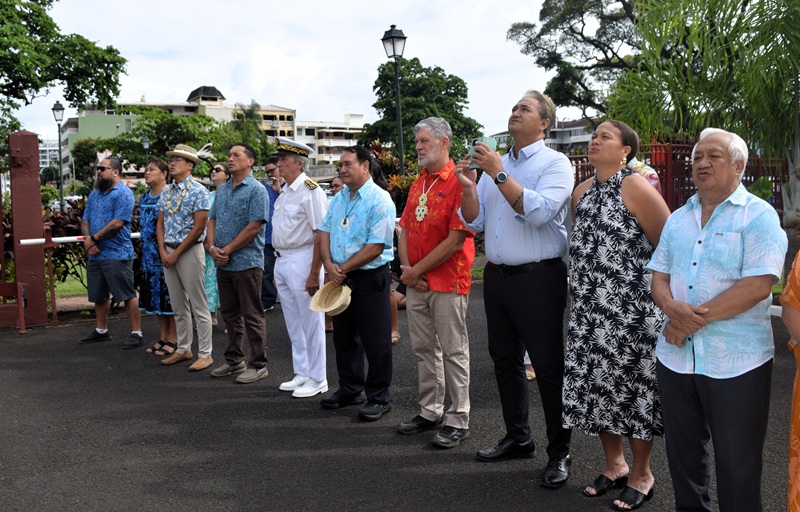
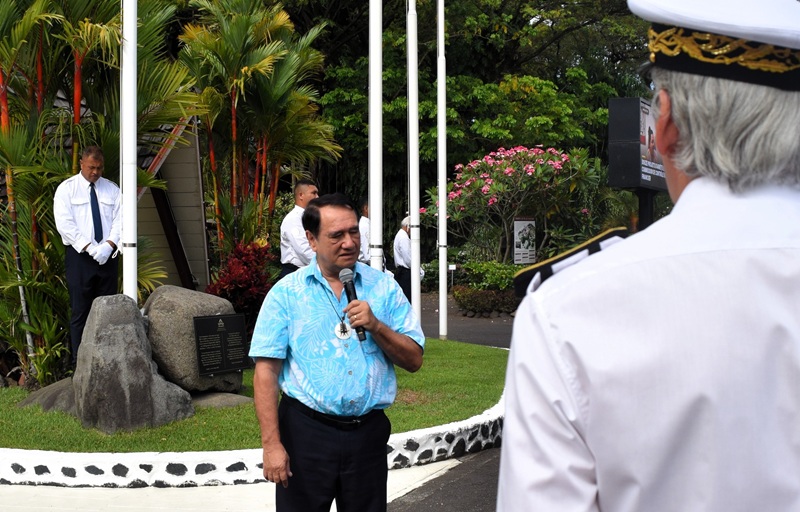
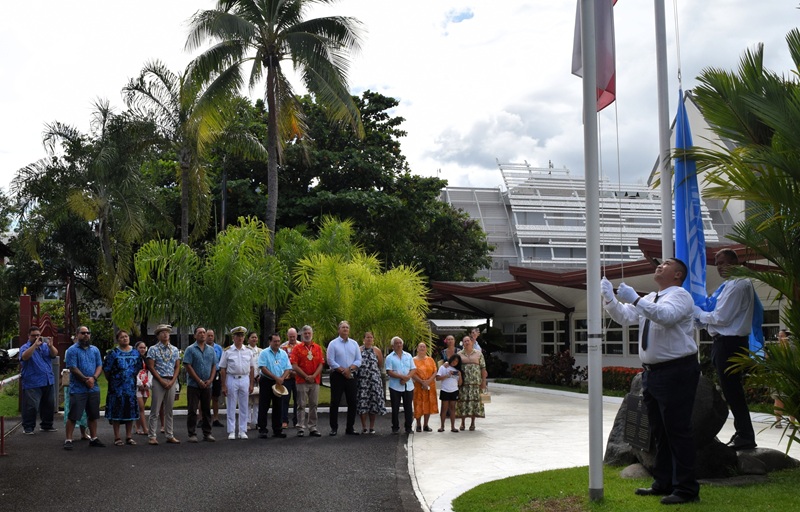
On United Nations Day, Tony Géros presided this Saturday over the hoisting of the flags of the UN, of French Polynesia, of France, and of the European Union at Tarahoi’s entrance. In his speech, the President of the Assembly reiterated his commitment to the UN institution, which he visited earlier this month with the Tavini, Tapura, and A Fano tià delegations to advance their joint initiative in favor of opening the self-determination process. An invitation from the Élysée to come discuss this matter in mid-November in Paris is to be handed to group leaders this weekend. However, Tony Géros believes that this meeting should take place in French Polynesia “with certain members and on specific dates,” according to the wishes expressed by some. On the sidelines of the ceremony, the vice-president of Tavini also commented on the resignation of Vannina Crolas, which could be followed by the other sky-blue representative in the government, Minarii Galenon. “It is a personal decision, which concerns only them,” he emphasized.
Radio 1: How significant is this year’s flag-raising at the Assembly?
Tony Géros: By drawing a parallel with the consensus reached before we went to New York, all the groups in the Assembly of French Polynesia show a very particular respect for this international institution. It is therefore normal that this day dedicated to the United Nations be commemorated once again within our institution.
There were no government representatives this Saturday; however, the State was present. Is that usual?
Since 2023 (the date when this celebration was established at Tarahoi), the State has always been present at this event. The government was sometimes represented by the vice-president, but today, I think they have a tight schedule that did not allow them to be present. But for us, it was important to celebrate this event, and we decided to devote a particular aspect to it since we delivered a speech to remind that the UN, beyond its objectives and sovereign duties, promotes respect for human rights and the liberty of peoples, notably the right to self-determination. And that, that is very important.
On the invitation from the Élysée: “We will meet to draft a consensual letter and decide on the place, the date, the content, and the composition”
We learned that this weekend the Élysée invitation would arrive for the political groups to come to Paris to discuss the institutional future of French Polynesia. Do you know more about this letter?
I was directly contacted, with the confirmation that a letter would follow listing three dates—November 18, 19, and 20. Before receiving this information, I had, upon returning from New York, sent a letter to each group president asking them to consult their political bodies to relay their views on the information conveyed to New York by the Élysée’s representative. Then, we will meet to draft a consensual letter and decide on the place, the date, the content, and the composition (of the members taking part in these discussions with the State).
But initially, the date and the venue appear to be already fixed by the Élysée. Will you still revisit this, as Oscar Temaru told us on Friday that, for him, it would be better for Emmanuel Macron or Sébastien Lecornu to come here?
That is probably the position of all the political groups. When I have a consensus on that, I will officially respond saying that the political groups of French Polynesia would prefer that this meeting take place in French Polynesia, with such a composition of members and at such dates, depending on how the political groups respond, because some may not be available. Then, what is very important is the content, always to respect the consensus. The independence groups within the Assembly have their views on the topics that should be addressed, the autonomist groups have theirs. All these topics are likely to form the talking points that will start the discussions, because we are not yet in dialogue. But in any case, three points seem essential to me: first, the visiting mission. Even if France refuses to undertake it, we must bring it back to the table. Then, the work program inside which we will insert all the topics. And finally, officially, the opening of the dialogue. Because as long as the dialogue is not opened, we are not in the UN process of self-determination. It is when this dialogue is officially opened that we can truly affirm our linkage to the process of accession within the framework of the act of self-determination. I think there will be a before, limited to short-term positions, and an after, following the presidential elections, where we can continue the discussion in the medium term and the long term.
“We must not discuss behind closed doors”
From your side, would you be willing to go to Paris?
No, I think all discussions should take place here in full transparency. It must not be done behind closed doors. It must be broadcast and the public should know what we are talking about, and especially what the positions of each side are regarding the topics raised.
Otherwise, within Tavini, do you have any information about the possible resignation of Vannina Crolas, and perhaps Minarii Galenon as well, the two last representatives of the sky-blue party in the government?
No, not at all. This is not a political decision, just as it wasn’t a political decision to allow them to be part of the government. It is a personal decision, which concerns only them. After that, everyone can interpret it as they wish. But within Tavini, since we allowed people the freedom to participate in the government’s makeup, it is up to them to decide to resign.
Do you confirm that the two intend to resign?
I don’t know. We haven’t discussed it. I haven’t met them on this matter.
“The entire government should be there on Monday for the ROB, except those who will have actually resigned”
The Budget Orientation Report (ROB) 2027 must be examined this Monday at the Assembly. Could there be absences from the government side?
In any case, the president must answer for everyone, for those who are present as well as for those who are absent. In principle, the entire government should be there except for those who chose to resign and who will have actually resigned by that date.
Why is this examination scheduled for Monday instead of Thursday, as is usually the case?
The government has taken so long to present the ROB that we, under the organic law, are constrained by deadlines. And the deadline is Monday. We can’t push it back any longer; it must pass on Monday, otherwise we would be out of time.
And if that were not the case?
There would be no penalty, but it would reflect the institution’s lack of respect for its operating rules. We cannot deviate from that.