
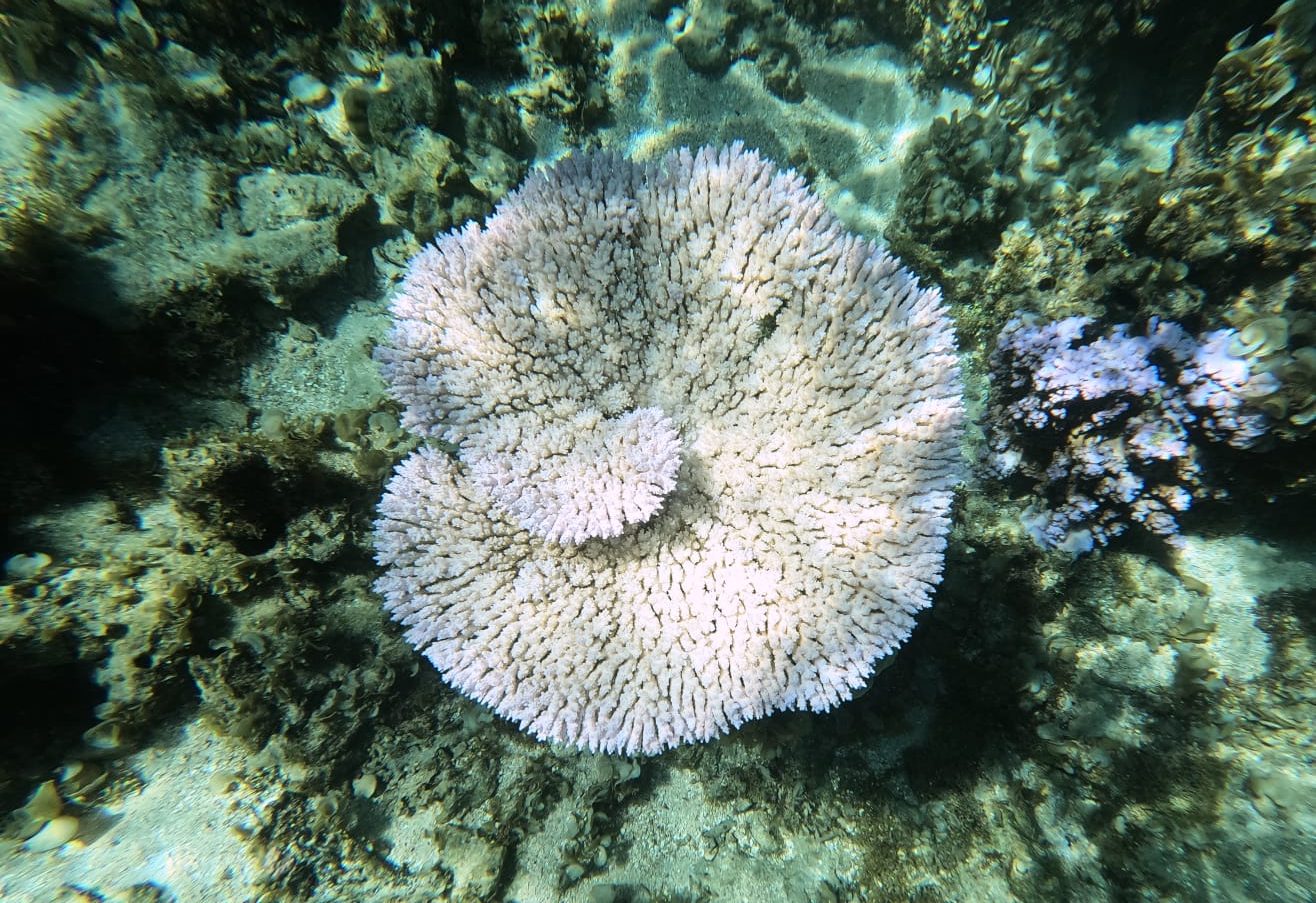
As part of the first global assessment of its kind, this leading international authority on threatened wildlife and plants classified 96% of coral reefs, spread across more than 80 countries and territories, as Critically Endangered, the highest level of threat defined by the organization.
“The future threat of climate change is imminent and grave, and it places a very high risk on the survival of these ecosystems.”, said Mishal Gudka, the scientific lead of the IUCN Red List assessment focusing on coral reef ecosystems, during the presentation of these findings at the COP17 biodiversity conference in Yerevan.
Corals, rich ecosystems that host a quarter of all marine species, are heat-sensitive and particularly vulnerable to climate change, which drives ocean warming and increases the frequency and intensity of bleaching events, with devastating consequences.
The emergence this year of a “super” El Niño, a natural ocean-warming phenomenon, also poses a risk to corals, he added, arguing that these threats should “sound the alarm” to push governments to act, “rather than a source of despair.”
He notes that some “coral reefs have shown remarkable capacity to recover after devastating bleaching events.”
Nevertheless, there is a real danger of losing some of the world’s largest and most biodiverse coral ecosystems. Among the most threatened are Australia’s Great Barrier Reef, the Coral Triangle in the western Pacific Ocean and Southeast Asia, the Mesoamerican Barrier Reef in the Caribbean, and the coral reefs of the Red Sea.
“Critical Window”
The IUCN assessment covered 127 tropical and subtropical coral ecosystems, spanning 188,362 square kilometers.
For this evaluation, researchers relied on the United Nations climate panel’s “intermediate” scenario, which projects a global temperature rise of 2.7°C above pre-industrial levels by 2100.
On Wednesday, the United Nations warned that, given current country commitments to curb greenhouse gas emissions, the world is heading toward a warming of about 2.6°C this century.
Although pollution, overfishing, and overtourism also contribute to degrading coral health, “thermal stress from climate change remains the most constant threat behind the global decline of coral reefs,” the IUCN stressed in a press release.
Nevertheless, “it is not too late to give coral reefs a chance to recover, but this requires decisive action to combat climate change and curb ocean warming,” said Grethel Aguilar, the IUCN’s director-general.
During this “50-year critical window” for conservation action, “we know what must be done: ambitious cuts in emissions, heightened protection and restoration efforts, and sustained investment in resilient coastal ecosystems and in the communities that depend on them,” the executive noted.
At COP17, nations are discussing how to salvage a historic biodiversity agreement dating from 2022 that aims to protect 30% of the world’s land and seas by 2030, but whose targets are increasingly hard to meet as governments lag in implementing their commitments.
A study published last week in Nature found that in 2020 nearly half of coral species faced an “elevated extinction risk,” with climate change identified as the main driver of this decline.