
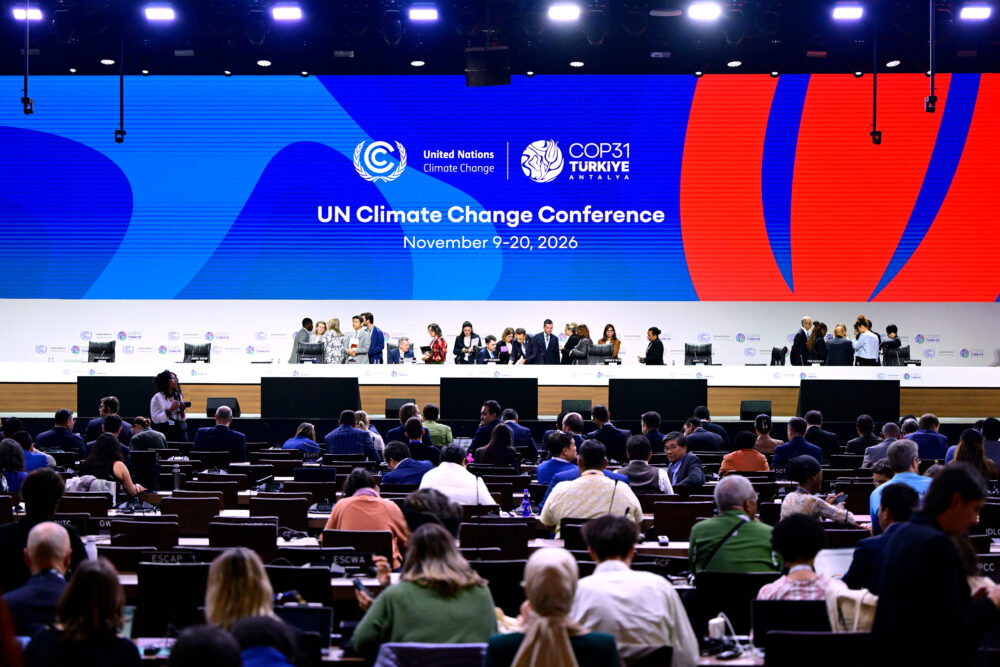
“We will not back a decision that even fails to mention fossil fuels, which are the main driver of climate change,” announced in plenary session the Irish Climate Minister, Darragh O’Brien, who currently chairs the European Union presidency.
Other countries such as Panama, the Marshall Islands, Vanuatu, and Belize have shown the same determination. The rule rests on consensus among roughly 200 participating nations, so the formal opposition of any one country can block a decision.
Despite two weeks of intense negotiations, COP31 managed to approve only technical texts. With more than 49 hours of extensions, the conference became the longest climate COP on record, surpassing COP25 in Madrid in 2019.
Its outcome, which reminded some observers of the loud failure of COP15 in Copenhagen in 2009, will likely fuel the many calls for reform of how COPs operate. “The world cannot afford for this to happen again,” judged UN Climate Chief Simon Stiell.
The Turkish president of COP31, Murat Kurum, was compelled to acknowledge his failure to secure adoption of the political declaration he had prepared with the Australian presidency of negotiations, which was meant to serve as the conference’s main outcome.
An ‘Failure’
“Unfortunately, we could not reach an agreement,” admitted Australian Chris Bowen, whose country shared the task with the Turkish host under an unusual compromise. He said he was “very disappointed.”
The leadership of this large conference, which drew tens of thousands of people to the Antalya outskirts, had released early Sunday a new draft final decision that again did not explicitly call for phasing out fossil fuels.
The draft merely alluded to the outcome of COP28 in Dubai, which in 2023 for the first time urged the world’s countries to shift away from oil, coal, and gas.
Nations from the Pacific, Europe, and Latin America pressed in recent days for an explicit mention of fossil fuels in the final text. But hydrocarbon producers, led by Saudi Arabia, opposed it.
COP31 “was taken hostage by oil-producing states,” Darragh O’Brien told AFP. “The COP31 failure is a scandal — it is outrageous that a handful of oil states can veto any reference to fossil fuels,” condemned Al Gore on X.
The former American presidential candidate and author of the documentary “An Inconvenient Truth” called for a “deep reform” of the way COPs operate.
At the heart of the dispute was also the demand to accelerate the deployment of carbon capture, utilization, and storage (CCUS) technologies, promoted by oil and gas companies.
“Climate change requires every solution on the table,” argued the Saudi representative, Mohammad Ayoub.
Money for Poor Countries
The draft decision also included the objective, championed by Turkey, to raise the share of electricity in total final energy consumption to 35% worldwide by 2035, coupled with efforts to increase the use of “clean energy.”
Expectations ahead of this major UN gathering had been modest. Yet Turkey hoped to conclude with progress addressing the climate emergency. The planet continues to bear the brunt of human-caused warming, from deadly floods in Nepal to heat waves across Europe, and breaching the 1.5°C threshold is now considered inevitable.
A substantive agreement was made more difficult by the geopolitical context, marked by spikes in energy prices tied to the Middle East conflict. And once again, the United States was absent.
Another fiercely debated issue was funding: developed countries, historically responsible for most emissions, pledged to provide financial assistance to poorer nations to help them cope with climate impacts.
Europe had warned before COP that it did not intend to provide new funding but merely to honor existing commitments.