
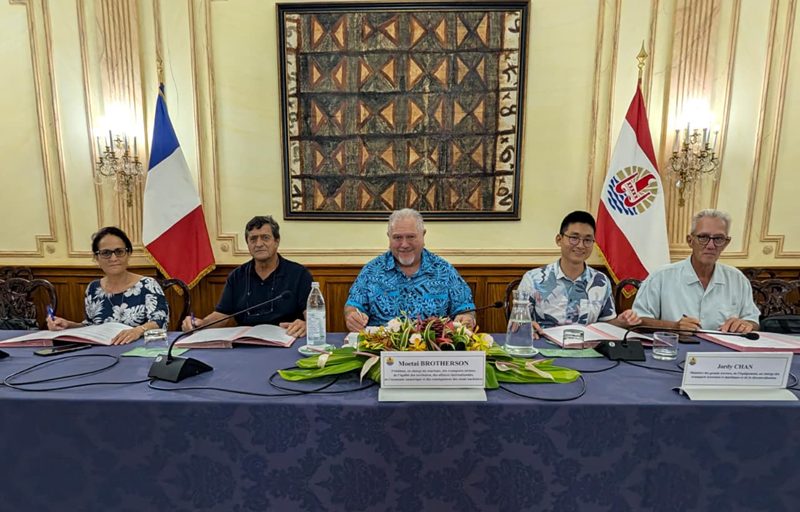
The CSTP-FO general secretary Patrick Galenon signed this Wednesday evening at the Presidency a protocol agreement addressing some of the dockers’ demands, who have been on strike since Tuesday. The State and the Autonomous Port commit, in particular, to extend the duration of the next stevedoring agreements from 15 to 20 years, to improve port security, and to support the fight against bogus patentees. Discussions then continued with the leaders of the three stevedoring companies and an agreement was also reached, according to our colleagues at Polynésie la 1ère. The strike is lifted, work resumes this morning.
The protocol with the State and the Autonomous Port reiterates a number of commitments that had already been the subject of a principle agreement on Monday, during discussions between the Minister of Public Works Jordy Chan and CSTP-FO. The specification for the future stevedoring agreements, which must be renewed before November 2027, must be amended to extend their duration from 15 to 20 years. The document should also mention respect for the right to strike, one of the union’s concerns. The deadline for submitting application dossiers, set for November 6, should not change, and the process remains open internationally, a legal “obligation.” The protocol also lists the commitments made by the Autonomous Port to ensure port safety, in terms of road conditions, lighting and access control, among other things, with a precise action schedule.
The State also offered a “principled support” for the fight against the “bogus patentees,” which, according to the dockers, would be increasingly used by stevedoring companies and other operators active at the port. The Autonomous Port should thus require, in addition to the usual documents, employment contracts from professional carriers in order to issue them an access badge to the customs-controlled zone. At the government, it is specified that this matter should mainly be resolved by the employers.
For President Moetai Brotherson, who signed alongside the Minister of Public Works Jordy Chan, the director of the Autonomous Port Jean-Paul Le Caill and the Minister of Public Service Vannina Crolas, this agreement is a “real satisfaction,” even though the protocol only addresses the “governmental aspect” of a notice that was mainly aimed at the stevedoring companies, the dockers’ employers. But according to our colleagues at Polynésie La 1ère, the discussions that extended into the night with the management of the three companies, Cotada, Cowan and Satnui, led to a comprehensive protocol to end the dispute. “We provided them with the president’s ceremonial reception room,” explained Moetai Brotherson shortly after 9:30 p.m., before a visit to the CHPF to meet the care teams mobilized for the night.
If the dockers’ strike movement that began on Tuesday did not lead to stopping cargo unloading, nor to blocking the access to the International Trade Terminal, the mobilization, highly followed, effectively prevented many containers from leaving the customs zone, including deliveries of perishable goods and medications. Many professionals expressed their concern on Wednesday, as did the Hawaiki Nui Va’a committee, which saw its organization compromised by this strike and by air transport disruptions. On the Autonomous Port’s side, they can therefore be reassured that the situation is returning to normal.