
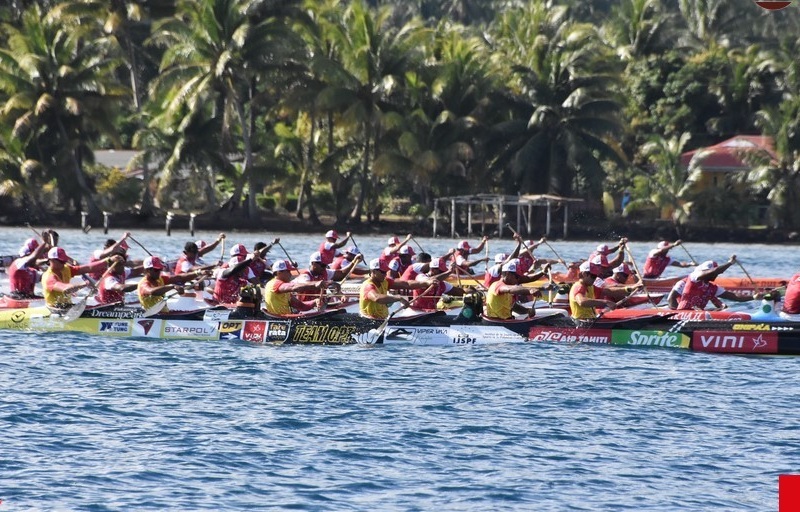
The 33rd edition of the Hawaiki Nui va’a will indeed kick off this Wednesday, despite the ongoing airline strike. And the schedule remains the same: three stages blending endurance, sprint, and strategy between Huahine, Raiatea, Taha’a and Bora Bora. The OPT – Shell duel, closely watched outsiders, Tahitian women determined to reclaim the trophy from the Hawaiians, a format that always holds surprises… Alex from Va’a News, who will bring the race live on Radio 1 and Tiare FM, analyzes the stakes of this apex moment in the va’a season.
- The Hawaiki Nui va’a: the Holy Grail of the discipline
This three-stage race between Huahine and Raiatea, Raiatea and Tahaa, Tahaa and Bora Bora remains the most renowned and mythical in va’a. « Beyond being an event, it’s the race not to miss, summarizes Alex from Va’a News. “Even if you win all the season’s races, if you miss the Hawaiki Nui, no one will talk about you. Only one team is remembered: the winner of this race held at the Raromatai.” A reputation that stems from the difficulty of the race: three stages « physically, psychologically and tactically difficult ». The Hawaiki Nui va’a is also the last V6 competition of the season, so the athletes arrive worn out by the year but also sharpened and ready to fight for this coronation after which everyone rows.
- The anticipated duel: OPT / Shell
The sport’s heavyweights will obviously all be present for this year’s rendezvous, with the two most anticipated teams, the ones who sweep the podiums: the OPT and Shell va’a. Last year it was Shell who ultimately won the duel: « They stole the title from OPT who were chasing a third consecutive victory », recalls Alex from Va’a News, who bets that the OPT team will want to « take their revenge ».
The scenario from last year left a mark and proves that nothing is decided until the finish line on Matira Beach in Bora Bora. The OPT team, already superior to its rivals in the season’s results, had won the first two stages with « a comfortable safety margin » over its direct followers, Air Tahiti and Shell Va’a. « But on the third and final stage, between Tahaa and Bora Bora, Shell Va’a knew how to make the right choices, both in terms of the embarked crew, the heading, the tactical plan, the mana, the feeling, the tahoe… And they win the stage with more than seven minutes ahead of their closest pursuer and thus the Hawaiki Nui va’a, thanks to its total time, the sum of the three stages, 9h 11min and 58 seconds. » Albert Moux’s team had beaten its own record.
For Alex from Va’a News, the OPT team found itself in a tricky position as race leader. According to our partner, once you lead the overall standings, the tactic is to pressure your rivals on the third stage and not let them slip to preserve the lead gained on the first two. But in the 2025 edition, the two pursuers of the OPT team, Air Tahiti and Shell, had chosen two different headings. OPT opted for Air Tahiti’s heading, « a choice many coaches would have made », says Alex. But it was the wrong move, as Shell Va’a, starting on another heading, surged to victory after a solo-at-sea race delivered in masterful fashion.
- Predictions: OPT or Shell
The crews have been slightly reshuffled on the two V6s. With Air Tahiti absent from the competition, some rowers from the airline joined their rivals. Kyle Taraufau joined OPT and Hotuiterai Poroi became the coxswain of Shell Va’a. Each V6 thus had to adapt to new crew compositions.
« If you look at the latest competitions, you’d tend to say that in two-hour races, Shell Va’a is very strong. But as soon as it gets a bit longer, it seems the OPT team pulls ahead. We saw it in Hawaii where the OPT team led the race and won a Molokai for the second consecutive time, » notes Alex. He also adds, « a more homogeneous lineup, rowers who know each other perfectly, an adaptation that clicked ».
On the Shell side, Alex regards Hotuiterai Poroi as « excellent » at the helm. He takes over from Rete Ebb, chosen last year and lauded for his excellent work on the third stage. He will not be back this year, « a coach’s choice » that seems logical: « We haven’t seen Rete this season, so I think he lacks the physical level and form to tackle a competition of this magnitude. »
As for outsiders, could teams challenge the favorites? According to Alex of Va’a News, Enviropol, Popora te Hoe Mamu, Kevin Céran-Jérusalémy’s Huahine team, and Green Lantern led by Steeve Teihotaata could come « to rattle the Top 5 ». « We expect a lot from Steeve Teihotaata’s team, with its experience and the strong rowers on board, they could pull off a surprise. »
- Three stages: endurance, sprint, and lots of strategy
The 2026 edition keeps its classic format: three stages on the program. The first, 44 km between Huahine and Raiatea, where the chosen heading is decisive. For years, crews watched the trajectory chosen by Huahine’s V6s, who know the place inside out and thus know the best direction to take depending on swell, wind, and currents. This opening leg also allows « to land a big psychological blow and show everyone ‘you’re not tiring out the guys, this year it’s us’ ».
According to Alex from Va’a News, the team that wins the first stage has a strong chance of winning the overall competition: « Once you’re in the lead, you have little to do afterward; you simply watch who your pursuers are, stay in touch to secure the victory, since it’s decided by the total time of the three stages. » These statistics don’t always hold true; Shell Va’a prevailed last year even though OPT had won this stage between Huahine and Raiatea.
Second stage: Raiatea – Tahaa, a 26 km sprint. It’s better to avoid being caught in the middle of the peloton and its “washing machine” with the churn of pirogues and follow boats. Generally for this sprint, teams choose to deploy their « freshest » and « most cardio » athletes.
Third stage between Taha’a and Bora Bora, perhaps the most spectacular at 58 km, with a start and finish in lagoons and the rest out at sea. « You must start calmly, take the time to settle in, to warm up properly. Then make the decisive heading choice at sea, depending on the swell and currents. You can depart, lead the race from the Taha’a lagoon for two hours. And in the end, you find yourself a kilometer and a half behind a canoe that took a magical heading. »
- On the juniors and the women’s side
Alongside the men’s senior race, other categories will also battle on the water: the veterans who will cover the same route as the senior category; and the veterans over 60, the juniors, and the women, for whom Hawaiki Nui va’a is contested in two stages. The first in Raiatea with a lagoon sprint between Taputapuatea and Uturoa, and the second between Raiatea and Taha’a.
In the women’s category, it is the Hawaiians who have held the title for two years. But the Ihilani Va’a women’s crew managed to win on their home ground in Hawaii, at Molokai, in 2025. They will surely be keen to win the title at the Raromatai and bring the trophy home.