
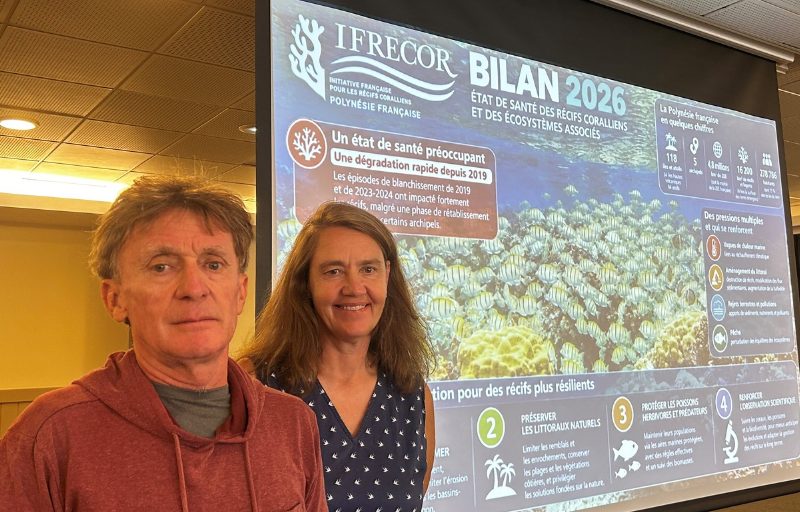
Polynesian corals have a strong capacity for recovery, but marine heatwaves are now occurring too closely together to give them time to regrow. This is one of the concerns raised by the 2026 Ifrecor report, which notes reef degradation across several archipelagos, notably the Society Islands, where living coral cover fell from 42% to 8% in five years. In addition to natural disturbances, local pressures are at play, on which Criobe researchers Suzanne Mills and Yannick Chancerelle propose action priorities.
This Tuesday, the French Initiative for Coral Reefs in Polynesia released its 2026 report. Five years after the last assessment, Ifrecor Polynésie laments a “degradation” of reef health “in several archipelagos.” In the Society Islands in particular, living coral cover dropped from 42% in 2019 to 8% in 2025.
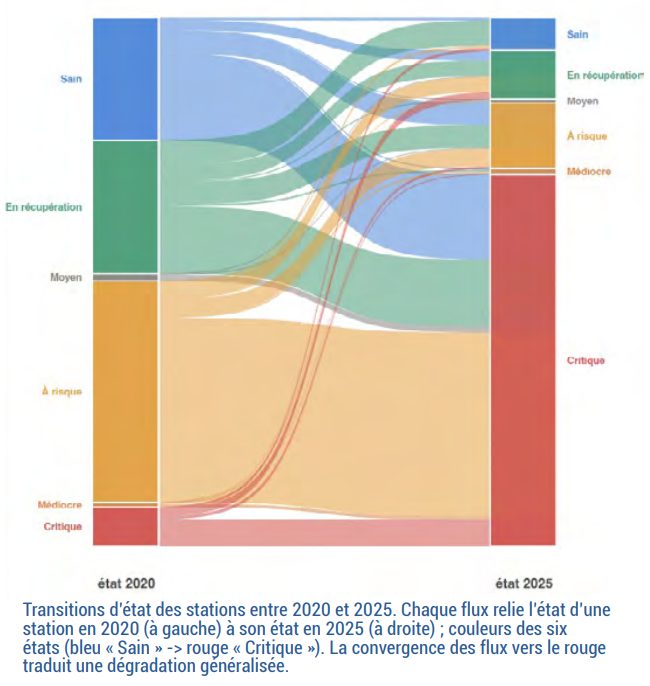
To establish its diagnosis, Ifrecor evaluated 13 study and monitoring stations of the Polynesia Mana network, coordinated by Criobe, spread across ten islands and five archipelagos. In five years, 92% of them were classified as “critical state.” In other words, the compilation of the current coral cover status, but also the trend of corals in recent years toward recovery or degradation, are both “concerning” for 12 stations, according to Suzanne Mills, deputy director of Criobe and presenter of the Ifrecor study. At the territorial scale, she notes a real retreat in favorable conditions: more than half of the stations are in a critical state.
For Yannick Chancerelle, head of monitoring for this study, “coral reefs have never faced threats this strong in their history, not even geologic, since they exist,” he says “with the hindsight we have from forty years of monitoring” and the drilling that allows us to know up to 14,000 years back the lagoon’s climatological history.
Reefs no longer have time to recover
Certainly, corals first have to contend with two natural disturbances: outbreaks of crown-of-thorns starfish (Acanthaster) and marine heatwaves tied to climate warming. These phenomena are well known in Polynesia, where the share of living corals on Moorea dropped from 46% to less than 1% in 2010 due to Acanthaster and Cyclone Oli.
After dropping below 3% coral cover in 2011, the Society archipelago recovered to 42% by 2019. The successive gains were particularly visible up to 2018, according to Ifrecor’s assessment, and for Suzanne Mills these movements testify to the “strong capacity for recovery” of the corals.
But over the last five years, Polynesian reefs have experienced the fourth global bleaching event, only a few years after the intense heatwave of 2019. Ifrecor’s report notes a cover of roughly 40% that has tumbled in five years, dropping below the 5% threshold in some stations.
This intensity and the increasing frequency of heatwaves worry the Criobe’s deputy director: “The report also showed that Polynesian reefs have a strong capacity for recovery. But now we see heatwaves becoming more and more frequent. Is there enough time for this recovery between the successive waves? That is what concerns us.”
On these natural pressures are added anthropogenic pressures: fishing, agriculture, urbanization… What the Ifrecor report now shows is that these pressures do not merely add up; they interact. At the same temperature, a reef subjected to significant nitrogen inputs faces a bleaching risk “twice as severe as a reef whose water is healthy,” notes Mills.
Local levers for action
To safeguard this recovery capacity, the report identifies four local action levers that could reduce anthropogenic impact.
First, improve sanitation. “Water is poorly treated,” notes Yannick Chancerelle. “Individual wastewater treatment plants, small septic tanks, work very poorly. Therefore, there are many nitrogenous compounds—nitrates, nitrites, etc.—that flow into the lagoon. And that gives an advantage to algae that use these nutrients and proliferate at the expense of corals.” According to the latest ISPF census, 8 households in 10 are not connected to the collective network. Moreover, he calls for reducing chemical and biological pollutions, namely fertilizers and sediment inputs that go into the lagoon via rivers.
Next, protect the fish. Primarily the herbivores which, by feeding on macroalgae, allow the coral to proliferate. But also “mesopredators that play an important role in the functioning of coral reefs and nutrient recycling,” notes the Criobe’s deputy director.
Finally, two more levers complete the list: limiting the artificialization of the coastline and maintaining and strengthening the scientific observatories, because “you only protect what you know well,” declared on our program Monday Sandy Lecoq Espallargas, Deputy General Secretary of the High Commission and co-chair of the Ifrecor Polynésie operational committee.
Although the next Ifrecor assessment is not planned for five more years, researchers are already emphasizing the danger of a world without a coral ecosystem. “We can only say, be careful, it’s dangerous, but we can also say there are examples in the world where this has happened. Southeast Asia, for example, with overfishing and pollution, the reef is completely degraded and we’ve moved from a coral-dominated system to an algal system. And there, to go back, it’s very, very difficult. Whereas when it’s weakened but there hasn’t been a shift, it’s still possible,” recalls the monitoring lead. “That’s where Polynesia is still somewhat in a favorable position amid this global change.”