
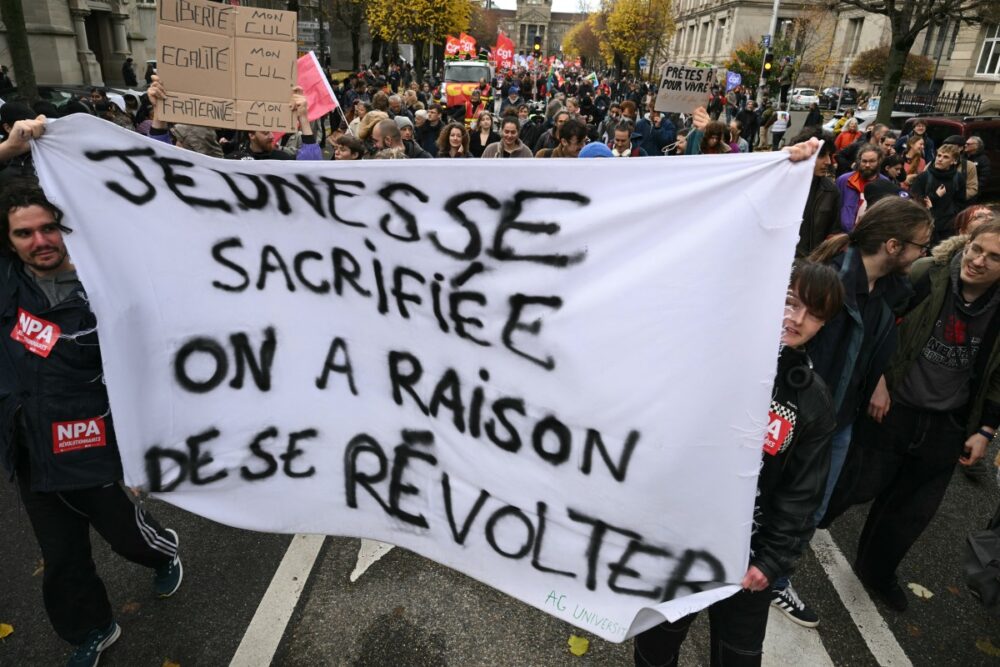
The day brought together, according to the CGT and the Île-de-France inter-union, more than 500,000 people, including 175,000 in Paris.
The Interior Ministry, for its part, counted 146,000 protesters nationwide and the Paris police prefecture 28,000 in the capital.
In Marseille and Toulouse, around 5,000 people were recorded by the prefecture, and 80,000 and 20,000 respectively according to the unions, down from November 5.
Thousands more also marched in Lille, Lyon, Bordeaux, Strasbourg, La Rochelle and Metz, with crowds visibly smaller than at prior rallies, according to AFP journalists.
The Ministry of Public Action and Accounts counted fewer than 3% of striking workers in the state civil service — employees of ministries, the prefectures or the rectorates among others. They were nearly 10% on November 5.
“It’s my second day of strike and I understand why turnout is lower because it weighs at the end of the month,” explained Emma, a contract worker in a local administration who participated in the Bayonne march and who only gave her first name to the reporters.
The CGT calls for fresh mobilizations in the coming days. Among them, a national retirees’ march on November 19, a European day of action the following day, and another day of protests against the cost of living on Saturday.
Mobilized Youth
Present at the Paris demonstration, Jean-Luc Mélenchon, the candidate of La France Insoumise, argued that “repression was hardening” toward young people.
The youth remained highly mobilized, AFP reporters observed, after Interfac IDF, which presents itself as the general assembly of students from the Île-de-France faculties, and the youth inter-union (USL-Fage-Unef-Union étudiante) announced they would join the call for strike and mobilization.
“We’re stressed about our studies, but when there are about twenty cops in front of the lycée every morning, we only want to keep protesting,” explained Mathilde, 17, a terminal-year student at Lycée Turgot, in the Paris procession.
In Toulouse, several high school blockades were lifted by police in the morning, some at the cost of a “very violent repression”, denounced to AFP by Martin Ramel-Brossard of the Union Syndicale Lycéenne (USL).
The Rennes procession, which gathered 7,000 protesters according to unions and 4,500 according to the prefecture, was halted by water cannons from the security forces shortly after it began, AFP reporter observed.
“We must go all the way” and today “this must be the start of building a real general strike”, argued Coppelia Moreau, from Interfac, who called for a new mobilization on November 26.
CGT leader Sophie Binet urged, among other things, that the government receive all unions (workers, youth, public-sector workers) to “make immediate announcements worthy of the moment”, because “only a response to our demands will stop the mobilization”.
On Friday, civil service unions had left Matignon angry after the government again refused to grant broad salary increases, a few days after the announcement of a boost to the minimum wage for the private sector. They denounced government measures on low wages that fail to address the urgency.
Minimum Wage
With the SMIC revalued on December 1 and ahead of the government’s “emergency measures,” 1.1 million public-sector workers would see their base pay fall below the minimum wage, i.e., nearly 20% of the workforce.
Despite raising the base salaries of the lowest-paid civil servants to offset the minimum wage increase, about 660,000 workers will continue to earn a base salary below the SMIC. They will receive a compensation allowance to offset the gap with the new wage floor.
But anger remains, notably because this allowance is not taken into account when calculating retirement benefits.
Between the SMIC revaluation and measures for the salaries of the most modest staff, the bill is expected to exceed one billion euros, according to the Minister of Public Accounts, David Amiel.