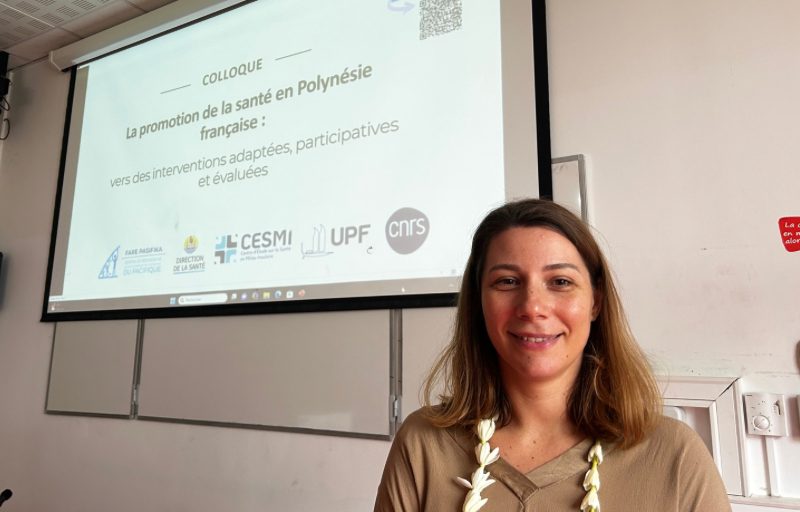
While Polynesia displays one of the highest obesity rates in the world, researchers from Fare Pacifika have turned their attention to the limits of prevention in this area. For two years, sociologist Lucile Hervouet has been collecting testimonies from patients and caregivers to understand what slows or blocks progress, and she presents her findings for discussion this morning at the UPF. The results raise questions about the resources available to health professionals and underline the need to rethink prevention within a more collective approach, tailored to local realities.
How can we help Polynesians safeguard their health without merely reminding them of the behaviors to adopt? This is the central question of the conference dedicated to health promotion in French Polynesia, opened this morning at the UPF, in the presence of Health Minister Raihei Ansquer, among others.
About 70 participants are registered, including caregivers, researchers, public-sector representatives and people affected by certain pathologies. Experts from Paris, New Zealand, and Quebec also participate in the discussions, which feature 17 thematic presentations. Organized by the Fare Pacifika research unit, these two days of meetings aim to identify action levers for the population, based on the survey results of the sociologist Lucile Hervouet.
« Prevention is no longer enough, it isn’t enough »
Following studies on domestic violence and Polynesian resilience in the face of illness, Fare Pacifika answered the government’s request by launching a new research program: Steps Quali, dedicated to the sociological determinants of cardiovascular health in French Polynesia. Led for two years by the sociologist Lucile Hervouet, it examines how residents experience prevention messages and the obstacles that can hinder their adoption.
As Health Minister Raihei Ansquer stated in her introduction: « Prevention is no longer enough, it isn’t enough. » With this reality in mind, Lucile Hervouet conducted 75 interviews with patients, most of them at home, 40 interviews with health professionals, and gathered 9 focus groups, bringing the total number of individuals studied to about fifty, in addition to observations in clinics on Tahiti and its islands. Her hypothesis is not to assume that the population is unaware of medical recommendations, but to understand why their implementation can remain difficult.
« Health is full of injunctions, a lot of advice and directives. People today do not necessarily feel equipped or able, they do not necessarily have the financial resources, time, etc., to follow all these injunctions to stay healthy,” explains the sociologist.
For her, the conference should also help professionals tailor their discourse more effectively. « This conference is about giving people the tools, but above all helping health professionals understand people’s expectations, needs, and how they can receive these messages », so that they are not experienced as a constraint, but as “an aid, a resource”.
The Battle Against Obesity
Right at the start of her research, Lucile Hervouet quickly noticed two successive distortions. The first arises in cardiovascular disease cases, where the health professional may promptly focus on obesity, while heredity, alcohol and tobacco use, or stress are equally influential factors. The second bias is that the patient directly links excess weight to diet, whereas the issue is multifactorial.
In the exchanges between patients and caregivers documented by the sociologist, the discussion can go much further. The interviews reveal that tackling obesity can trigger mockery, stigmatization, and real suffering among patients. For Philippe Biarrez, former Health Director and president of the association Partage Santé Pacifique, it is time to rethink how sick people are perceived. « People know what to do, but they expect institutions to accompany them, to help them, to create favorable environments », he notes.
« People know what to do, but they expect institutions to accompany them, to help them, to create favorable environments. »
He argues that prevention cannot rest solely on individual responsibility. Lifestyles depend also on the conditions in which each person evolves. Rather than viewing individuals as irresponsible, he calls for creating environments that concretely facilitate behavioral changes. This starts with substantial financial means to improve the conditions in which health professionals operate. Facing a surge of patients and limited resources, caregivers have less time to support each person and address prevention questions. In her study, Lucile Hervouet notes a risk of reducing medical advice to a remark about dietary habits, without taking the time to explore the constraints and daily realities of the patient.
For Philippe Biarrez, these difficulties fit into a broader crisis of the health system. « All health systems are overwhelmed,” he observes. Prevention also suffers from a lack of human resources: in his view, Polynesia has many professionals to treat diseases, but too few people specifically trained in health education and prevention. The challenge, therefore, is to empower patients to take action on their health as much as to enable caregivers to support them in other ways. Because when consultations pile up, it becomes harder to move beyond general recommendations, to understand the obstacles each person faces, and to build a relationship conducive to prevention.
The Community as Engine
On the Health Ministry side, officials insist that health promotion is one of the priority axes of the health-system framework (SOS) approved this year. Raihei Ansquer thus champions an approach that goes beyond the health care system and involves residents, associations, municipalities, and other societal actors.
« Va’a Ora, it’s simply saying today that a person is in good health, but we will consider their physical health, their mental health, and their social health to define health, and it also means a person within an environment with which they must be in harmony. That is an ancestral concept. »
She highlights the concept of Va’a Ora, long presented as a Polynesian holistic health model. It takes into account the physical, mental, and social dimensions of health, but also the environment in which each person evolves. « We are all together to improve the health, well-being, and welfare of the population, and of course that involves messages adapted to this population culturally. So it involves cultural mediation, but also concepts that resonate with this population », she explains.
Within her approach, Raihei Ansquer aims to think beyond mere translation of prevention messages, taking into account cultural references and local realities to truly address residents. The challenge remains to evaluate existing mechanisms and to better understand why the multiple efforts and investments in prevention campaigns do not translate into the figures.
The minister has expressly asked that the solutions developed by the end of these two days of interaction be sent to her to feed a prevention plan that is currently being finalized. For her, “the conclusions of this conference will be decisive for the future and the next 20 years.”
Open to all, the conferences continue until tomorrow at the UPF.