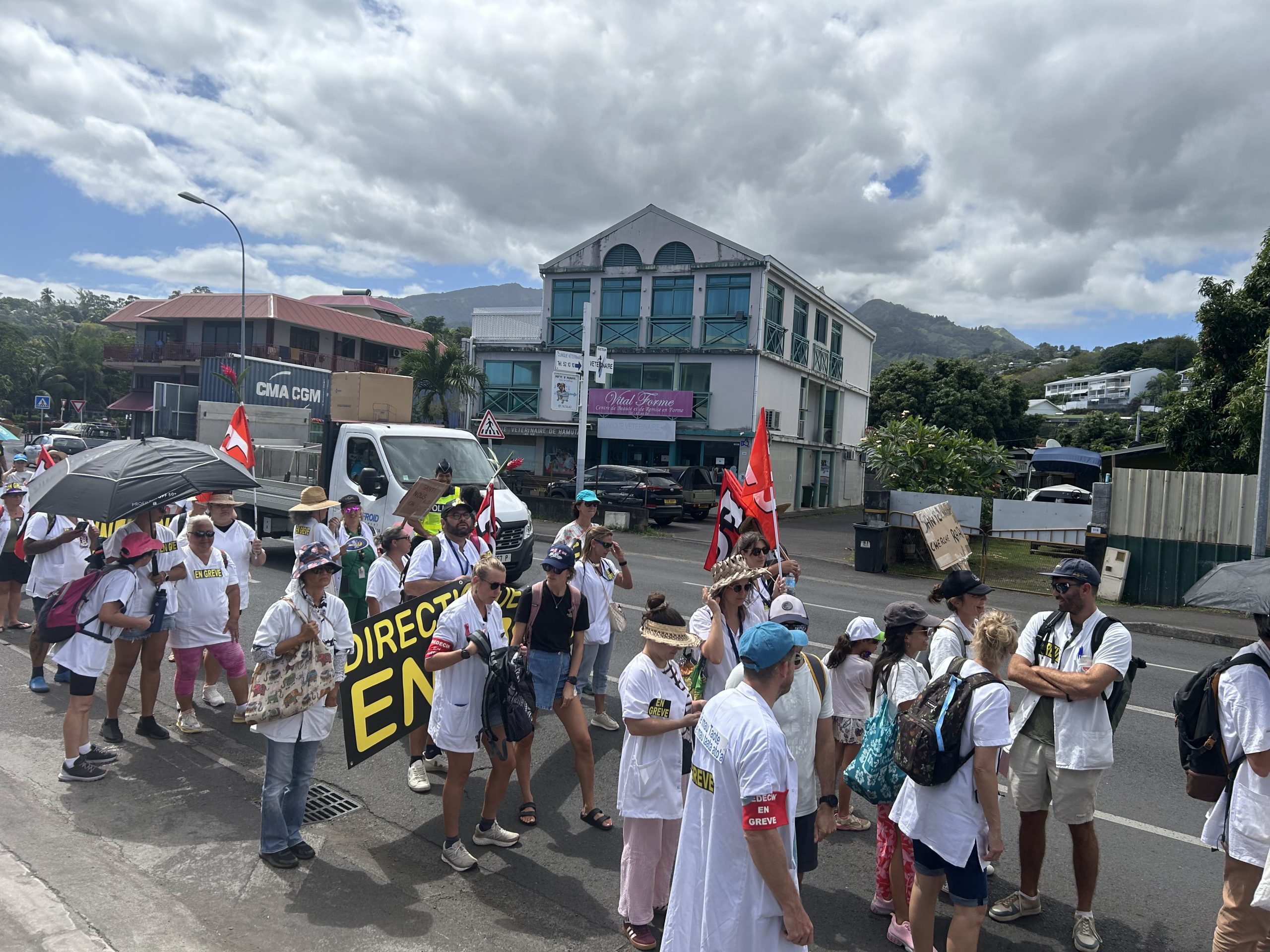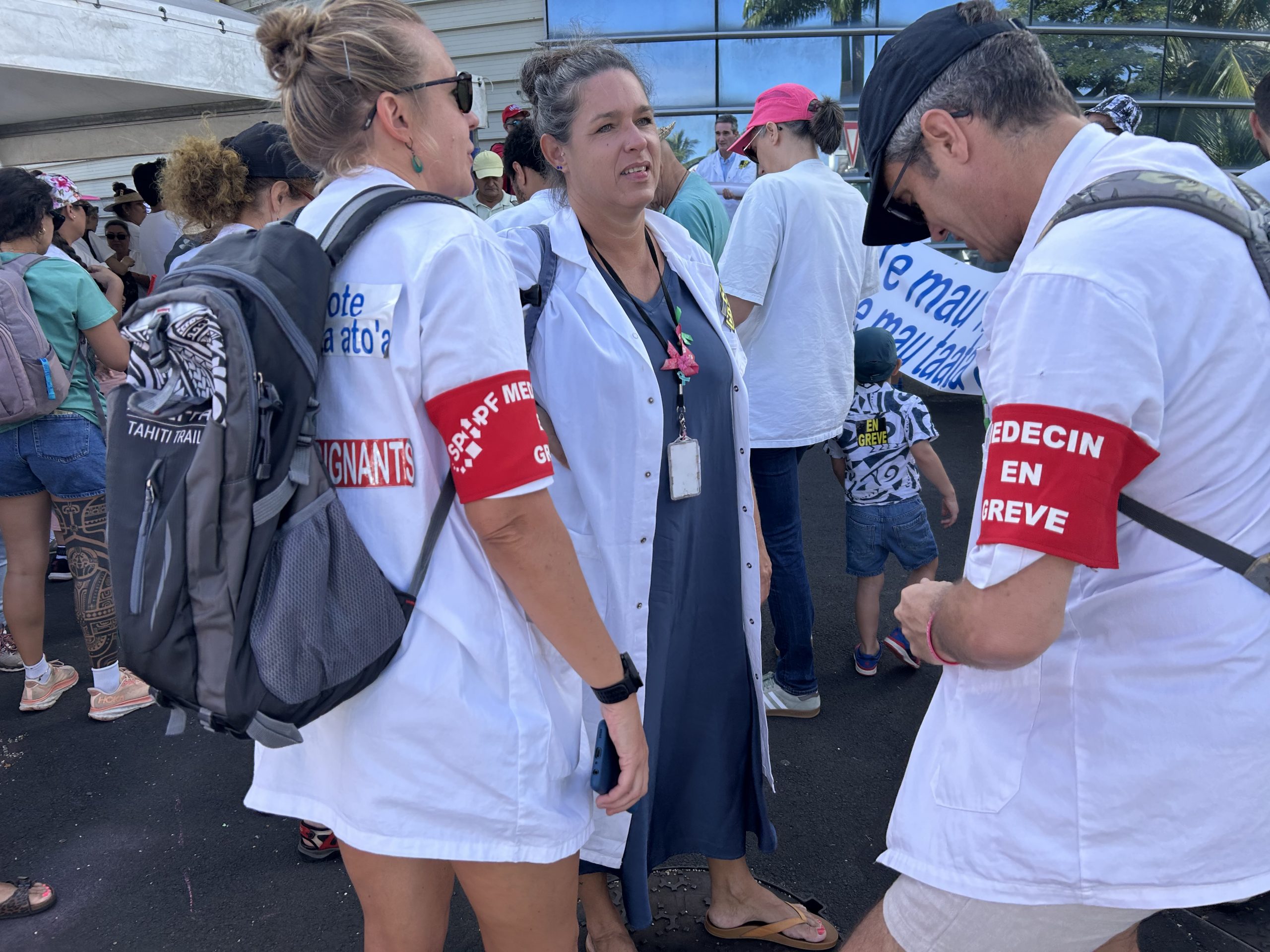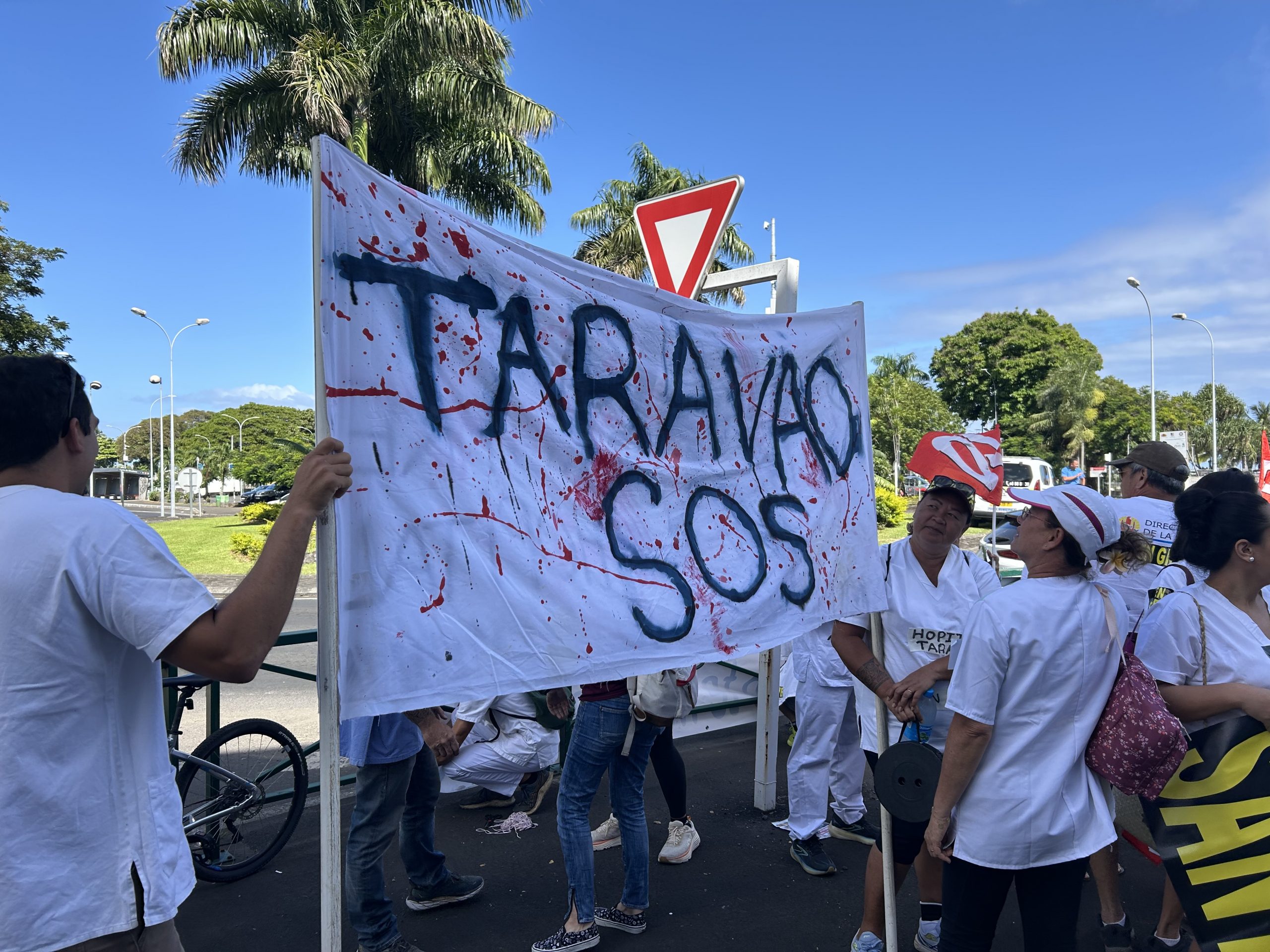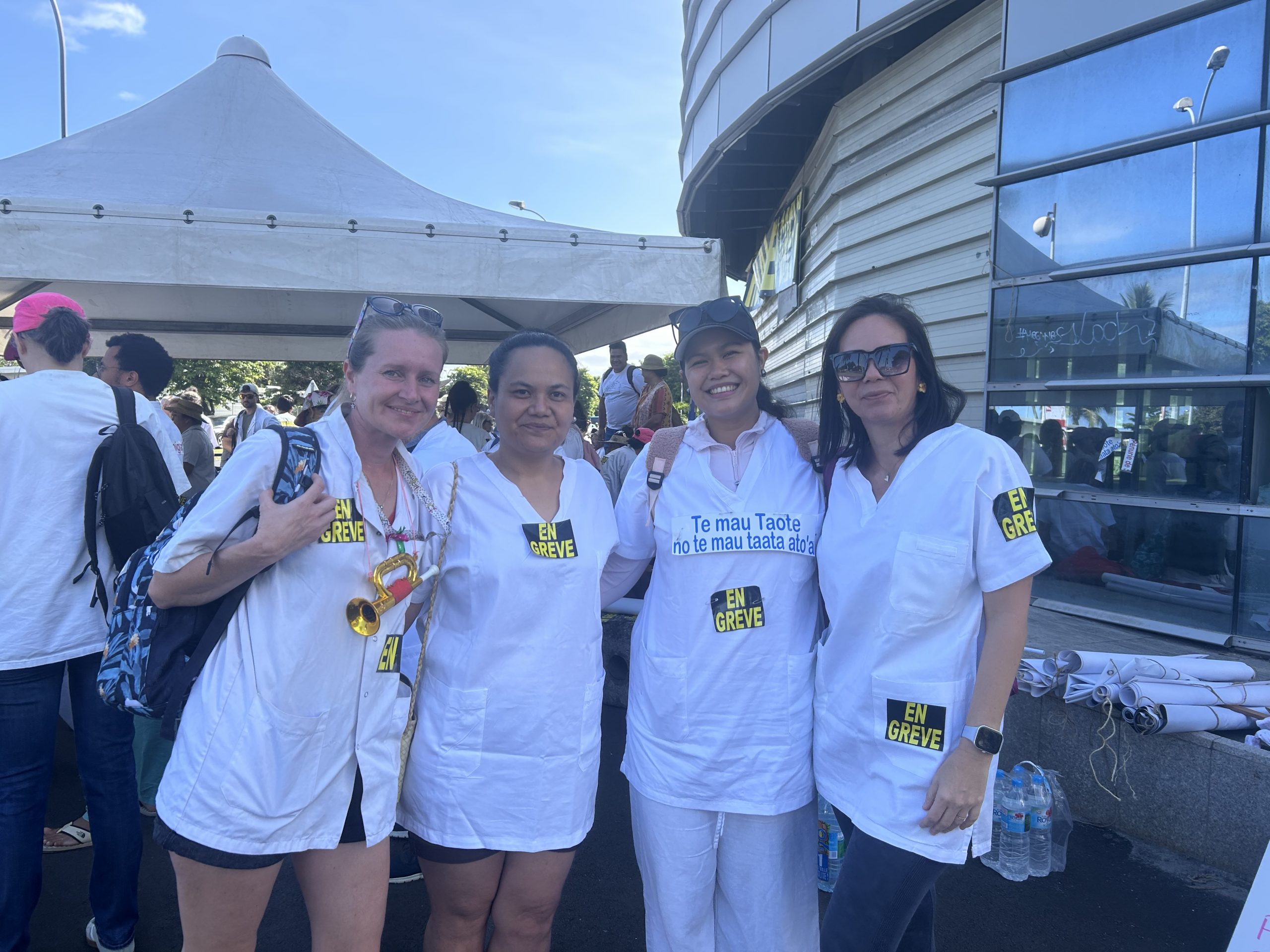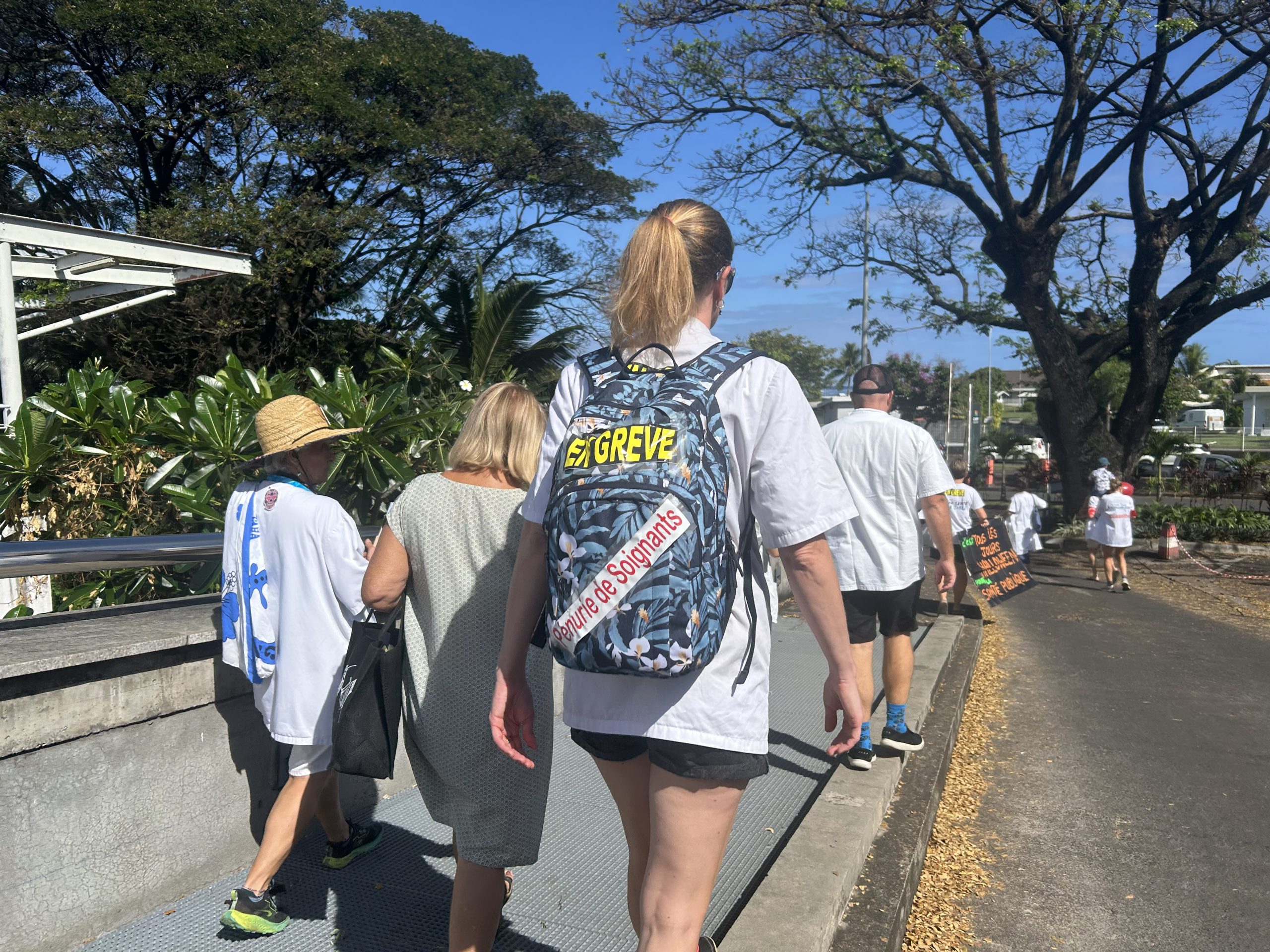
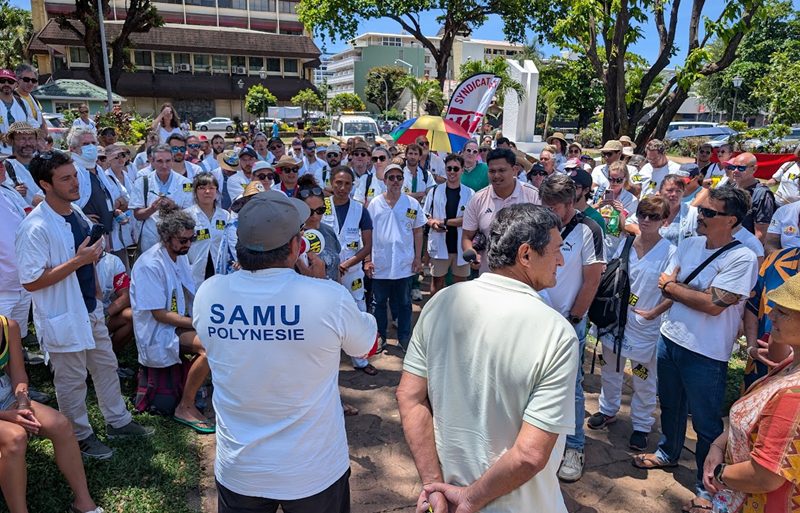
About 200 public health workers demonstrated this morning, marching from Taaone to the presidency. “Caregiver shortages,” “lack of attractiveness”… At the head of the procession, hospital doctors and pharmacists demanded a revaluation of their status and salaries. While awaiting new proposals from the country, CSTP-FO and A ti’a i mua met with Tony Géros, who invited them to exchange with the assembly groups on Thursday… A day of counter-mobilization by Fissap, the first hospital union firmly opposed to the practitioners’ demands.
[Update 8:00 PM: the striking unions were received at the presidency later in the day, where the government proposed new proposals, which were again deemed insufficient by hospital practitioners. Read at the end of the article]
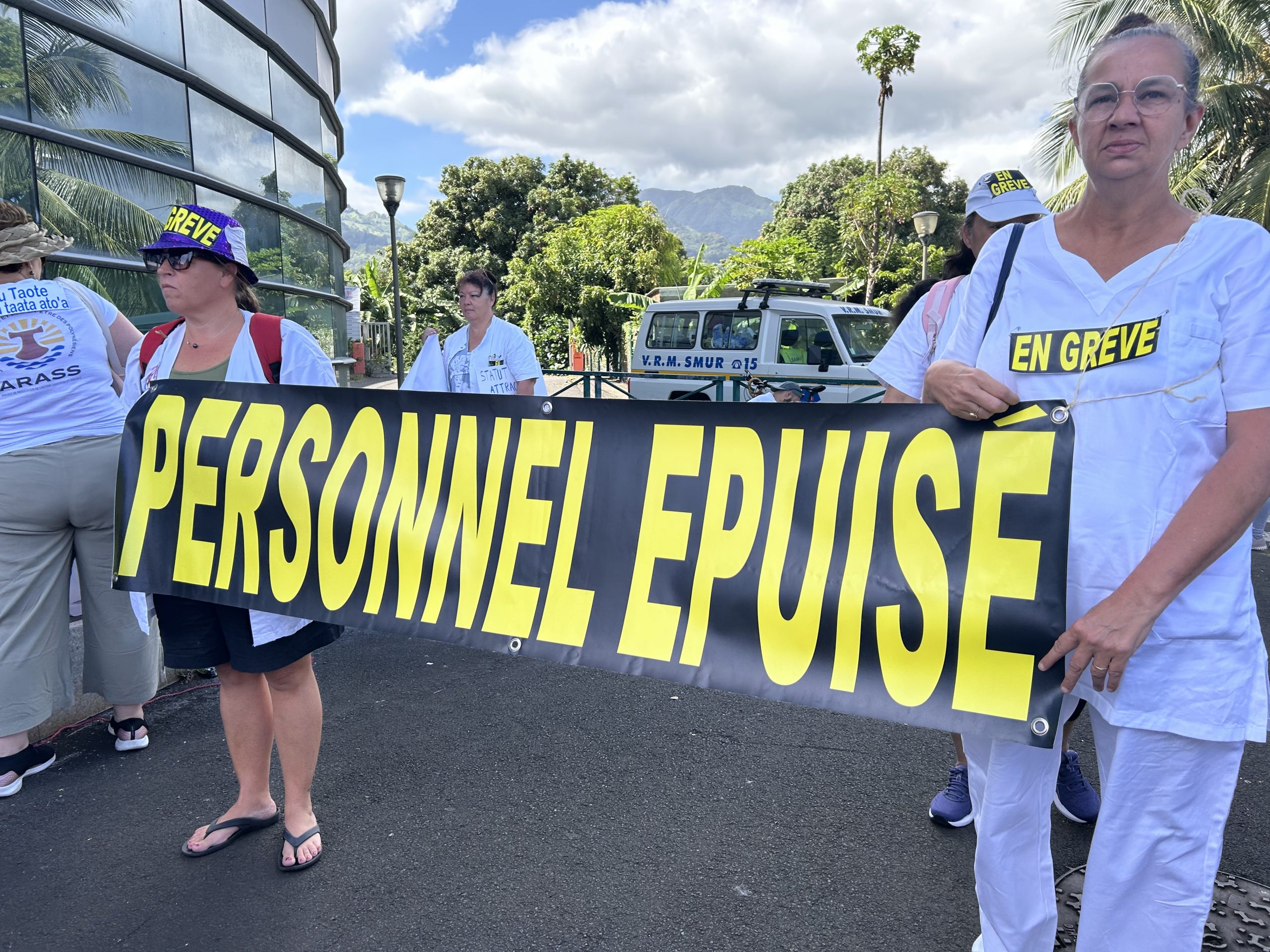
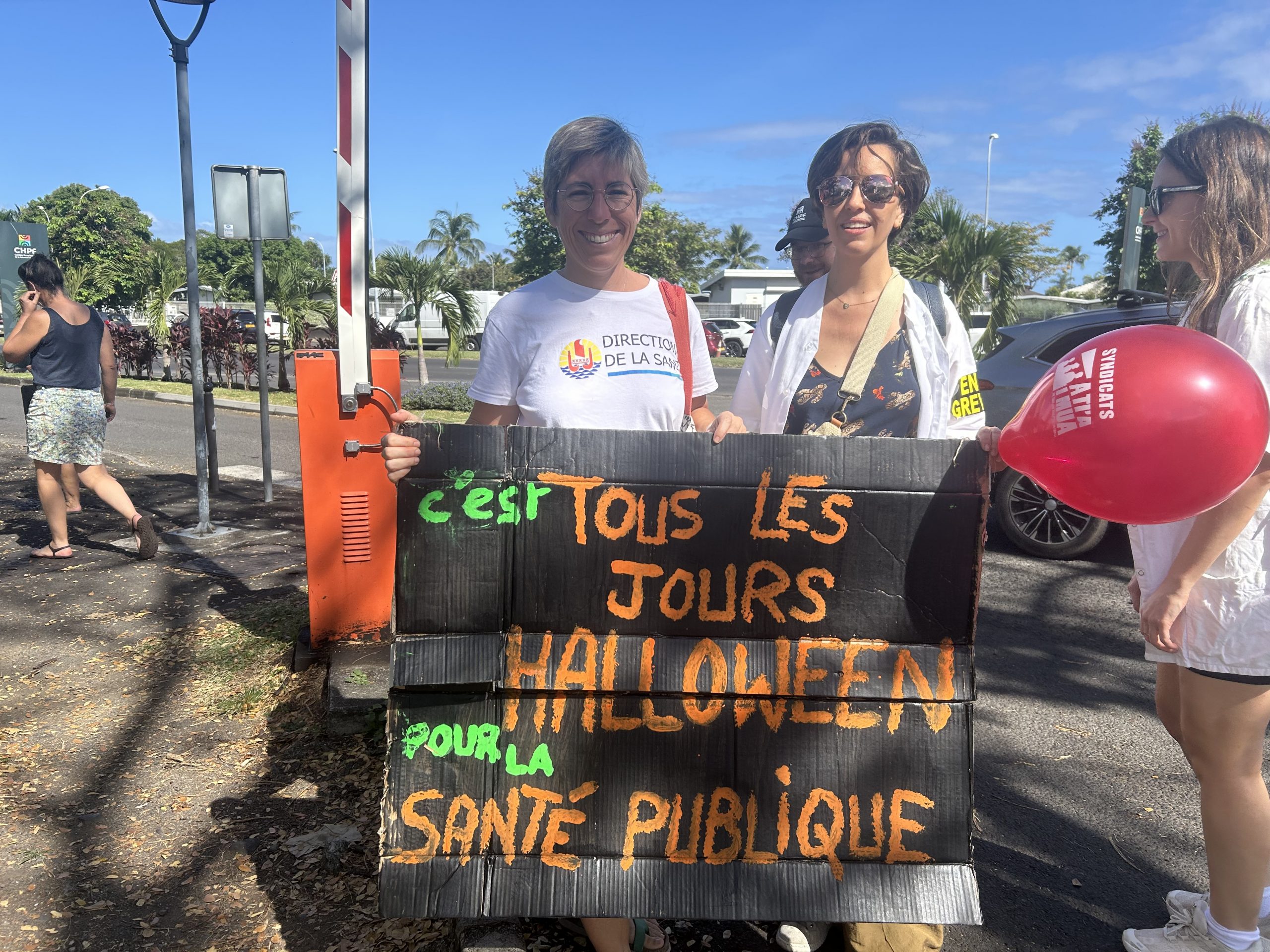
“Exhausted staff,” “It’s Halloween every day for public health,” “Our years aren’t just coconut oil: they don’t evaporate in the sun”… More than 200 health professionals demonstrated this morning to voice their demands amid the deterioration of their working conditions and the lack of staff at the CHPF and the Health Directorate. A situation that endures, and is mainly linked, for the marchers, to the lack of attractiveness of public health professions in the territory. In particular those of hospital practitioners, originally, and still central to the movement. Gathered in three CSTP-FO and A ti’a i mua affiliated unions, central bodies that support the strike, they call for an ambitious reform of their status and substantial pay increases to facilitate the recruitment of hospital doctors and pharmacists, prevent their “flight” to the private sector and to other overseas territories, and give young Polynesian doctors good reasons to join the Polynesian civil service.
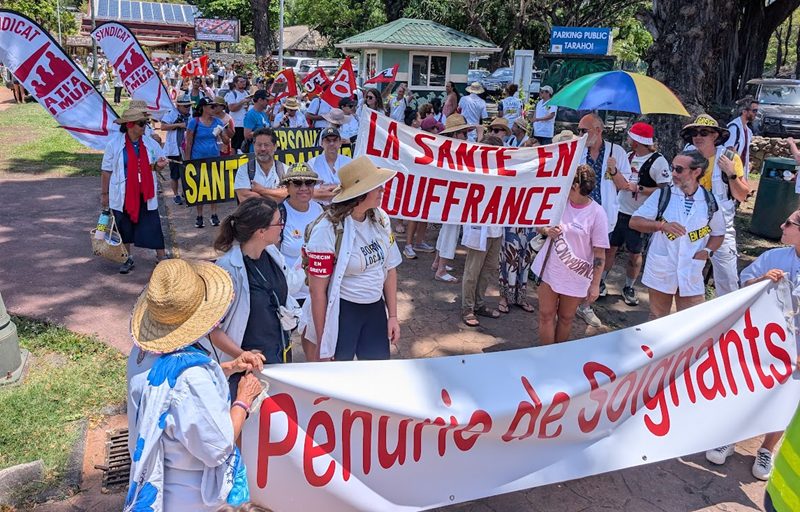
Meeting set for Tarahoi on Thursday
The march therefore left the CHPF at 9 a.m., before reaching the presidency, stopping at Tarahoi Square with music and slogans, while the assembly was in plenary session. Clad in white coats and bearing their “on strike” stickers, the protesters were received on-site by Tony Géros. While he did not wish to provide an immediate response to their demands, he proposed a meeting this Thursday at Tarahoi.
“We will meet here and I will ask all groups to appoint a spokesperson so that they come and deliver the same information,” explained the speaker of the assembly. “Then we will coordinate with the groups to see how, strategically, we can, with the budget review, make decisions that respond to the demands of these strikers.”
Thursday will also mark the start of a strike by the Federation of Interprofessional Health and Administrative Services in French Polynesia (Fissap). The Mireille Duval union, unsurprisingly, was absent from the procession: the leading CHPF union, mainly representing categories B, C and D health workers and hospital technical and administrative staff, strongly opposes the claims made by hospital practitioners, as does the SFP, deeming them too costly and unfair.
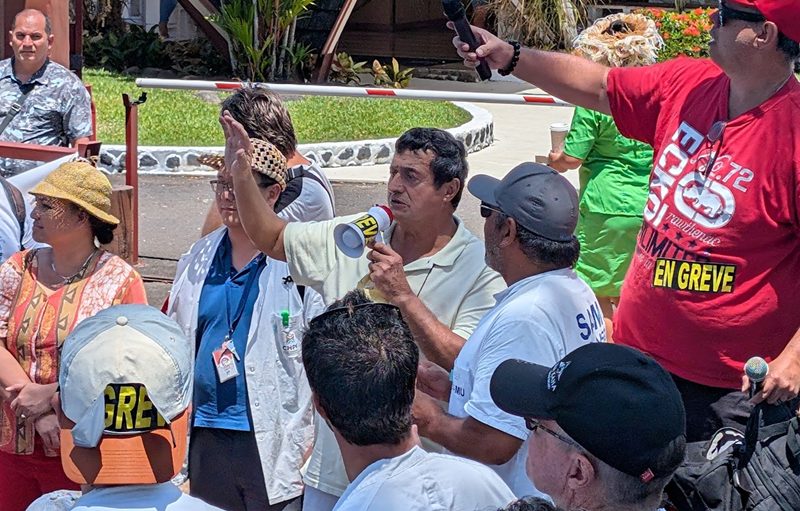
“Fissap? Who is Fissap?”
Asked about the absence of this heavyweight in public health, and about its counter-mobilization order, Patrick Galenon, secretary-general of CSTP-FO and a former deputy of Mireille Duval, quipped: “Fissap? Who is Fissap?” The union leader knows well that this other pre-notice weighs on the country’s decision-making. Moetai Brotherson, after meeting this weekend with health sector representatives, had asked the various organizations to agree on common demands, aware that progress for some could be contested by others.
“With the government, in the first days we believed we were making progress. And then, little by little, we saw the government retreat, or set us against other unions, which is not exactly in the spirit of the unions,” repeats Patrick Galenon, who stresses the purpose of their mobilization: “We have demands, we are in negotiation and we are there to ensure that our patients are well cared for.” “Trying to pit professions against one another is not very nice. You know, we don’t practice politics in health; we care for patients and strive to make the system work better.”
The union leader goes further and suspects that Fissap has struck an agreement with the government that would weaken the mobilization. “They must have found agreements with the government to weaken us. Obviously Fissap isn’t here. We could have marched together and gone to see the government.”
“C
For Avaiki Teuiau, secretary-general of A Ti’a i Mua, hospital practitioners have reached a breaking point after exchanges that struggle to yield concrete solutions. She points to the government’s responsibility, which sent the unions back to their own discussions at their last meeting, Saturday.
“Of course the government receives us and listens to us. But it may not be fully listening,”, she laments. “It offered us rather than negotiated, to meet among unions to resolve these difficulties and the working conditions that hospital practitioners experience.” “I want to tell you, each in their own field.” “At some point, if we have to file strike notices, it’s precisely because these professionals have reached their limits,” supports Avaiki Teuiau.
Beyond their working conditions, the strikers intend to alert about the consequences of a lack of resources for patient care. They hope the government will take their demands into account, while, according to Patrick Galenon, the authorities’ “listening” “is beginning to erode.”
Nouvelles propositions, nouveau rejet
Moetai Brotherson indeed announced during the day at Tarahoi new proposals “that concern all health workers” and which were placed on the table at the presidency by the end of the day. After less than two hours of discussion, the striking unions emerged from their meeting disappointed. According to practitioners’ representatives, the country proposed a “bonus” corresponding to a 5.5% increase in the pay scales for all public health staff. A proposal that corresponds to the first point of the CSTP-FO and A ti’a i mua demands, even though the latter had proposed a revalorization of the index point that would have applied to all territorial civil servants. This one-off effort, whose durability beyond 2027 is not guaranteed according to the unions, should allow the government to carry out the major overhaul of the pay scales launched through the Peperu project, with particular attention to that of practitioners, caregivers and other hospital staff.
But the two unions again rejected this idea, which, according to representatives, does not cumulate with the previous proposals. “We have addressed the first point of the demands charter,” notes a CSTP-FO activist. There remain 19 others. And notably point 2, which sets the fight for the strikers: a return to the version of the reform of the practitioners’ status tabled by the working groups of professionals, whose budgetary impact was estimated at 2.7 billion francs annually by the country.
Alexandra Perrini et Charlie Réné
| Fissap wants to organize a round table
In a statement released on Monday, Fissap calls for organizing a round table to quickly find a solution to the conflict between sector actors that has lasted seven days. The union warns of the risks that prolonging the movement poses to patients, who, it says, are caught in the middle of negotiations. The federation notes that, while the status of hospital practitioners concerns around 300 agents, it is also working on reforming the statuses of categories B, C, and D, which account for nearly 3,000 agents. Since March 2026, eleven statutes have been filed and are being finalized. Fissap states that it has proposed pay scales and advancement charts, without requesting a precise funding amount. It also notes that since May 2024 it has contributed 6.4 billion francs to CHPF to preserve continuity of care. Regulatory-wise, it argues that reform of hospital practitioners cannot be separated from the broader transformation of public health facilities and the evolution of the statuses of other staff. Finally, Fissap asks that the funding for all these reforms takes into account the high cost of living and the crisis context. It rejects having their costs borne by the population through new taxes or levies, or by an increase in contributions. |