
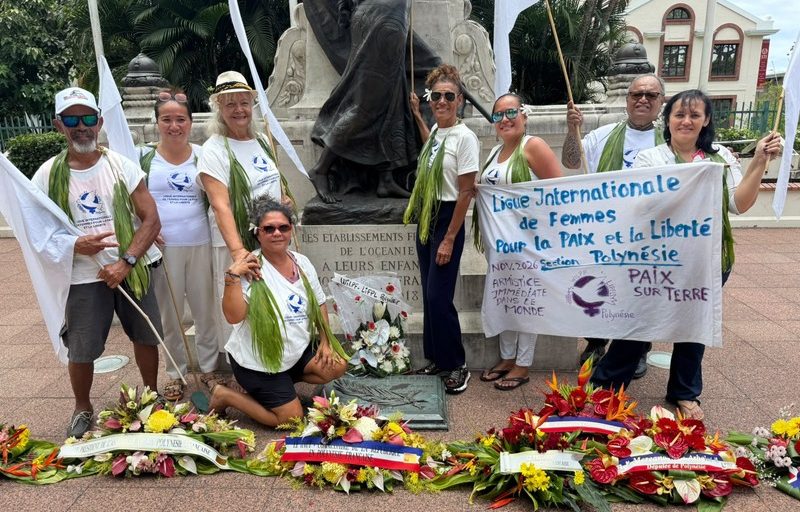
Having lain dormant for years, the local chapter of the International League of Women for Peace and Freedom (WILPF in English) returned to the public scene this November 11. Armistice Day, 1918, was not chosen by chance: the NGO, more than a century old and active in 40 countries, has always blended anti-militarism and feminism. Its Polynesian branch, heir to Marie-Thérèse Danielsson’s anti-nuclear activism, also aims to participate in the fight against violence toward women and in education on human rights — two essential levers for building lasting peace, according to its vice-president, Roti Make.
Civil authorities and military officials were not the only ones to lay a wreath on this November 11 at the memorials in Papeete. On this Armistice Day, about ten Polynesian activists from the Women’s International League for Peace and Freedom (WILPF) paid homage, in speeches and in song, to war victims, but also to their loved ones and descendants.
« It’s a symbolic action », explains Roti Make, vice-president of the local WILPF branch. It is above all « the first manifestation of the league’s return » to the homeland.
« It will be our sons, our husbands, our fathers who will go to the front »
Created in 1915, in the midst of World War I, by the pacifist wing of the international feminist movement, WILPF is a non-governmental organization present in around forty countries, holding consultative status at the United Nations. Its Polynesian branch, for its part, was launched in 1981, with Marie-Thérèse Danielsson as its leading figure, who denounced the consequences of nuclear tests after the death of her daughter, who died of leukemia. Gradually put to sleep, the local association had not spoken out since 2019.
By choosing November 11 to resume its public actions, WILPF returns to its anti-militarist origins. « Armistice means bending one’s adversary with weapons, while the United Nations call for respect of all nations and for building peace, a lasting peace for the well-being of all humanity, explains the former president, and today vice-president of the branch, the artist and former teacher Roti Make. A war is not only the soldiers who will die, it is also civilians, families who will be displaced, who will be killed, who will be bombed. We, women, are concerned at the highest level because it is our sons, our husbands, our fathers who will go to the front. It is important that we understand what a war is: a psychological and human disaster, for all nations.»
Roti Make has today handed the baton to Béatrice Airuarii, a writer and activist for recognition of the victims of the nuclear tests, a fight embedded in the association’s DNA.
Awakened by the Morin Law reform
This awakening comes a few weeks ahead of an important milestone for victims of the nuclear tests. The Morin Law reform, notably led by deputy Mereana Reid Arbelot, is to be examined in a second reading at the National Assembly on December 1, with the hope of final adoption. The text notably aims to remove the one-millisievert exposure threshold and to open compensation to secondary victims.
Not yet enough for Béatrice Airuarii, recognized as a victim of the tests in 2022, who believes that the consequences of underground tests must also be taken into account. Like associations such as Moruroa e Tatou or 193, she also calls for transgenerational studies for all these victims, these families who currently have cancer in Polynesia, to be safe for our children later.
Note that the parliamentary inquiry commission on nuclear energy, of which Mereana Reid-Arbelot was the rapporteur, did indeed recommend epidemiological studies and a study on transgenerational diseases. These recommendations, according to the independentist deputy, will be the subject of proposals once the Morin reform is adopted. “The fight does not stop with this law,” the parliamentarian has repeatedly stressed.
« It’s the education system that’s the problem »
For Roti Make, the future also hinges on education in human rights and the fight against violence toward women. On this first point, the law advances thanks to education, she says, convinced that human rights and citizenship must be taught from kindergarten. We must learn to say no to violence.
This issue, according to the painter, also concerns Polynesian youth: the activist worries that military service is too often a route for young Polynesians who lack educational or professional prospects. Beyond the advantages of access to housing, meals, and learning a trade, for Roti Make military service “teaches our children to kill” and “I don’t want our children to become murderers.” “There are islands where all the young men have left,” laments Roti Make. “It’s not because there is no work, it’s the educational system that’s the problem. It does not educate our children to become entrepreneurs, to become capable people. We must find other solutions to educate this youth who is arriving and who lives in the valleys, who lives in the shantytowns. We want to give resources to this youth who lives in the valleys, in the shantytowns.”
« There are many battles to fight to achieve gender equality »
The League also intends to continue the fight for gender equality as well as for the rights of LGBT people. “There are many battles to fight to achieve gender equality,” says the vice-president, who now wishes to pass on the activism to other women “to be able to defend their human rights, the rights of indigenous peoples, the right to life, to identity and to well-being.”
After this first action, WILPF announces its next rendezvous on November 25, on the occasion of the International Day for the Elimination of Violence Against Women. The association currently counts about twenty members and intends to carry out peaceful demonstrations “on all the important dates”, concludes Béatrice Airuarii.