
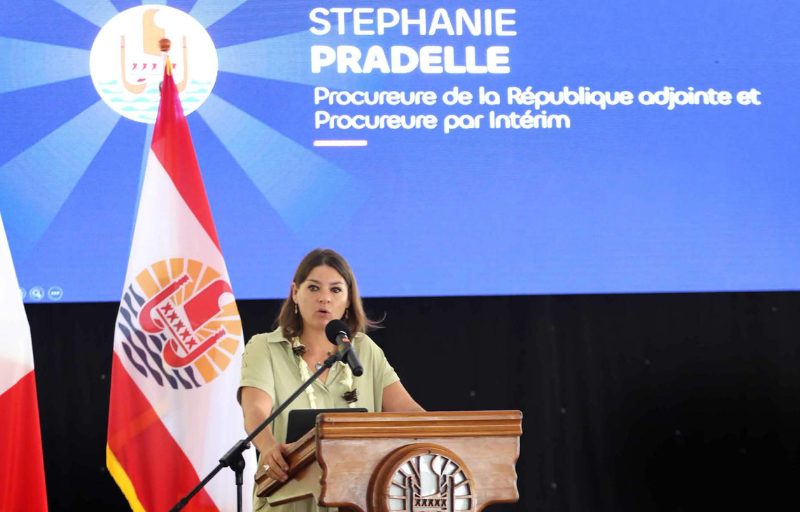
The judiciary is considering criminalizing the largest ice trafficking cases to allow their referral to the Assize Court and to hand down sentences that could reach up to 30 years of imprisonment. “We are talking about the upper end of the narcotics trafficking spectrum,” notes Stéphanie Pradelle, interim public prosecutor. She spoke this Friday at the presidency, where nearly 200 service heads and administration leaders gathered for a seminar dedicated to work-related addictions.
Nearly 200 public service department heads and human resources managers were gathered Friday morning at the presidency for a seminar devoted to addictive behaviours in the workplace, with a particular focus on ice use. Organized by the Directorate of Talent and Innovation (DTI), this morning aimed to “give them the keys” to identify worrying situations, support the concerned agents, and direct them to the appropriate contacts.
A meeting that resonates with the Health and Safety at Work Days (JSST) held in September of last year, which had notably addressed a delicate question: what can an employer actually do when they suspect an employee of using ice? This time, the exchanges also broadened the perspective to the scale of drug trafficking in Polynesia. Several speakers were present to shed light on these issues, including the interim prosecutor, the interministerial representative, the head of the addiction service of the mental health unit, the lieutenant colonel of the gendarmerie, the prevention engineer from the Directorate of Labour, and the head of legal affairs at the DTI.
Trafficking that pushes justice to consider new prosecutions
The figures presented by the interim prosecutor, Stéphanie Pradelle, illustrate the magnitude of the phenomenon. In 2025, 60 kilograms of methamphetamine were seized. By July 31, 2026, the tally had already reached 66 kilograms intercepted. In response to this progression, the judiciary “envisages criminalizing” certain ice-related cases. “We are talking about the upper end of the narcotics trafficking spectrum,” emphasises the prosecutor. “We have the legal possibility to criminalize these cases, that is, to choose different legal qualifications, notably through organized crime which implies a clearly identified structure.” The objective would therefore be to “bring these dossiers before a court of assizes to obtain penalties that are two-digit,” she adds. “If we are dealing with structures that have that face, we will orient ourselves toward this type of prosecutions,” confirms Stéphanie Pradelle.
The illicit importation of narcotics, an offense punishable by a maximum of 10 years’ imprisonment under the Penal Code, becomes a crime punishable by 30 years’ imprisonment when committed in an “organized gang,” under Article 222-36 of the Penal Code. The choice to open a criminal investigation rather than a misdemeanor one is relatively rare concerning drug trafficking. Criminal proceedings follow different rules — especially regarding pre-trial detention — and are also heavier, often longer. “We must have cases that lend themselves to that,” notes the interim public prosecutor. “Not all cases deserve a criminal qualification, which becomes evident during investigations.”
“They must be losers on the cost-benefit balance.”
As announced, justice also intends to target more effectively the profits generated by trafficking networks. “We really need those who organize these drug traffics to be losers on the cost-benefit balance,” explains interim prosecutor Stéphanie Pradelle. To achieve this objective, the judicial response rests on two levers: the penalties imposed and the seizure of criminal assets, whether they are properties, cash, or sums deposited in bank accounts. On September 9, auctions held before judgment thus raised 4,734,040 francs. This procedure allows certain assets to be sold before the verdict to prevent them from losing value, notes the magistrate.
Having been in charge of narcotics cases since March 2025, Stéphanie Pradelle also highlights another worrying indicator: the price drop of ice. In a year and a half, the price per gram of methamphetamine fell from 120,000 to a range between 50,000 and 80,000 francs. For the interim prosecutor, this decrease signals a higher circulation of the product on the territory, suggesting a more abundant supply.
Prevention, care and the fight against trafficking
If the justice system plans to strengthen its response to trafficking networks, the country also emphasizes prevention and early identification of addictive behaviours, notably within the public sector. “We have 8,500 agents who represent as many families”, says Rauarii De Longeaux, interministerial delegate in charge of the fight against addictions and violence. “Our objective with this seminar is to provide managers with the keys to identify, and thus prevent, in one of their agents who use or even in their personal environment. The goal is to give them a toolbox so that they can, at the end of this seminar, be able to direct people toward the appropriate channels.“A social issue, this will be addressed by the vice-presidency; a health issue, this will be handled at CHPF or with CPSA; and a judicial issue, it will be the authorities or the public prosecutor’s office that are involved.”
At the request of the country’s president, Moetai Brotherson, this seminar also aimed to assess the actions undertaken over the past year and a half against addictions, particularly ice consumption. The government’s action plan rests on three pillars: prevention, care, and the fight against trafficking. The first pillar includes raising awareness among youth, training professionals who work with vulnerable populations, and giving greater attention to the families of consumers, whose role can be decisive in raising awareness about addiction, continues Rauarii De Longeaux.
The second pillar foresees better health and social support, with the strengthening of specialized addiction staff at the mental health hub and the establishment of Liaison and Care Teams in Addiction (Elsa) at the CHPF emergency department. These teams assess situations and direct patients to the appropriate structures. Finally, the country intends to strengthen the fight against trafficking, respecting the powers of the State, and to counter the image of success associated with revenues from the illegal drug trade. Deployed in the municipalities at the start of the month, the A’ARA guides also participate in this effort: these health guides must identify worrying situations and direct people toward the appropriate social and health services, without substituting for authorities or acting as a denunciation.
Through this seminar, the country thus aims to better empower public sector leaders to address addictive behaviours, with a central objective: to identify risky situations as early as possible to promote appropriate care, without leaving the affected employees without a solution.