
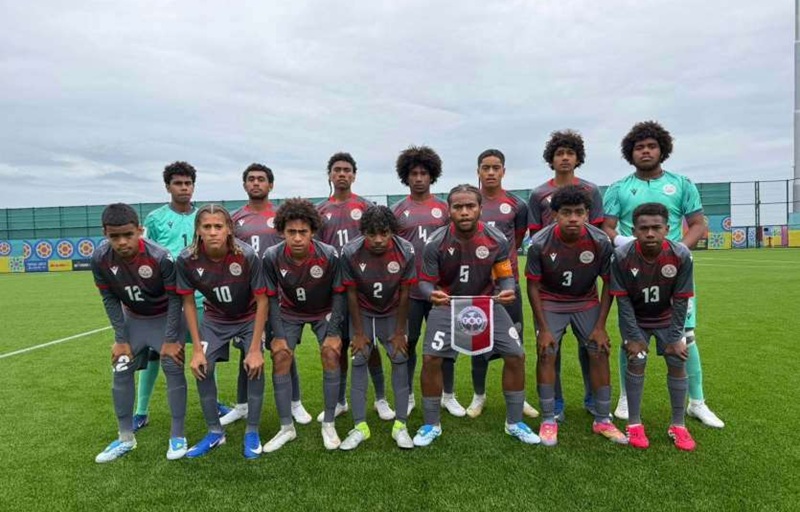
The organization tied to the Azerbaijani state used the presence of the Caledonian and Tahitian teams, taking part in the first edition of the U15 World Cup in Baku, to launch a social media campaign against the “French colonialism.” The Caledonian Football Federation demanded the withdrawal of the posts and announced that it had referred the matter to FIFA. The Tahitian Football Federation, for its part, spoke more discreetly, in an article in Tahiti Infos at the start of the week. Details from our partner Les Nouvelles calédoniennes.
Organized in Azerbaijan from October 24 to 30, the very first Under-15 World Cup took a political turn. The Baku Initiative Group, a non-governmental organization, actually close to the Azerbaijani state, took advantage of the event to campaign against the “French colonialism.”
Already accused of several attempts at interference and manipulation of public opinion, the Baku Initiative Group multiplied in recent days its posts on social networks, on the margins of the competition, using the image of the Caledonian selection, but also that of French Polynesia, presented as tools in the fight for the emancipation of French territories in the Pacific. Photos of some players, mostly aged 14, were also used on visuals of a political nature.
“From protest to the stadium: Kanaky and Maʻohi Nui oppose French neocolonialism,” one can read, for example, on a post sharing photos of a handful of spectators who wave the Polynesian and FLNKS flags as the buses carrying the two teams pass by.
The organization also states that it received delegations from both selections to discuss “the ongoing struggle of the people of Kanaky and Maʻohi Nui for independence, the importance of protecting their national identity and their cultural heritage against the French colonial regime, and the ways to strengthen cooperation.”
“Inacceptable Instrumentalization,” denounces the Caledonian government
“The FCF did not approve nor authorize this association,” reacted the Caledonian Football Federation in a statement published on Thursday. It denies any endorsement by its side of the political message behind these posts. The presence of its delegation in Baku could not be “presented as support for this message,” recalling its political neutrality. And adding: “Our U15 selection participates in a sporting event, not a political démarche.”
The FCF thus requested the withdrawal of the various posts using the image of the Caledonian team and its players, and announced that it had referred the matter to FIFA as well as the OFC. The government official in charge of sport and youth, Nina Julié, also reacted to the controversy, denouncing an “unacceptable instrumentalization.” The official further stated that she would firmly oppose awarding subsidies to leagues and sports clubs that used public funds for political ends.
In Tahiti, the Tahitian Football Federation reminded its delegation to stay out of politics
On the Polynesian side, the Tahitian Football Federation did not officially take a position, but it had spoken on the subject that Monday in an article in Tahiti Infos. Contacted by the newspaper, it said it did not know about this instrumentalization, while affirming that it had reminded the head of the Polynesian delegation not to engage in political considerations “to protect the children and football.”
According to the daily, the FTF also specified that a Polynesian activist present in Baku, Tauhani Chrystal Lesca, was not part of the official delegation and had no right to speak on its behalf. This activist had been cited by Xalq Qəzeti, a newspaper presented as not independent of the Azerbaijani government. According to Tahiti Infos, she had merely expressed pride in seeing French Polynesia represented internationally in this competition. But the Azerbaijani newspaper had headlined about increased recognition of Ma’ohi Nui thanks to Azerbaijan’s support.