
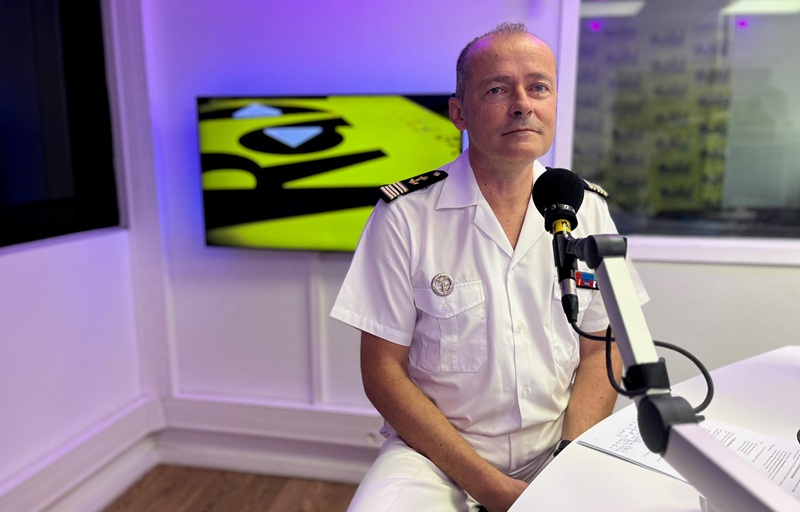
Olivier Drevon has just taken up his new duties as head of the JRCC (Joint Rescue Coordination Centre) after leading Cross Gris-Nez in Pas-de-Calais. He thus moves from the smallest French area of responsibility to the largest, spanning 12.5 million km². To coordinate rescues despite the distances, the JRCC “pulls out all the stops,” relying on maritime solidarity and improving the the VHF and MF radio coverage, with ASN to automatically position the vessel in distress, near certain islands. Hiva Oa and Nuku Hiva are the latest to be equipped with these stations, and studies must be conducted to equip other islands in the Raromatai archipelago.
Radio 1 : You were the deputy director of the MRCC of Polynesia, the former JRCC, from 2005 to 2009, what made you come back?
Olivier Drevon: The extraordinary reception I had received from Polynesia at the time when I worked there. We had also strengthened that MRCC to make it more efficient, more effective. The MRCC, which previously handled only maritime rescues, became the JRCC when it took on this additional remit to coordinate the search and rescue of an aircraft that had fallen into the sea, in connection with SEAC, the Civil Aviation Authority. When I had the opportunity to apply for the JRCC leadership, I wanted to come back to see how all that had evolved. I discovered this JRCC, now very well equipped.
The JRCC handles search and rescue, navigation surveillance, dissemination of maritime safety information, and monitoring of maritime pollution.
This is in line with the classic missions of French sea rescue centers. The priority mission is obviously search and rescue at sea. Navigation surveillance aims to monitor the behavior of ships, such as container ships, tankers, etc., to detect any abnormal situations. The typical abnormal situation is a ship that has stopped. Why would it stop? Is it in distress?
Or is it fishing? Is that what you’re watching for?
Foreign vessels are not allowed to fish in the EEZ. However, a number of them traverse this zone; it is part of the freedom of navigation on the sea. But we do indeed monitor that these vessels do not fish in the prohibited area.
The JRCC has evolved a lot. A major project was completed at the end of 2025 to modernize the VHF and MF radio infrastructures and to achieve better coverage.
The JRCC is bound to a satellite watch and it receives alerts from the Cospas-Sarsat beacons, which equip a large number of ships. The area is so vast that conventional radio coverage cannot be guaranteed everywhere. The VHF stations in Tahiti cover roughly 40 to 50 kilometers around the island. We are equipped in Tahiti, Raiatea, and the Marquesas. The Hiva Oa station was put into service last year and Nuku Hiva two weeks ago. Channel 16 and these Marquesas stations are now remotely controlled from the JRCC in Arue. The JRCC operator can speak with a small boat off Nuku Hiva that is fishing or transiting. It’s a real added value and a safety for ships in this area.
And with the improvement of this radio coverage, a digital selective calling technology, ASN, has also been introduced to achieve instant localization of vessels in distress.
The stations I just mentioned are all equipped with this digital selective calling system. Specifically, on your VHF, there is a small button; you press it for a few seconds to instantly send an alert to the JRCC, which receives the vessel’s identification, your position, your name. We will be able to trigger the rescue operation even without talking to the captain, since we will already have the essential information.
Are there plans to extend this improved radio coverage to the other archipelagos?
We focus on the sectors with the most activity. We have extension projects in the Leeward Islands, but I don’t want to go too far because it requires studies on wave propagation. We need to place our stations on high points.
500 rescue and assistance operations per year
Are maritime rescues increasing?
Over the last two years, the figures have remained fairly stable. We are a little over 500 rescue and assistance operations. I distinguish rescue from assistance because in a rescue people are truly in distress; if we do nothing, they are in immediate danger. Assistance refers to a vessel with a motor problem, for example. People are not in danger, but we may need to go and pick them up to bring them back to port.
Maritime safety rules are regularly reiterated…
One must check one’s vessel, service the engine, equip oneself with a life jacket or flotation vest. And if there is a problem, be able to alert by using a mobile phone in a waterproof case in the Tahiti–Moorea area, and having a VHF with the ASN system is even better.
12.5 million km² watched 24/7
The JRCC teams maintain constant vigilance, 24 hours a day, 7 days a week. And like on a ship, you operate in shifts.
At the JRCC, for 24 hours, you have a pair that relieves every 6 hours. There is always someone behind the screens, behind the radios, doing a 6-hour shift. They can work immediately in pairs if the operation requires. And this pair is led by a duty officer.
A team to monitor an enormous area, larger than the Polynesian EEZ: 12.5 million square kilometers.
I come from the smallest French zone in Pas-de-Calais, which was tiny compared to the one I now oversee, which includes the Polynesian EEZ and adjacent international waters. We must handle in this area all distress alerts we receive with the resources at our disposal. When a vessel is in trouble, we broadcast messages to locate a nearby vessel capable of intervening more quickly than sending assets from Tahiti, to provide immediate assistance. Seafarers have an obligation to assist. There’s no need to remind them. It can divert a fishing vessel to rescue another fishing vessel, or divert a container ship to assist a sailing vessel. We pull out all the stops to solve the problem. The distances here are enormous, so one must be patient because sometimes the rescue asset will arrive only 24 hours, 36 hours later. But we will do everything possible to be as effective as possible.