
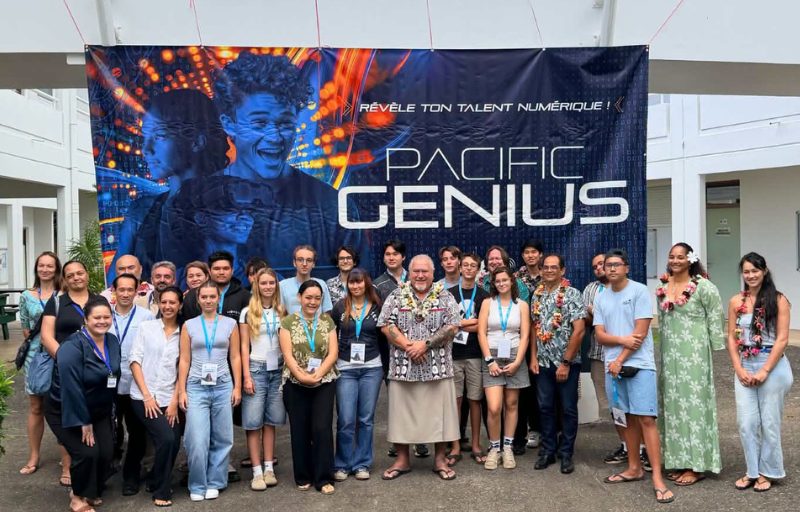
Creating a short film in five days? That is the challenge 15 high school students will have to tackle as a team at Inspé. For this 3rd edition, Pacific Genius ventures into the world of audiovisual professions: equipment orientation, scriptwriting, and even acting. The theme: preventing screen addiction. The interns will be guided by health professionals, audiovisual experts, and local figures from the fenua such as West Leclay and Maori actress Te Ao o Hinepehinga Raun. An opening toward the Pacific, which is one of the milestones set for upcoming editions.
Also read: Zero screen time in waiting rooms: a call to let little ones play
The clock started this Monday morning at the National Institute for Teacher Education (Inspé). At the start of the school holidays, 15 high school students were chosen from about a hundred applications to dedicate their first week of vacation to a discovery internship in audiovisual professions: Pacific Genius. For this 3rd edition, they have five days to forge connections, learn the workings of responsible digital practices, and above all to write, direct, and assemble a short film. Whether in front of or behind the camera, they will have to present their creations on Friday before a jury composed of representatives of the country, the Directorate General of Education and Teaching (DGEE), the Directorate General of the Digital Economy (DGEN), the Public Health Directorate and their instructors from the audiovisual sector. Among them, a few familiar faces in the fenua, such as Hawaiian host and actor West Leclay or New Zealand actress Te Ao o Hinepehinga Rauna who works alongside Jason Momoa in Chief of War.
An everyday adventure that delights Louison, a senior at La Mennais, especially before choosing post-bac options: “I really want to discover everything around audiovisual. To have an overall view too, because it’s the first time I’ll touch a bit of everything, including directing and production.” A new challenge to tackle in a team of three in under 20 hours, but it doesn’t scare her: “I love anything that’s collaborative, so I’m excited to discover, meet new people, and learn.”
“We become the slaves of the digital tool.”
Among the 35 hours of training, 13 will be devoted to theoretical learning, notably on this year’s theme: digital addictions. After artificial intelligence last year, this edition named “Motion & Emotion” aims for the short films produced during the week to carry a preventive message about screen addiction. The objective for the country and the DGEN, the project’s lead, is to “raise awareness of the dangers of screens.” The students’ productions will not necessarily be broadcast, but if they were, especially on social networks, this would—according to Raimana Lallemant-Moe, Director General of the DGEN—“use screens to raise awareness about screens.” “Knowing how to use screens is, in the end, the first step and perhaps the most important step to not fall prey to it.”
To succumb, in other words, to fall into digital addiction. In Polynesia, 15% of youths admitted to the addiction prevention and care center are hooked on screens. President Moetai Brotherson, present at the Pacific Genius opening ceremony, also shared his screen time: two hours a day on social networks “including WhatsApp to harass ministers,” he quipped. Yet, according to him, what should be prioritized is “the management, information, and prevention.” “I don’t think screens should be banned. An instrument is an instrument. As long as it remains an instrument, and we decide to put it down or pick it up, it’s manageable. It’s indeed when you become a slave to the tool that it becomes complicated. Banning, we’ve learned from history: it started with an apple in a garden, it didn’t work,” smiled the head of state.
A theme and a prevention mission that have appealed to the first beneficiaries: the high school students. Louison is already inspired: “I think it’s a very good theme because it affects us, us the youth. It shows that we can do something, even if we aren’t necessarily taken seriously, we’ll say. It’s not bad to put us on topics like this, especially for prevention.” The new generation addressing the new Polynesian generation.
In the longer term, the country hopes to give Pacific Genius a new dimension. President Moetai Brotherson recalled that during last September’s Pacific Islands Forum he already mentioned the ambition for 2027 to open the event to young people from other Pacific countries.