
Questioning six hours of talks on Tuesday with the newly appointed Minister of Public Service, the interunion of hospital practitioners again laid out its demands. While “the dialogue is renewed,” the cost of the reforms sought by the unions, estimated at 4.5 billion francs in 2027 and 5 billion francs in 2028 for all public health professionals, remains the main obstacle. A new meeting is planned for next Monday, with the possibility of a strike resuming not ruled out.
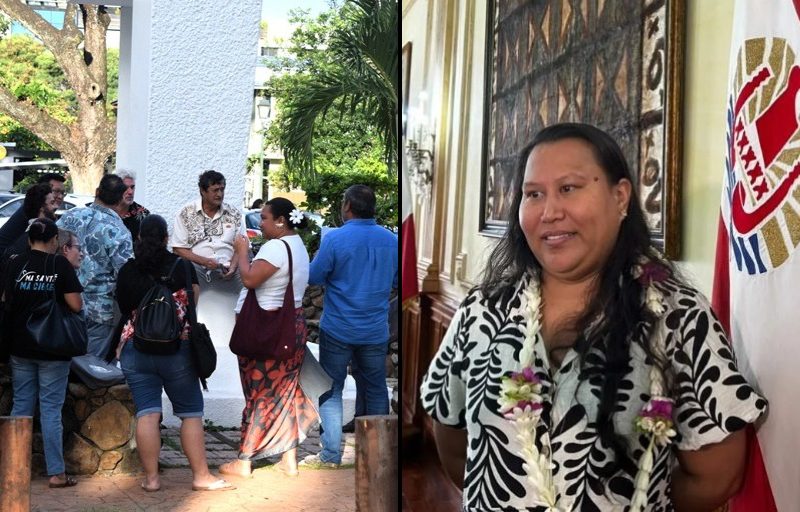
The representatives of the interunion of hospital practitioners spent nearly six hours at the table this Tuesday afternoon with Christelle Lecomte-Sandford, the new minister of Public Service, officially introduced the day before by the government. It was a “very long” meeting, summarizes Dr. Jonathan Larson, secretary-general of ATIM-PH, and it allowed them to revisit the entire file and to recall the context of the crisis that has been shaking the public health sector for several weeks. They “reiterated the difficulties and the constraints inherent to our health profession,” adds the anesthesiology and critical care doctor.
On the table, the government again presented a draft agreement, very close to the one already submitted and rejected by the physicians. The unions offered their observations and proposals. The document must now be reviewed by the executive, including Moetai Brotherson and Warren Dexter, while the interunion CSTP-FO and A Ti’a i Mua must also submit it to their bases. But for the practitioners, it is useless to multiply discussions without first addressing the cost of the reform, which they estimate at 4.5 billion francs in 2027 and 5 billion in 2028 for all public health professionals, doctors, nurses, and aides.
“We pointed out to the minister that she had said she did not want to waste any more time, and so we proposed solving the main issue, which is funding. She committed to discussing with the Ministry of Finance, with its president, and also with the assembly in order to resolve this crucial number-one problem before tackling all the other items of the notice. If this number-one problem is resolved, we can continue with the other points of the notice,” explains Jonathan Larson.
“The government says they only have 1.5 billion in total”
This budget question has been at the heart of the conflict since the movement began on October 20 at CHPF and the Health Directorate. The practitioners demand a revaluation of their status and remuneration, as well as the creation of a single status for practitioners in public health structures. The reform concerns both doctors at CHPF and those in peripheral hospitals, the Health Directorate, and ARASS.
During earlier negotiations, the government had proposed a 15% salary increase as of January 1, 2027, potentially accompanied by a second, equivalent rise in 2028. But this was not enough for the practitioners. Another proposal then presented by the executive involved a monthly Va’a Ora allowance of 18,000 francs for the roughly 3,800 agents in public health structures, along with a revaluation of on-call duties and the extra working hours of hospital practitioners, representing an estimated net monthly benefit of 116,000 francs per doctor. These proposals also failed to convince the interunion, which demands stronger commitments and, above all, their budgetary translation. “The government says they only have 1.5 billion in total. But the APF says we can bear this annual overcost,” sums up ATIM-PH’s secretary-general.
An “renewed dialogue,” but a possible strike resumption remains
“The dialogue has been renewed,” rejoices Dr. Tony Tekuataoa, member of the Syndicate of Public Practitioners of French Polynesia, even though “we are still quite far from our objectives.”
The minister and the interunion are set to meet again next Monday at another gathering in the Ministry of Public Service. In the meantime, the unions still count on the support of assembly members during the examination of the 2027 preliminary budget in Tarahoi. At the end of October, they had asked representatives of the political groups to ensure that their demands were taken into account in budgetary arbitrations.
The “suspension” of the strike, announced after this Tarahoi meeting following eleven days of mobilization, therefore does not signal the end of the movement. And this is true even if, as Fraap showed in 2025, the legal validity of such a suspension is uncertain, and a potential resumption of the strike could go through a new notice. The essential for hospital practitioners is to maintain pressure. The mobilized professionals continue to display their determination by wearing yellow armbands at their workplaces.