
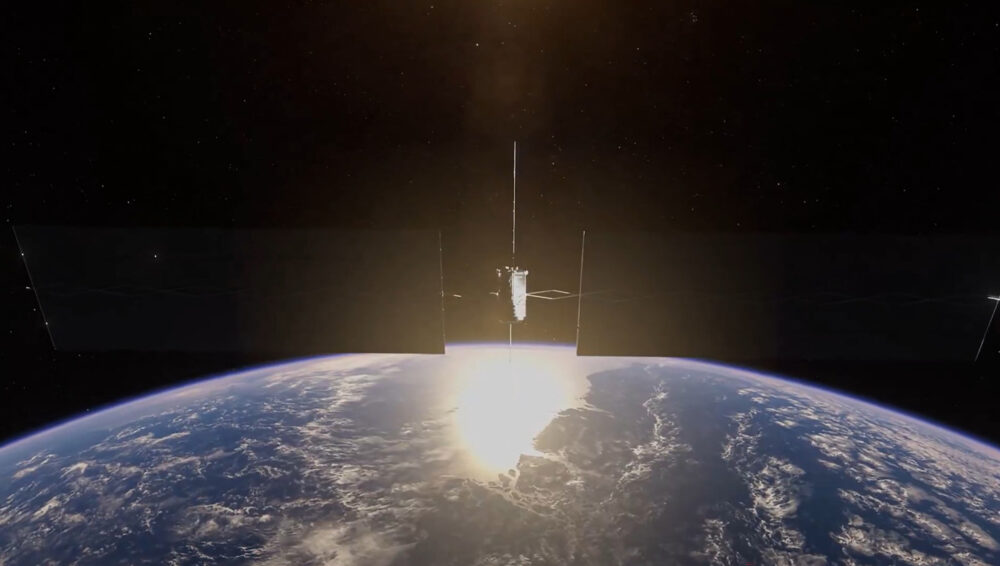
Since last year, orbital data-center projects have been multiplying. Beyond SpaceX and its Starmind constellation, Google is pursuing its own work under the code name Suncatcher, and Blue Origin has filed with the U.S. telecommunications regulator, the FCC, for its “Project Sunrise”.
Several startups are also in the race, notably Starcloud, which already successfully operated a cutting-edge processor called a GPU from a satellite, by the end of 2025. Google achieved this there as well in October.
SpaceX’s Starmind constellation “will process enormous amounts of data intended to be used on Earth,” according to the FCC. The license granted to SpaceX runs through 2040, according to a document published Wednesday on the Federal Communications Commission’s website.
“America leads the world in the era of superintelligence,” said the FCC chairman, Brendan Carr, in a statement, echoing the term used by Trump to describe artificial intelligence.
According to him, data centers will be “essential to maintaining America’s leadership” in this field. SpaceX has the advantage of owning its own launch vehicles, which have already carried out hundreds of missions.
In August, SpaceX chief Elon Musk promised a first orbital deployment in the fourth quarter of 2027 and a ramp-up in 2028.
“Sad and Appalled”
The company has struck an agreement with Nvidia, which will supply its latest-generation processors, the Vera Rubin, specifically designed to operate in space.
Most space-based data-center programs share a similar architecture, namely a constellation of satellites in low Earth orbit (LEO) and in close proximity to one another to ensure a reliable connection between them.
In the case of Starmind, these satellites will communicate with those in SpaceX’s Starlink satellite internet constellation, already in orbit, which will then relay the data to Earth.
Other competing networks plan to receive and send data directly to Earth, via lasers.
All technical aspects of the operation are not yet resolved, notably the radiation-hardness of processors in this harsh environment.
Experts also point to the difficulty of withstanding extreme temperatures or avoiding damage from space debris and micrometeoroids.
The American Astronomical Society (AAS) said it was “sad and appalled” by the decision announced on Wednesday.
“The proposed constellation would seriously undermine decades of federal investments in astronomical facilities, as well as the ability of astronomers and the public to enjoy and study the night sky,” the AAS said in a statement.
It noted that the constellation “involves larger (and thus brighter) and more numerous objects,” meaning that the satellites “would be visible as extremely bright objects for longer periods in the night sky.”
“The massive expansion in the number of satellites in space has a direct impact on the daily lives of people as well as the future of our planet,” insisted Jan Hasselman, senior attorney at the Earthjustice NGO.
Space offers numerous advantages for locating a data center compared with Earth. Thanks to a so-called heliosynchronous orbit, a satellite can notably harness solar energy continuously and with eight times the efficiency of its ground-based counterpart.