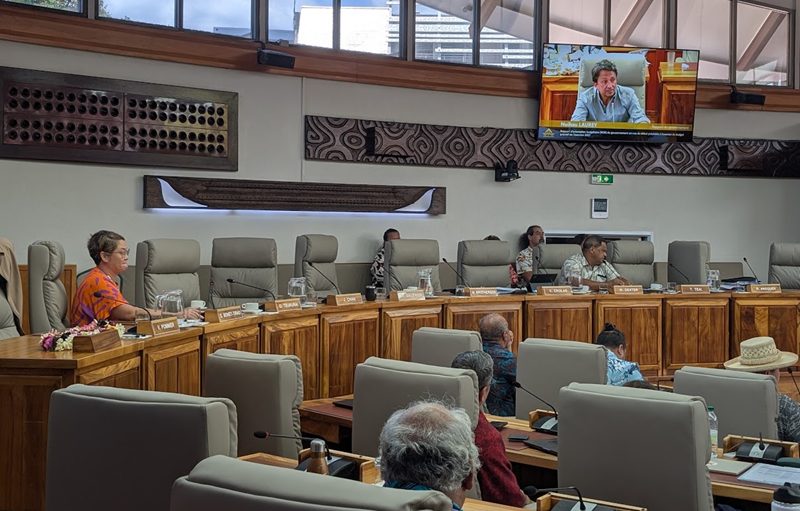
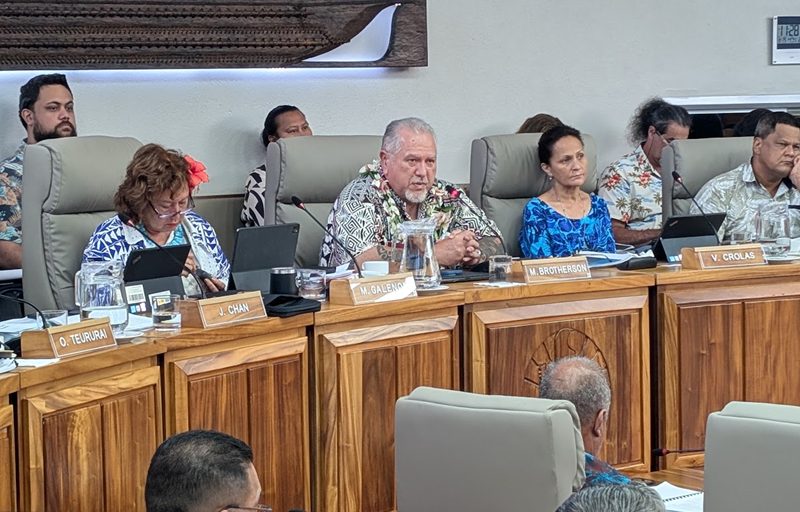
The budget orientation debate this Monday at the Assembly signals weeks of tension ahead of the adoption of the country’s 2027 budget. Tapura and Tavini criticized Moetai Brotherson’s lack of direction, who brushed aside the “incoherent injunctions” of the opposition. Social tensions and rumors of Vannina Crolas’s resignation, neither commented nor denied, did little to calm the exchanges, which were marked in late morning by a group departure of ministers at the call of Minarii Galenon. The executive eventually answered the lawmakers’ questions in the afternoon.
Although not as concrete and technical as the study of the budget project, which is due to begin in mid-November, the budget orientation debate sets the tone, each year, for the marathon of discussions that lies ahead at the Assembly. And judging by the exchanges this Monday, the atmosphere is likely to be heavy in Tarahoi by the end of the year.
Warren Dexter had briefly outlined the framework of the orientation report, already passed by the Economy and Finance Committee the previous week. Global tensions from Ukraine to Iran, billions of francs in spending aimed at maintaining, despite the rise in prices, pump prices at a level that “does not hamper activity,” concerns about the “state’s financial commitment,” in the middle of a national budget crisis and on the eve of presidential elections… The Finance Minister touts a lower inflation than elsewhere and an economy that is “still buoyant,” but still with a reduced margin for maneuver. And thus a need for prudence: the report calls for 10% cuts in ministerial budgets and belt-tightening on the part of public establishments.
Ceiling and Denial
Facing him and the rest of the full executive this morning, each group offered its own analysis. For Tapura, the report appears as a “nostalgic patchwork of promises awaiting fulfillment,” without a clear direction, and with numerous budget alerts, notably the heavy reliance on exceptional revenues to bridge the “slowdown” in tax receipts. No doubt for Tepuaraurii Teriitahi: the government, after riding for three years on the inherited economic momentum, has reached a “ceiling.” The Tapura representative vocally questions the forecasts of stabilizing the wage bill “in the context of current social tensions,” particularly in the health sector. And she believes Moetai Brotherson has buried himself in the denial of the failure of his actions:
Nuihau Laurey, for the “last budget to be exercised over a full year during the term,” analyzes, on her side, the lack of results in terms of employment, consumption, wages, and especially regarding the commitments made in 2023, from a government that benefited “margins of financial room that few administrations had known before him.” For the Tavini side, there is also, once again, questioning of the promises from the latest territorial elections, not kept by the sky-blue group, on purchasing power, local agricultural production, renewable energy, housing, and the defense of culture and heritage… “These are issues that touch the dignity of our people,” stresses Maurea Maamaatuaiahutapu. Only the Tematai Le Gayic group came to the government’s aid, recalling that the social, health, and economic problems denounced by the other groups “do not date from 2023” and deeming that the government had “put on the table solutions” on many points. The president of the A fano tià group and vice-president of the party created with Moetai Brotherson called for overcoming political cleavages, notably to reflect on the PSG’s future, after the assembly’s reversal on the reform of the RNS, which still awaits a decision from the State Council to be repealed.
“Contradictory Demands”
In response to these introductory interventions by the “opposition majority,” Moetai Brotherson, late in the morning, denounces “contradictory demands” from lawmakers who “ask us to increase spending and to cut revenues.” The president also questions the Assembly’s scant regard for the consequences of the current oil crisis, “which has already cost 13 billion,” and the attacks on a strategy to control fuel prices that aims “precisely to shield households from inflation” on electricity costs, fish, and purchases more generally. No detailed answer to the many questions raised by the groups: the president must leave the chamber to meet hospital practitioners gathered at the doors of the Assembly.
Maurea Maamaatuaiahutapu denounces, as she leaves on behalf of Tavini, the “now legendary contempt of the president,” and a posture that has not changed despite calm discussions in committee and the alerts of Collective 3:
“We can clearly see that there is a collective resignation.”
Even though the morning exchanges remained limited, the orientation debate was among the most heated. Moetai Brotherson, repeatedly asked about strikes in public health and in air travel, was also directly questioned about rumors of departures of Vannina Crolas and Minarii Galenon. Still no comment, still no denial, neither from the concerned parties nor from the country’s president. “They are here today,” Moetai Brotherson merely noted, surrounded by his Minister of Civil Service and his vice-president. The former, however, did address the issue of her resignation with the government and then with her cabinet in the middle of last week. In the corridors of the Assembly, many believed, this Monday again with no confirmation, that Vannina Crolas had agreed to remain within the government team until the end of the public health labor dispute, which her ministry is supposed to manage, given the statutory demands of hospital practitioners, and the long-announced withdrawal of Health Minister Raihei Ansquer, herself an emergency physician. Nothing indicates, however, that Minarii Galenon, who had indeed placed her resignation on the table at the same time as Vannina Crolas after the split between the Tavini and A Fano tià, is also on her way out. On the Tavini side, there is denial of any pressure on the two government members. “We can clearly see there is a collective resignation,” suggests Tepuaraurii Teriitahi, who believes that a new reshuffle would not help the government to find a “clear direction.”
Courage, let’s flee!
Discussions that escalated late in the morning after Moetai Brotherson and Vannina Crolas left to meet hospital practitioners. While Senator Lana Tetuanuia lamented the lack of response and the “nonchalance” of the country’s president toward the Assembly, Minarii Galenon asked her to wait for the head of government to return before making criticisms. After a series of interpellations, the vice-president asked the government to leave out of respect for our president. “Criticize us all, I take responsibility for it,” she said, before several ministers followed her out of the chamber, even though, at the time, the chair Bruno Florès had not yet called for a suspension.
Only Warren Dexter and Education Minister Samantha Bonnet-Tirao stayed to answer questions. “A first,” deemed “scandalous” by Lana Tetuanui, who sees there a “good summary” of the government’s strategy in the face of criticism: “Courage, let’s flee!” The senator even suggested, as did other elected officials, and after consulting the Assembly’s general secretariat, that the budget vote could be compromised if the government did not agree to return to answer the representatives’ questions:
Moetai Brotherson, Vannina Crolas and the rest of the government were eventually back after the lunch break, and they answered numerous questions from the elected officials in the afternoon. The fact remains that these initial exchanges do not bode well for a soothing study of the country’s 2027 budget project. It must be transmitted to the Assembly before November 15.