
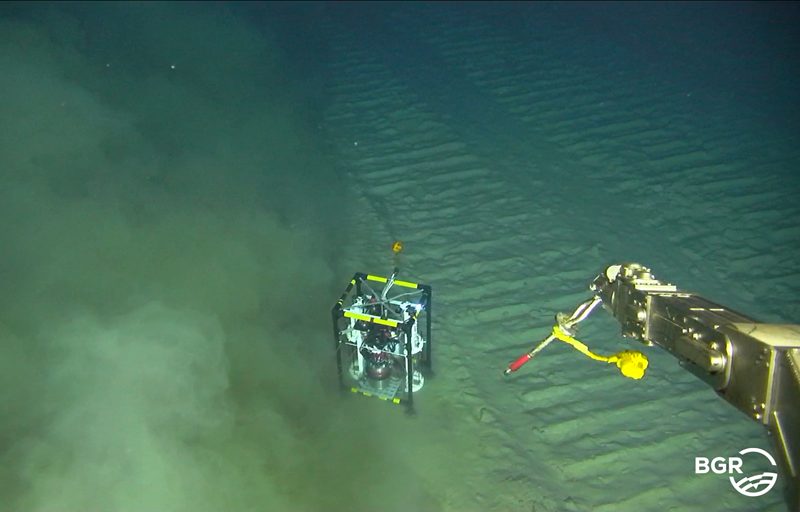
On Thursday, the United States granted, after unprecedented auctions, two mining leases covering 125,000 km² of federal waters off American Samoa. The startup Wetstone US Ventures, which spent $6 million for the two lots, will be able to commence exploration work aimed at a possible future exploitation of these seabed riches potentially rich in metals. This allocation, a first of its kind that is expected to set a precedent, occurred despite strong local opposition and a court ruling criticizing the failure to account for environmental risk.
This is a first in the United States: the Trump administration, which has long shown its intention to move forward with deep-sea mining, granted two permits covering more than 125,000 square kilometers of federal waters off American Samoa. The two licenses, both won by the mining startup Wetstone US Ventures for a total of $6 million, currently cover only mapping and exploration of the area’s resources – notably polymetallic nodules. But the permits are issued for 20 years and could lead, after another round of authorizations, to the exploitation of these “underwater mines,” as reported by Associated Press.
The project, long announced and presented as a means to secure American supply of critical minerals in the face of Chinese dominance, has sparked considerable reaction in this American “unincorporated territory.” Yet neither the opposition of local elected officials – including the governor of American Samoa, Pulaali‘i Nikolao Pula –, nor the mobilization of environmental NGOs, nor even a federal judge in Hawaii who ruled on Monday that Washington had violated the law by failing to consider the potential consequences of these permits on protected wildlife and flora, have caused the Trump administration to back down.
Upcoming auctions in Guam and Alaska and studies on permits in international waters
Because while this allocation is a first, it is unlikely to be the last. An auction is planned for December for mining concessions around the Northern Mariana Islands and Guam. A consultation was launched earlier this year with a view to potentially auctioning a permit for a broad area off Alaska.
Washington also intends to rely on its Deep Seabed Hard Mineral Resources Act to authorize companies to operate in international waters, bypassing the International Seabed Authority. Several American companies have filed applications in this sense with the National Oceanic and Atmospheric Administration (NOAA). Including American Deep Sea Minerals, which is eyeing the Penrhyn area located between the Cook Islands, which itself supports deep-sea mining, and the Polynesian EEZ, where a wide stretch has been classified as a high level of protection by the neighboring country close to the coveted zone.
In a statement cited by AFP, Doug Burgum, the U.S. official in charge of the file, described the awarding of the two first permits to Samoa as “a historic step for the United States’ energy and mineral security.”