
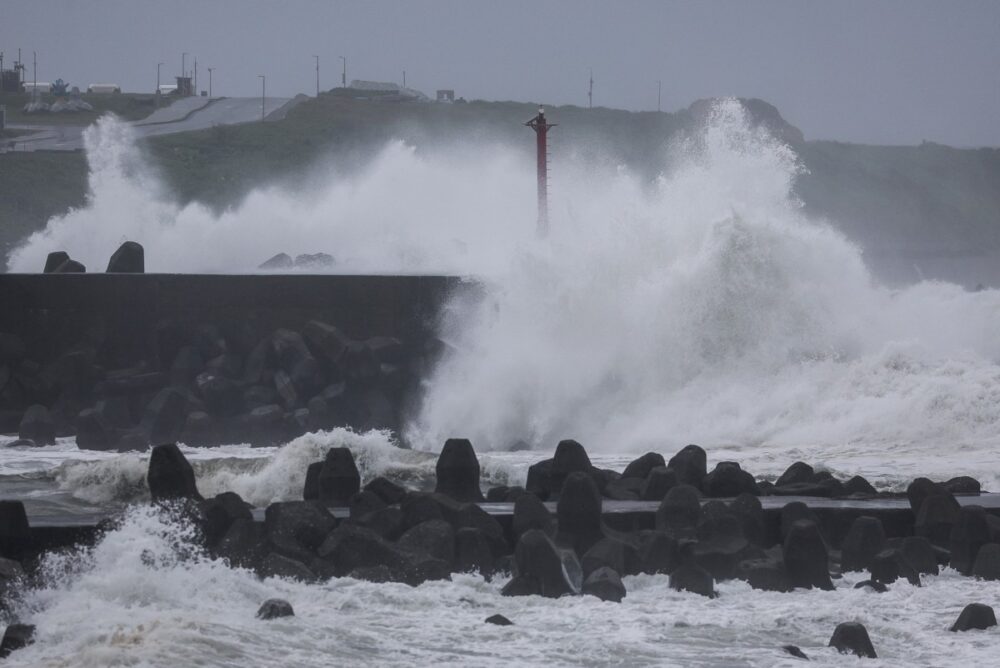
Typhoon Champi dumped heavy rains, uprooted trees, and left more than 21,000 homes without power as it swept through northeastern Taiwan on its path toward China and Japan.
Most shops and schools across Taiwan were closed, hundreds of flights were canceled, and more than 4,300 people were evacuated from their homes before the violent storm arrived.
One person in Taiwan was killed after being swept away by waves stirred up by the typhoon, authorities said.
At least 350 people were injured. “From tonight through tomorrow morning, conditions will be very windy and stormy everywhere,” said forecaster Ling Ping-yu of the Central Weather Administration (CWA) at a briefing. “Please stay indoors as much as possible during this period for your safety.”
Government text messages sent on Friday evening, as Champi battered northern Taiwan, warned of “destructive winds” and urged the public to “seek shelter as quickly as possible.”
Work and classes were suspended across almost the entire island.
The streets in the northern and northeastern districts of Taiwan were deserted as residents took refuge at home to wait out the storm.
“Sandbags”
“We may prepare some sandbags,” said Peter Chan, a 27-year-old convenience-store employee who told AFP he was worried about the conditions forecast for Friday night when the eye of the typhoon would be closer to Taiwan’s coast.
Champi briefly reached the status of a super-typhoon during its crossing of the ocean, with maximum sustained winds reported near 300 km/h, but has since weakened.
“As it approaches the northeast tip of Taiwan (…), the typhoon could slow down. If it slows, its impact will last longer,” warned Lu Kuo-chen, director of the Central Weather Administration of Taiwan, at a press briefing.
In Japan, several local events were canceled on Okinawa Island, south of the archipelago.
Stores were also closed on Ishigaki, the southern Japanese island near Taiwan, and merchants hung windbreak nets around their shops to protect them from gusts.
Some tourists were also stranded due to canceled flights. Many sought refuge in hotels.
“Hard to Get Back Home”
“Many shops and restaurants were still open yesterday, and I was able to stock up. But there isn’t much information online about the typhoon and what to do,” said Laura Czypulovski, 33, who lives in Zurich, Switzerland.
“Now it’s hard to get back home, especially because it affects my upcoming flights and has led to many reservation changes,” she added.
Storm chaser James Reynolds posted on X a video shot in Ishigaki, in the Okinawa region east of Taiwan, showing a “violent storm surge” in a channel leading to the island’s port, while Champi’s fierce winds whipped the surface of the water.
“I’m seeing the ocean do things I’ve never seen in 20 years of chasing storms!” he said in his post.
According to forecasts, Champi could dump up to 90 centimeters of rain from Thursday to Saturday, with northeastern Taiwan the hardest hit, the weather service said.
“People should know that strong winds and extremely heavy rains will continue into the first half of tomorrow,” warned Lu on Friday.
Thousands of military personnel remain on standby to participate in rescue operations.
Champi is the latest storm in what has been a particularly active Pacific season, driven by the climatic El Niño phenomenon, which has caused unprecedented warming of equatorial Pacific waters.