
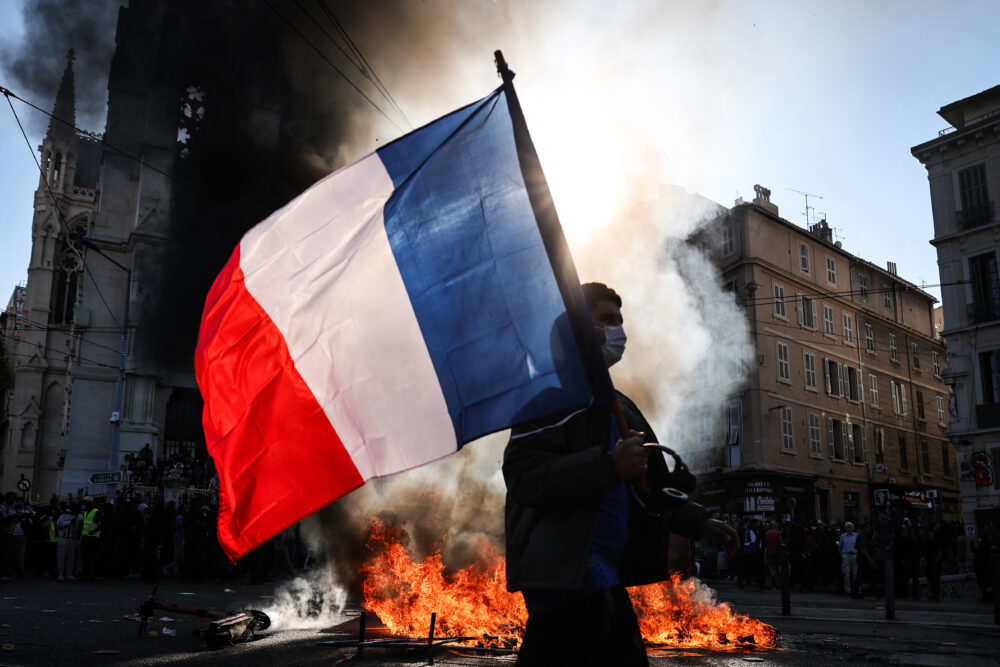
The “chaos” is “highly localized to urban centers,” according to Prime Minister Sébastien Lecornu, following an interministerial crisis cell.
As a result, he stated that he had “asked the prefects to trigger a number of curfews for tonight,” specifying that these would be “localized” and “partial.”
In the afternoon, the first curfews were announced in certain districts of Paris from 11:00 p.m. to 6:00 a.m., as well as in the center of Lyon and in Lille.
In the opposition, the Greens’ leader Marine Tondelier described the decision as “heavy with consequences.” “Before multiplying exceptional measures, the government must account for the operational and strategic decisions taken and the resources committed,” she said.
Sébastien Lecornu ruled out the setting of a state of emergency, but said he was ready to do so “if necessary.” Other demonstrations are planned: the Yellow Vests movement announced an “Act II” for Saturday, ahead of protests on October 31 and November 5.
This weekend, “at least 3,000 businesses” were affected by damage or looting, Serge Papin, the minister responsible for the sector, noted. Partial unemployment measures will be put in place for businesses starting Tuesday, along with a “specific support fund.”
During a meeting, the government will request several online platforms to remove listings for the resale of goods looted from shops. Vinted, Amazon, eBay, Leboncoin, Meta and TikTok are involved. The French Alliance of Trade Venues and the Federation of E-commerce and Distance Selling (Fevad) will be present. Asked by AFP, Vinted said it is applying “zero tolerance” in this regard.
Response Not Up to the Mark
With six months to the presidential election, the crisis has taken a political turn. For the opposition, the government and the security forces bungled the demonstrations and mishandled the ensuing violence.
Interior Minister Laurent Nuñez offered his mea culpa on Monday, acknowledging a “loss of control” in certain cities. But President Emmanuel Macron refused his resignation.
The administration is under fire, even from within its own camp: former Prime Minister Gabriel Attal said, “the government’s response is not up to the level of the situation. We must go much further to regain control without delay.”
Paris’ Socialist mayor, Emmanuel Grégoire, linked the violence to a “form of rot creeping into this social movement organized by the government.”
Raphaël Glucksmann, a social-democratic presidential candidate, argued that the “chaos” would benefit Marine Le Pen, the candidate for the National Rally (RN).
If the executive acknowledges flaws, it points at La France Insoumise (LFI), the radical left, which would bear “moral and political responsibility for the violence,” according to them.
“The far left is the cancer of our democracy,” stated the president of the RN, Jordan Bardella.
Sébastien Lecornu also accused the “movement of the far left” of seeking to sow “deep disorder” and “even call into question the timetable for the presidential election and its conduct.” A meeting on this matter, with the Interior Minister and the intelligence services, is planned for Monday evening.
In response, LFI candidate Jean-Luc Mélenchon expressed his “astonishment” and said he had “not heard anyone talk about that.”
International Resonance
The right-wing presidential hopeful Bruno Retailleau denounced “a convergence between the far left and riffraff” stemming from immigration, promising the loss of nationality for the “looters.”
In this tense context, Emmanuel Macron instructed the Prime Minister to bring together parties, unions, local authorities and parliamentarians.
Jordan Bardella warned that neither he nor Marine Le Pen planned to attend this meeting. The gathering with the unions was scheduled for Wednesday morning.
At the call of the Association of Mayors of France (AMF), thousands of elected officials and citizens gathered at noon in front of town halls across France, expressing their fear, solidarity and their desire for “order.”
To help local authorities cope with the damage, the government announced an exceptional fund to finance the reconstruction of destroyed public facilities.
The French crisis did not go unnoticed abroad: U.S. President Donald Trump wrote that “France is burning,” judging the country “broken” by immigration.
China urged its nationals in France to “increase vigilance against risks” and to “closely monitor the evolution of the local situation.”
Meanwhile, the European Union condemned the looting and fires, while calling on France to “protect” the right to peaceful protest.