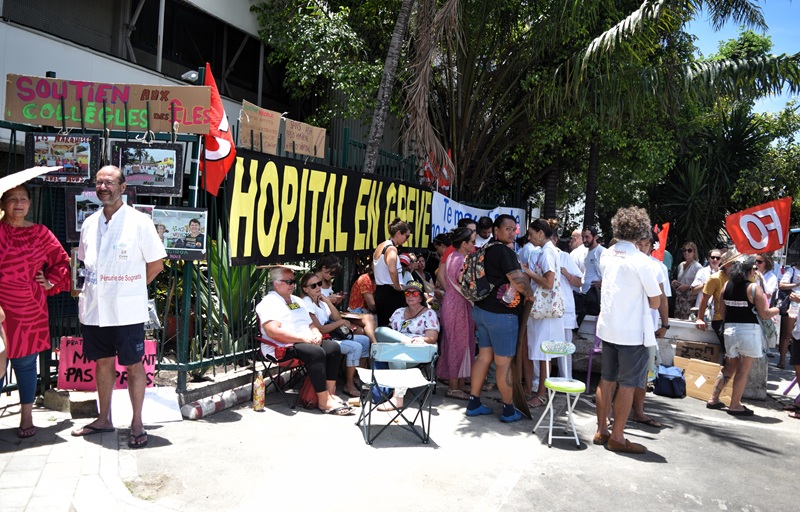
On the third day of an unlimited movement, the strikers from CHPF and the Health Directorate held a joint picket in Papeete, displaying their determination together. The mobilization, which is spreading to the islands, brings together several categories of caregivers, but the practitioners remain at the forefront. At Taaone, 138 of these doctors and hospital pharmacists were declared on strike this Wednesday, representing 75% of those on duty, many of whom refused their assignments, forcing the administration to request requisitions from the State. Only 82 non-practitioners joined them. On the Health Directorate side, the unions count “20% of the strikers in total, and one doctor for two”.
The movement in public health, mainly driven by the demands of hospital practitioners, does not seem ready to fade. This Thursday, late in the morning, the CHPF strikers joined those of the Health Directorate in front of their Paofai offices to present a united front. “It is the entire public health system that is on strike, not only the va’a ora of Taaone, but the va’a ora of every island,” emphasizes Jonathan Larson, hospital practitioner and general secretary of A Ti’a i mua-PH.
75% of CHPF practitioners on strike
Launched Tuesday by CSTP-FO and its Union of Public Practitioners of French Polynesia (SPPPF), joined Wednesday by A Ti’a i mua, the movement currently has no deadline. It is an “unlimited movement,” warns Dr Tony Tekuataoa, head of the CHPF emergency department and member of the Syndicat des praticiens publics de Polynésie française (SPPPF). According to him, such a mobilization of the entire public health system “has never been seen in Polynesia.” He sees it as “a cry for alert” and “a request for help” directed at the government.
Among the strikers are nurses, nursing assistants, and other categories of health sector workers, and the unions highlight the idea of a common movement for all caregivers. In practice, however, hospital practitioners (doctors, pharmacists, dentists working in public health facilities) are central to the movement. And reform of their status and the upgrading of their pay, in a context of recruitment difficulties in the public sector for years, is the main negotiating point. While the Polynesian Medical Board, as well as a group of young Taote Polynesiens, which has surpassed 100 signatures on its tribune, support the current claims, no other hospital professionals’ union has joined the mobilization. Several organizations, representing other caregiver categories or public health workers, including Fissap, the CHPF’s leading union, oppose the doctors’ demands, deeming them unfair and too costly.
A division is visible in the strike numbers, at least on the CHPF side. According to management, 138 practitioners were on strike this Wednesday at Taaone, i.e. 75% of those expected to work. Only 82 non-practitioners declared themselves on strike that day, out of a total CHPF workforce of 2,440 employees, including administrative and technical services.
“We are tenacious; we will not give up.”
Between the strikers and their employer, dialogue has been broken since Monday evening. After more than four hours of talks at the presidency, the unions declined a protocol proposing a 15% pay raise from January 1, 2027, with a renegotiation clause and the possibility of a second increase in 2028, when the budget horizon would be “more favorable.” This second tranche, the practitioners note, does not come with a firm commitment today. In any case, the offer is judged by the strikers as “not up to the stakes” of attracting medical professionals and the current shortage of practitioners. The government acknowledges the lack of attractiveness, partly offset, according to them, by several reforms, but insists it cannot go further in its proposals. Moetai Brotherson spoke Tuesday evening of “the largest salary increase in recent history” in the Polynesian civil service.
“We are tenacious; we will not give up.” explains Manu Nouet, a surgical consultation nurse and CSTP-FO representative at the hospital. He regrets not having heard from the president since Monday’s meeting.
Assignments refused, requisitions in the offing
At CHPF, tenured physicians on strike all refused their assignments, forcing the administration to ask the State to carry out requisitions. Director Hani Teriipaia describes this refusal as a “refusal to obey hierarchical authority.” This is “not symbolically positive for the values of a health institution,” she says, before recalling that this refusal constitutes a “professional fault” that could lead to disciplinary sanctions.
The doctors, for their part, defend this choice. “We are entitled to refuse assignments, and afterwards there are the requisitions that we do not refuse, of course,” replies Dr Tekuataoa, according to whom “the CHPF administration is in trouble.” This refusal was also intended to involve the high commissioner in the conflict and to send a “message of challenge to the supervisory authority”: “We want the government to hear us, but today, it does not hear us to the level of the stakes.”
The islands on the front line of the Health Directorate
In the Health Directorate, which employs 132 hospital practitioners, the mobilization is also real. Dr Jean-Marc Segalin, a physician at the Health Directorate and member of the SPPP board, counts “20% of strikers in total, and one doctor for two,” noting that these figures are incomplete due to the lack of reports from many islands. Some dispensaries in Tahiti are closed. Others, on Moorea, Raiatea, Huahine, or Bora Bora, operate in a “reorganized” mode. Each evening, the Health Directorate posts a situation update on its Facebook page.
For Dr Segalin, the claims of doctors go beyond salary. Including those who do not work in hospitals, whose “status is markedly less favorable than that of hospital practitioners.” They practice scattered across the islands, in “extremely difficult working conditions,” with “very high turnover,” limited access to training and career progression that is improving slowly, he notes. As a result, vacancies remain. “There is no doctor on Hao, Makemo, Rurutu… It is extremely complicated. And their salary level is lower than that of practitioners. Compared to other territories, we are far behind.”
Doctors also revisited the numbers cited on Wednesday by Dr Philippe Dubois, who works at Uturoa Hospital. The head of the Windward Islands Health Staff Union (SPISLV), affiliated with CSTP-FO, told our station, based on figures from the Ministry of Public Service, that doctors working in the public sector earn on average today “1.4 million francs per month gross, not including allowances.” But according to his colleagues, it is a mistake caused by confusion with indexing ratios. They did not wish to publish their real salaries and instead pointed to the online salary scales. Those scales indicate gross pay but not the allowances from on-call duties and on-call shifts that add to this base salary.
Lucie Ceccarelli and Charlie Réné