
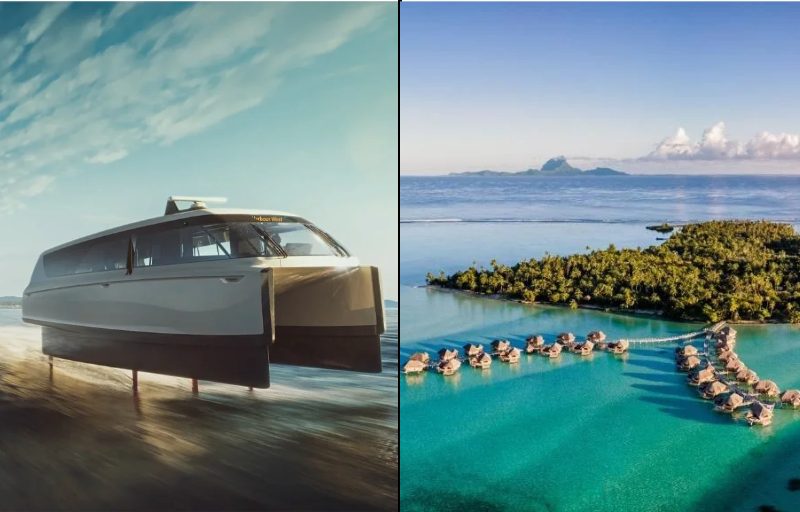
After Bora Bora and its solar catamaran, Le Taha’a by Pearl Resorts aims to replace one of its diesel shuttles with an electric hydrofoil vessel for transferring guests between the motu Tautau hotel and Raiatea airport. Named PolyNerf, this “zero-emission” project, recharged by a dedicated onshore solar installation, is one of the winners of the national call for projects to decarbonize maritime transport. The initiative is not isolated to the fenua: the Bora Bora municipality dreams of a foil- and hydrogen-powered shuttle to serve its airport.
Following its solar ships in Bora Bora, the Tahiti-based Pearl Resorts group seeks to develop a 100% electric hydrofoil shuttle on the island of Taha’a. It is intended to replace one of the diesel boats used by Le Taha’a by Pearl Resorts to transfer guests between the hotel on the motu Tautau and Raiatea airport, about 16 kilometers away. A journey of around 35 minutes that requires skirting along Taha’a and crossing the lagoon that separates the two islands.
This electric shuttle project, named PolyNerf, is among the 33 winners of a national call for projects to decarbonize maritime transport. Operated by ADEME on behalf of the Ministry of Transport, the Sea and Industry, the first edition of this call for projects titled “Investment aid for the decarbonization of transport and maritime services”, funded from revenues of the European carbon market, the ETS (Emissions Trading System), a system under which companies buy quotas for their CO2 emissions and to which maritime transport is now subject.
Of the 92 applications filed, 33 were selected: sailing freighters, shore power connections for major ports, or small service boats, including the luxury hotel on Taha’a, for which the amount of aid allocated is not specified.
The establishment, which currently operates three diesel shuttles, thus wishes to replace one with an electric “foil” boat. The principle: wings submerged under the hull lift the boat above the water as soon as it gains speed. Less friction, hence less energy consumed, and quieter navigation. A technology that has already been tested in Sweden, where Candela’s foil ferry convinced Stockholm’s city hall, according to the French Association for Electric Boats. The energy powering the boat would come from a photovoltaic installation dedicated to Taha’a.
Nearly a decade after Bora Bora by Pearl Resorts’ solar ships
This is not, in any case, the first time the group has shown interest in clean boats. About ten years ago, Bora Bora by Pearl Resorts was one of the pioneers of the kind with its solar catamaran Okeanos Pearl, a SoelCat 12 designed by the Dutch shipyard Soel Yachts, delivered in 2017 to take a dozen guests on lagoon excursions, with no emissions or engine noise. This project received the Best Innovation award at the first edition of the Tourism Trophies organized by the country in 2017.
The group’s head, Romain Vidal, argued at the time on the Advanced Maritime Technology International site that sustainable solutions were necessary for the hotels’ activity to endure, explaining that the catamaran had helped save on imported fuel and on maintenance. That is why, in June 2020, the group announced its intention to convert the entire Bora Bora hotel fleet to solar electricity, with Soel Shuttle 14 shuttles able to accommodate up to 24 passengers.
Two of them were delivered in early 2022, with a capacity for 22 guests and two crew, mainly serving airport transfers, according to Advanced Maritime Technology. But the rest of the regular rotations between the motu hotel and its base on the main island are still to this day handled by conventional boats, or even local providers.
Cleaner maritime transport also on the municipality’s agenda
These private solar-powered maritime transport projects mirror the Bora Bora municipality’s broader ambitions. In March 2025, Gaston Tong Sang presented the island as a “laboratory of the future” in which he wished to install a hydrogen production unit, powered by solar panels, at the Haamaire technical landfill site. Hydrogen intended to fuel airport shuttles, as well as the boats of the hotels and the municipality, to shift them toward cleaner and quieter propulsion.
The tavana, who then said he would prefer fuel cells powering electric motors rather than hydrogen engines deemed too noisy, also highlighted the interest in foils, which some Swiss manufacturers, such as MobyFly or Almatech, are developing for passenger transport.
| Electric-propelled ships at the heart of the Country’s Climate Plan
These projects fit into a broader, quantified assessment: according to the Polynesia Climate Plan 2030, maritime transport consumed 29.2 million liters of diesel in 2024, up from 22.9 million in 2010, i.e., 27% more, for around 98,000 tonnes of CO2 equivalent. The schooners that service the islands consume two-thirds of this. The municipal shuttles, meanwhile, remain marginal, with an estimated figure of 395,000 liters, while the figures concerning private hotel shuttles do not appear in the study. The Country highlights two levers to address this: electrifying the quays, starting with Papeete, and renewing the fleet. The Na Hiro e Pae, which must begin its first rotation toward the Austral Islands on December 6, with its 22-meter turbofoil and electric propulsion, is cited as an example. The Climate Plan also foresees studying green hydrogen for maritime and land transport, and the Country’s Innovation Strategy 2030 includes among its actions the engagement of the maritime sector toward alternative propulsion energies. While small shuttles weigh little in these figures, they remain visible as a showcase for the fenua’s tourism. |