
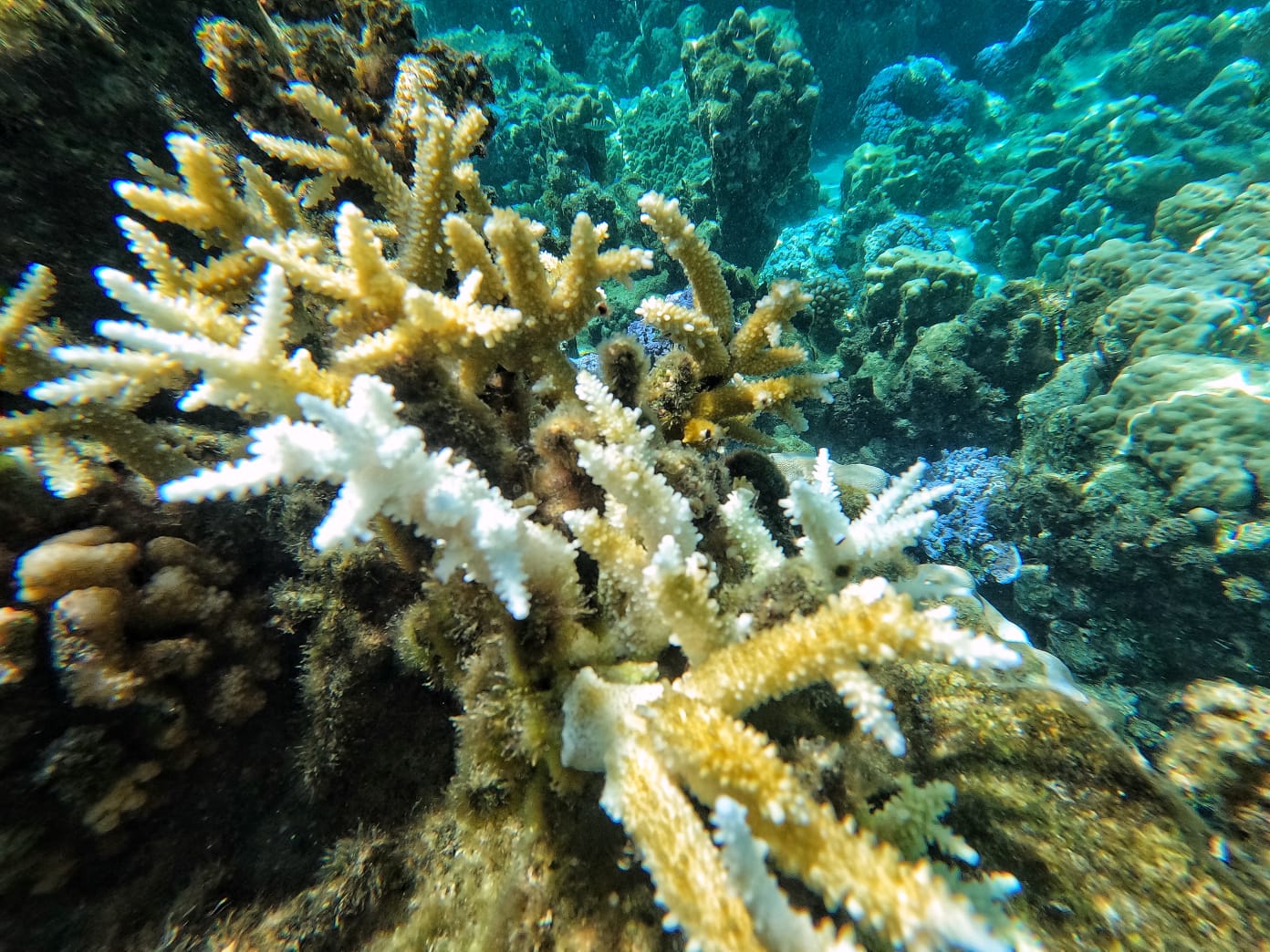
“It’s astonishing”, exclaims to AFP the lead author of the study, Daniel Collins, who still remembers the moment he saw the first positive results and ran to his thesis supervisor’s office to tell him the news.
Coral reef restoration, as barriers against erosion and reservoirs of biodiversity, is a broad field of scientific research. Current efforts focus on the use of artificial nurseries or the development of species more resistant to high temperatures.
By contrast, bleached corals have been largely dismissed because of their high mortality rates, explains Daniel Collins, who has instead demonstrated with his work that they “should really not be considered a lost cause.”
The results of the study, published in Science Advances, could well pave the way for a concrete intervention if it can be reproduced on a large scale.
Healthy Algae
Corals live in symbiosis with algae that provide them with the nutrients they need, as well as their color. Under thermal stress, these algae can produce toxins that cause the corals to expel them: this is bleaching. The coral then loses its ability to feed.
The method used by the Stanford team, in the United States, involves transferring healthy algae to the bleached corals.
Tests conducted with cauliflower corals are conclusive: after five days of contact between healthy specimens and those undergoing bleaching, the latter began a spectacular recovery.
Two things gave rise to this idea in Daniel Collins.
First, a study showing that plastic waste could contaminate corals by transmitting harmful pathogens. He then wondered whether it might be possible to reverse the process by transferring beneficial elements.
The second source was a fortunate accident observed by one of the study’s co-authors, Stephen Palumbi: he noted that two corals, one healthy and the other not, had toppled and touched, and the bleached one had begun to recover.
Scaling Up
A minimum of three days of contact between two specimens is necessary for the bleached coral to begin healing, and after five days it is truly recovered.
Researchers observed the phenomenon under the microscope: after one to two days of contact, the coral tissues fuse, creating a “nutrient bridge.”
But the study quickly revealed significant limitations.
For instance, direct contact between the corals was required. A gap of a few millimeters between the two specimens was enough to block any recovery.
Moreover, the phenomenon only works between two corals that share the same genetic heritage. If not, the specimens trigger stinging cells, a reaction similar to organ transplant rejection in humans.
The main challenge will now be to reproduce this laboratory finding at a large scale.
“It is unlikely that we would place corals in contact with each other on reefs in the open sea,” notes Daniel Collins.
Nevertheless, it is possible to extract the algae that live in symbiosis with the corals and cultivate the healthy ones. The team is now considering ways to reintroduce them to bleached corals.
This solution could also address the issue of genetic heritage, which applies only to corals and not to the algae.