
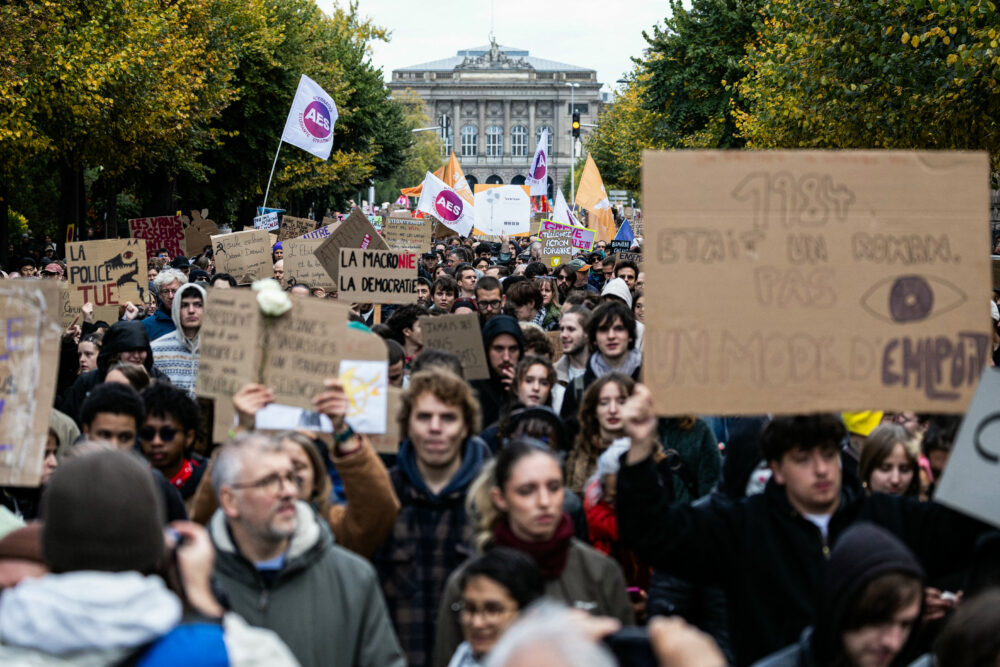
Not wanting to relive the images of clashes, fires, and looting by hordes of rioters that had circled the globe, authorities mobilized 70,000 police and gendarmes, about 20% more than the previous week, for this second act.
“The parades went smoothly,” judged Interior Minister Laurent Nuñez on Saturday evening.
The number of demonstrators did not rise. In total, the CGT union counted 800,000 protesters nationwide, the same as a week earlier. For its part, the Interior Ministry counted 410,000 protesters on Saturday, compared with 550,000 the previous week.
In the various cities where protests had been authorized, the marches mostly unfolded calmly until late afternoon, amid storefronts some of which were barricaded to prevent looting. Traditionally, the endings of demonstrations can provide an opportunity for rioters to act.
“More than 500 rioters” began attacking the police at the end of the Paris march, according to police. They also attempted to attack an Audi car dealership.
Earlier in the capital, nearly 110,000 people gathered according to authorities, 250,000 according to the CGT, for this mobilization that again brought together different movements—high school students, university students, unions, the yellow vests—and which left-wing parties intend to exploit in view of the presidential election in six months.
In Marseille, Rennes, or Lille, protesters with sometimes disparate demands insisted on their right to protest.
In Rennes, Emma, 23, said she was angry about everything that is happening at the moment, denouncing protest bans and the repression of high school students.
“Neither the president, nor the weather, will stop me from protesting,” argued Delphine, 47, in Lille, at the head of the march.
Presidential Election in Sight
Facing the risk of spillovers, authorities permitted only certain demonstrations. They intensified bans on gatherings or imposed curfews, drawing accusations of authoritarian drift from the radical left.
In this generally calm panorama, a few sporadic incidents nonetheless erupted in Lyon (east), where demonstrations are prohibited, or in Nantes.
The union security services were also present to supervise the demonstrators and try to keep violent elements at a distance, as in Bordeaux, where this longtime CGT member, flag in hand, warned two masked and black-clad youths: “We are here despite a ban on protesting, so we are not here to act flashy, so you don’t mess things up.”
Six months before the presidential election, the leader of the radical left, Jean-Luc Mélenchon, threatened Emmanuel Macron and the government with even more demonstrations.
“It is time to concede,” said Emmanuel Macron, the presidential candidate at the head of the Paris parade, otherwise “he will understand that this will repeat every week,” and “what awaits them is a general strike.”
Since the start of the movement, the government has accused his party, La France Insoumise (LFI), of fanning the flames. Jean-Luc Mélenchon, 75, is running for the fourth time for the presidency. According to polls, he is well placed to reach the second round against the favorite, the far-right candidate Marine Le Pen, but loses in the finale.
Orléans
The general tension across the country rose again the day after a racist terrorist attack, in the words of President Macron, which left one dead and five injured in Trappes, in the Paris region, and whose author apparently aimed at people from immigrant backgrounds.
The city of Orléans (central) is also a focal point of the day. The National Rally (RN, far-right) of the presidential favorite, Marine Le Pen, was holding its congress there.
Around 13,000 people, authorities said, marched peacefully to denounce it, with officials and certain banners linking it to the Trappes attack, while LFI leaders frequently accused the RN of racism.
Marine Le Pen, also a candidate for the fourth time, is tipped to win by various polls.
Emmanuel Macron hosted for the first time on Friday representatives of high school students, whose mobilization has been one of the drivers of the protests. His entourage promised concrete decisions for Monday.