
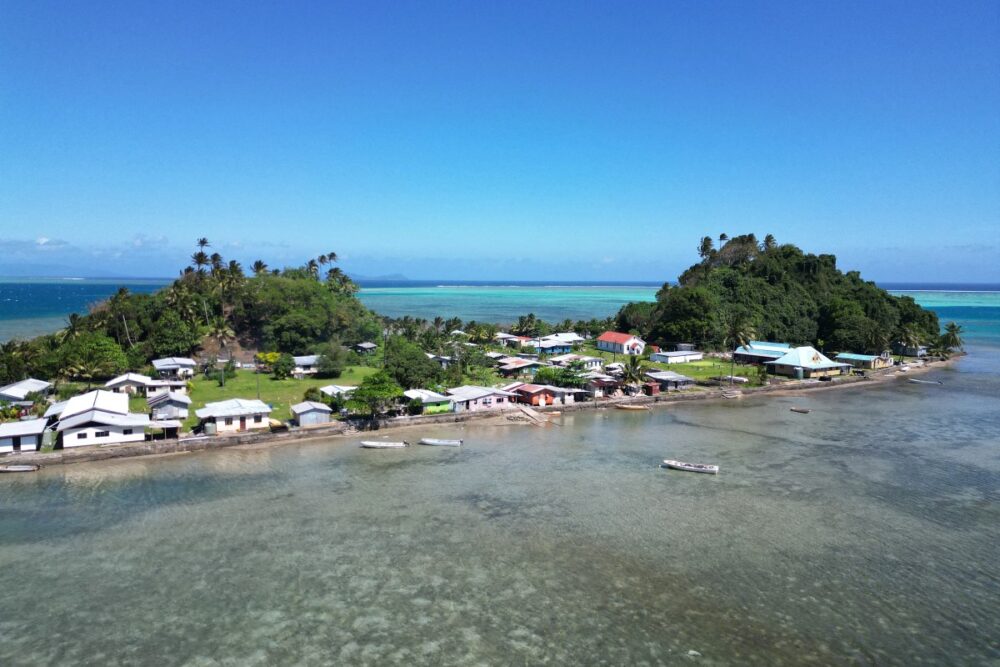
Seen from the land, that is from the archipelago’s main island located just to the north, Serua is idyllic: two steep hills covered with palm trees frame the island’s low-lying center, bordered by coral reefs teeming with fish.
But as soon as you step ashore, the risks tied to rising sea levels become visible: a concrete seawall is the only shield against the waves.
“The higher the atmospheric pressure, the higher the waves. They then surge into the heart of the village.”, explains to AFP Avenai Ranuku, a resident of the island.
When cyclones strike, dozens of houses, market gardens and graves are threatened.
Water licks the concrete piles where homes and a hospital once stood at the eastern end of the island. Two houses have been moved from the western side, where the land has been washed away.
When he was younger, in 2016, Mr. Ranuku watched Category 5 Cyclone Winston strike the island. The population had sought refuge on one of its peaks. “It was terrifying.”
“As soon as the chief announced it, we went up with all the villagers. No one was left behind,” he recalls. “We help everyone, we carry everything from the houses, the food. That’s our evacuation plan.”
There, in safety, Avenai Ranuku heard “the waves crashing all around and the roofs of the houses swept away by the waters.”
Pure Air
Sea levels are rising at a record pace, driven by warming oceans and melting glaciers, according to a report from the UN Secretariat released in August. In the Pacific, Fiji, like elsewhere, these changes are already a reality.
But the threat of cyclones and rising waters is not enough to convince Serua residents to relocate. Quite the opposite.
“We love this island, you know,” explains Mr. Ranuku from the same summit refuge, “the pure air, fishing every day, that’s why we don’t want to leave.”
“Many people used to say they went to that hilltop house to watch the sunset: it’s a view worth 100 million dollars.”
Constant Threat
In 2025, the village of Serua partnered with Habitat for Humanity to develop a detailed disaster-risk-reduction plan, with most residents rejecting relocation calls.
They prefer to protect their ancestral home and their culture, deeply intertwined with this land.
The island “lacks natural breakwaters (and) is constantly threatened by sea-level rise and cyclones,” the report states.
“Serua experiences more frequent dike overtopping during high tides and extreme tides, saline intrusion affecting soil fertility, and stagnant waters after rainfall, which increases health risks,” he notes.
He details that “more than 50% of the homes have both unstable foundations and roofs, as well as joints, walls and bracing that are fragile, making them particularly vulnerable to cyclones and extreme weather events.” Only three houses are capable of withstanding them.
Armed with these findings, the village immediately set to work.
In October 2026, the AFP observed dozens of workers renovating homes along the northern coast.
Fragile walls and corrugated-iron roofs are dismantled and then hauled away by boat.
Some houses have already been elevated to reduce flood risk, with others to follow soon.
“Why would we want to leave?” says Avenai Ranuku, gazing into the distance. “We have a view that’s worth 100 million dollars.”