
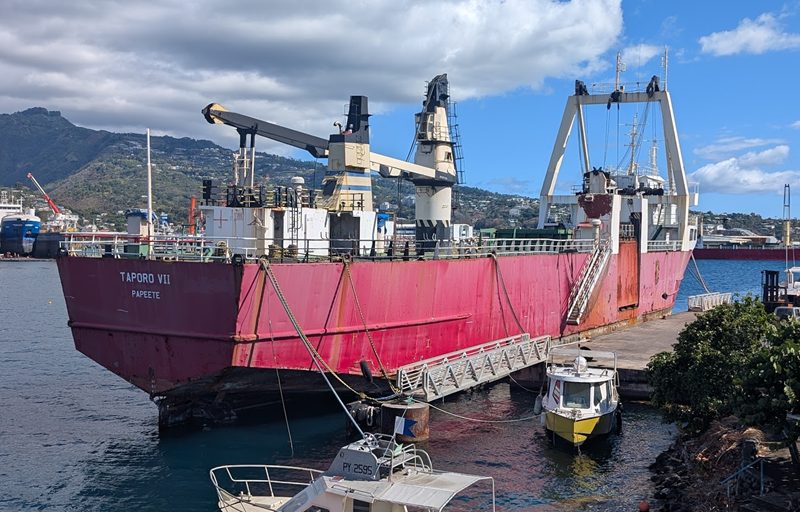
Leaving the port, but going where? This is the question facing Taporo VII, which, following a decision by the administrative court, has 60 days to vacate the port district, under threat of a daily penalty of one million francs. CFMT will appeal, and has already warned that if it can no longer maintain the schooner, immobilized since 2022, it risks sinking for good. The shipowner clings to the idea of oceanizing the wreck, rejected by the country and the state. The court considers that transporting it abroad on a dedicated, specialized vessel, although financially costly, remains a viable solution.
It is a schooner that has become quite burdensome since it sank, then was partially burned, at the quay in March 2022. The ship of the Compagnie française maritime de Tahiti, built in 1978 and put into service in Polynesia in 2001, has never resumed its rotations to the Raromatai. And the autonomous port has grown impatient. Last year, the public establishment had requested and obtained, in summary proceedings, the eviction of the vessel from its berth to free space for inter-island cargo ships in working condition. It had been moved to the transit quay, but the port continued its underlying judicial proceedings. This Tuesday, the administrative court therefore ordered CFMT to remove the ship from the port district. Upon notification of the decision, the shipowner will have 60 days to comply, after which he will have to pay no less than one million francs in daily penalties for delay. The question, which has been the subject of all the debates during the October 13 hearing, and remains relevant today: leaving the port, but going where?
Existing technical solutions… but financially out of reach
Because if CFMT had asked the autonomous port for time, it was primarily to “find solutions.” First financial, by pursuing its lawsuits in Europe against its insurer, which refused to cover the 2022 incident. Then logistical: the owner awaits a decision of the Paris Administrative Court of Appeal on the country’s and the state’s refusal to authorize sinking the Taporo VII wreck at sea. This “oceanization,” for the owner, is the “only viable solution” for the schooner’s end of life, since local dismantling channels are not suited to a ship of 80 meters, and dragging it to an overseas approved cutting site is, according to CFMT, too risky.
The problem is that authorities reject any immersion of wrecks since the Kura Ora II scandal in 2019. The autonomous port wants nothing to do with it: its district is limited, the inter-island fleet is growing, quay space is in high demand… And evacuation solutions exist, had estimated the institution’s representatives, citing in particular the transport of the Taporo by a specialized semi-submersible vessel. The court agrees this Tuesday in that sense, confirming, on the basis of a 2024 expert report, the existence of technical solutions. “The cost of such an operation cannot absolve CFMT from the obligation to cease its occupation without right or title of the public port domain,” the judges state.
Risk of “worsening the situation”
L’armateur devrait selon toute vraisemblance faire appel à Paris de cette expulsion, et demander un sursis à exécution de la décision prise à Papeete, puisqu’en matière administrative, l’appel n’est pas suspensif. Lors de l’audience du 13 mai, l’avocat de la CFMT, Me Quinquis, avait pointé qu’une telle décision ne ferait « qu’aggraver la situation », en précipitant la liquidation de l’armateur, et en risquant, si le navire venait à être déplacé et à être amarré à un quai qui ne permet pas un entretien régulier, de le voir sombrer « pour de bon ». L’avocat avait aussi rappelé que la compagnie fondée par Morton Garbutt, avait tenté, à la fin des années 2010, de revendre ses Taporo au groupe Brasserie qui devait investir dans le renouvellement des bateaux, avant que l’APC ne « l’en empêche ».
Il faut noter que le port autonome n’applique pas son grand ménage qu’à la CFMT. Ce mardi, le tribunal administratif a aussi ordonné, à la demande de l’établissement public, au groupe Degage de dégager cinq de ses navires non utilisés, dont le Matira, le Kiri et le Faimanu VIII, de la circonscription portuaire. Ils sont actuellement amarrés au ponton Sopom, près du pont de Motu Uta, et leur expulsion est prononcée sous 45 jours avec une astreinte de 500 000 francs par bateau. Le cas de l’ancien navire de croisière Haumana, dont le port autonome demandait aussi l’expulsion, mais qui appartient à une société distincte, sera traité dans une future requête.