
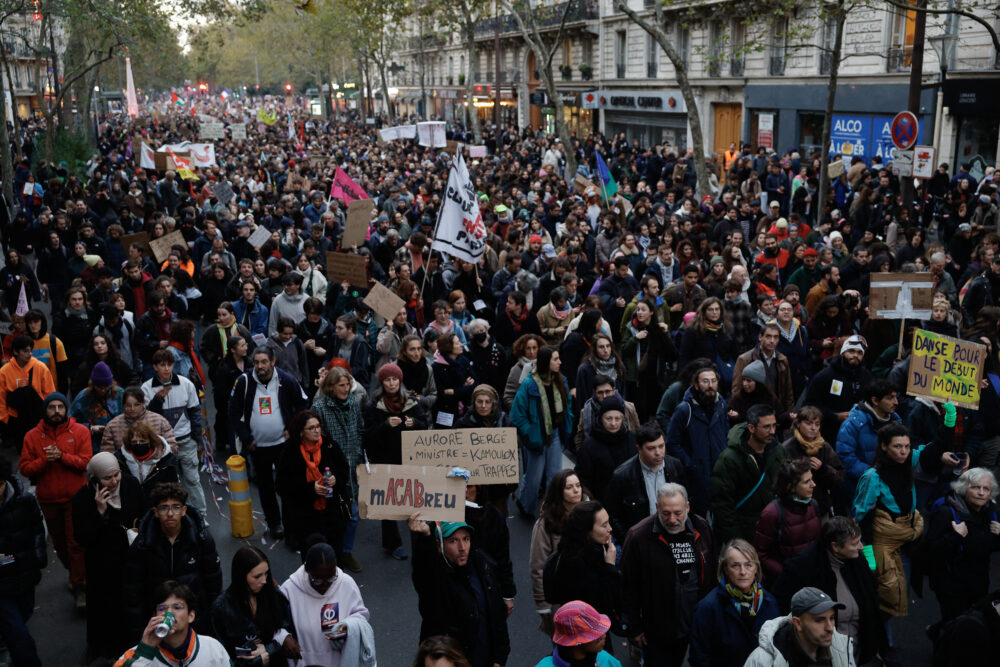
The Ministry of the Interior counted 575,000 protesters nationwide (including 65,000 in Paris), more than on October 17 (550,000), October 24 (410,000) and October 31 (320,000). The CGT union, for its part, put the figure at 1.6 million demonstrators, including 350,000 in the capital.
This day could be the culmination of a very heated autumn of social unrest in the euro zone’s second-largest economy, burdened by debt and under close market scrutiny to clean up its finances.
The CFDT and CGT unions, among the organizers of the national mobilization which they dubbed a success, are demanding a substantial rise in the minimum wage (SMIC), and beyond that an increase in all wages.
The conference, announced by Prime Minister Sébastien Lecornu, aims to “provide answers to questions of purchasing power and wages,” his services stated.
“The question being asked today isn’t ‘will we win?’ but ‘how much will we gain?’,” said Sophie Binet, the CGT’s spokesperson (a dissenting voice), who is demanding “a 10% increase of the SMIC.”
Her counterpart at the CFDT (moderate), Marylise Léon, is asking for a 100-euro boost to the SMIC and calls for “concrete answers” to address the current difficulty of the French people “to make ends meet.”
“A Living Wage”
Determined to avoid new riots like those of October 17, the Minister of the Interior, Laurent Nuñez, had announced the deployment of 70,000 police and gendarmes, promising “an extremely firm response” to possible “outbreaks.”
“I want something to live on,” says Fred, soon to be retired and marching in the capital. “For years, I can’t afford restaurants or leisure. I can only eat and have a place to stay.”
The Paris demonstration began with a minute of silence for the victims of the recent racist attack in Yvelines, in the Paris suburbs.
Brief tensions erupted and vandalism was carried out along the route, where the police intervened “to stop the excesses and isolate the troublemakers,” according to the police prefecture.
In some other cities, the processions were marred by violence, such as in Lyon (east-central) where between 30,500 (prefecture) and 55,000 people (CGT) demonstrated. An AFP photographer, wearing a “press” armband, received five blows from a baton during a charge by anti-riot police.
In Rennes (northwest), clashes intensified in the afternoon as the demonstration, which gathered between 20,600 (prefecture) and 35,000 people (unions), had begun in good spirits.
In Bordeaux (southwest), where 21,000 (prefecture) to 120,000 people (CGT) marched, Morgane and Tania, social workers aged 30 and 29, spoke of precarity, housing access, and climate change.
“People are doing poorly. I meet people who are relieved because their children at least have a full meal thanks to the canteen, but I can’t stand that,” laments Tania.
This first call to unite the public and private sectors drew in high school and university students, Yellow Vests who have renewed protests against the cost of living for three Saturdays in a row, and farmers as well.
Nearly a thousand high schools were blocked or administratively closed on Thursday according to Snes-FSU, the main union of secondary education, while the government counts only 81 out of 3,700 across the country.
A third of higher education institutions were “disrupted” according to the government, with the Student Union reporting “90%” of the roughly 70 universities “mobilized,” i.e., blocked or closed.
The unions’ call to end work was followed unevenly: about 16% of teachers were on strike according to the Ministry of National Education, with Snes-FSU reporting 52% of strikers among middle and high school staff.
Echo in Europe
Transport was only lightly disrupted, with “more than one in three railway workers on strike at SNCF” (National Society of Railways), Romain Pitelet, CGT Cheminots’ deputy general secretary, told AFP.
As for tourists hoping to visit the Eiffel Tower or the Arc de Triomphe, they were disappointed: the two Parisian monuments remained closed.
Between rising fuel prices and a proposed austerity budget, purchasing power sits at the heart of the social discontent, which has intensified since the end of summer.
One in two people say they are barely getting by with their household resources, according to a barometer published on Wednesday. The protest movement resonates across Europe.
Under a banner reading “From Greece to France, we fight for publicly funded and free education,” about 4,000 people demonstrated Thursday in Athens and Thessaloniki, Greece’s second city, according to police and AFP journalists.
Protests against the cost of living and for more resources for education also occurred in recent days in Germany, Belgium and Italy.