
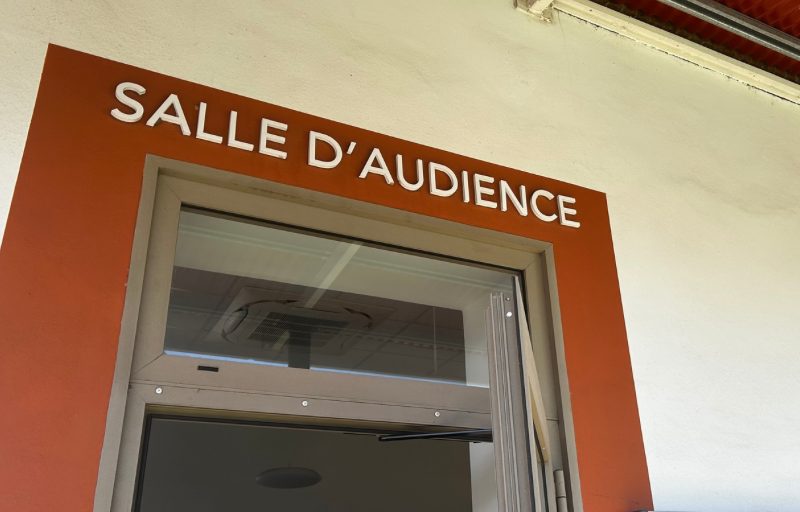
After 12 days of strike action, Air Tahiti and the CSIP had a hearing scheduled this Tuesday at the court. In front of the interim judge, the union accused the company of facilitating the circumvention of the law to lessen the effects of the movement launched more than 10 days ago. Air Tahiti denied it, pointed to a lack of evidence, and denounced the instrumentalization of justice to shape public opinion and weigh in negotiations. The decision will be rendered Thursday at 2:00 p.m. Meanwhile, negotiations continue without any sign of agreement.
Lire aussi : Strikebreakers “foreign”? Airlines deny, CSIP takes legal action.
Never two without three? No: the lawyers for Air Tahiti and CSIP were finally able to plead before the interim judge of the Papeete district court, this Tuesday afternoon. CSIP had summoned the local company for a summary hearing on Thursday the 29th, and an initial hearing had been scheduled the following day. It had been postponed, at the request of the confederation, allied with the union of commercial flight crew and with O oe to toe rima in the strike that began on October 22. It was then to take note of the conclusions filed by Air Tahiti’s lawyers. On Monday both sides were ready at first light, but this time the magistrate in charge of the file, Nathalie Tissot, had requested the postponement to study new lawyers’ submissions also received late. The third hearing was therefore the right one. At 2:00 p.m. this Tuesday, the two lawyers could plead, starting with Me Usang, representing the CSIP.
“A route to circumvent the law”
According to him, Air Tahiti must bear its “responsibility,” that of having “facilitated the execution of offenses.” For several days, Cyril Le Gayic’s union has denounced the presence on the Tahiti-Faa’a tarmac of “foreign” personnel. From Air New Zealand spotters, to an Air France agent arriving from the Caribbean, accused of being there to perform tasks that the domestic carrier—also a ground handler for international airlines—would not be able to accomplish due to the strike. In plain terms: strikebreakers, though employees of third-party companies, but who have Air Tahiti equipment, notably the devices used to push back aircraft on the runway. For the CSIP’s lawyer, these rental contracts allowed circumventing the prohibition in the Labor Code against replacing strikers with fixed-term contracts or temporary workers.
“Air Tahiti acknowledges renting this equipment. This equipment cannot operate by itself, so Air Tahiti provided the equipment to the other companies, which is a way of circumventing the law,” explains the lawyer, for whom the relationships between the local operator and the international airlines are not merely a simple provision of equipment.
The union, which also questions the legality of the work performed by these external agents at Tahiti-Faa’a, did it “miss the target” in its procedure? No, replies Me Usang, for whom the action of the international companies is “not the point.” He nonetheless calls on authorities, particularly at the national level, to address more generally the question of the presence of these external workers at Tahiti-Faa’a. “We bring in staff from abroad, who are not French nationals and who work without a work permit in breach of the local employment protection law,” the lawyer notes.
« Aucune preuve. C’est zéro »
Readings sure to be contested by Air Tahiti’s defense, which argues that they merely answered a request to rent equipment from client airlines. And above all, that they continued to operate with their own staff. The company has “the right to rent equipment, and that is what we did,” sums up lawyer Me Yves Piriou briefly. He thus disputes any intention to circumvent the law to replace the strikers and points, beyond the rhetoric, to the fragility of the concrete elements advanced by the union. No employment or interim contract, “No proof. It’s zero,” he insists.
For the former bar president, the only material element on the table is the rental contracts produced by Air Tahiti: “Nothing to hide, we provided them with the proofs.” The lawyer also believes that the union chose to target Air Tahiti not for legal reasons, but in a logic of weaponizing the conflict. He argues that “they thought they had nothing to lose” by taking the matter to court.
A procedural path whose aim, in his view, would be to shape public opinion around the strike rather than to establish an offense. “They had no reason to go after Air France or Air New Zealand since it would have served them nothing. In front of the courts, it’s different,” he notes, underscoring that the accusations must be backed by concrete elements. “The law is on our side,” he asserts, convinced that the airline’s legal arguments will eventually prevail.
Me Usang intends to carry the judicial fight forward if the tribunal does not side with the union. He already announces his intention to appeal in case of defeat, stating that “there is no question of losing.” The lawyer does not rule out a criminal action either, with the filing of a complaint “against X,” so that accountability can be pursued since “the Tahiti airport and the Civil Aviation Authority are silent in this case.”
Thus, both sides leave the hearing relatively confident, with the decision due this Thursday at 2:00 p.m. While negotiations continue, they keep meetings scheduled for Tuesday and Wednesday. After more than 12 days of strike action, the unions remain “as motivated as ever” on the picket line, asserts their lawyer.