
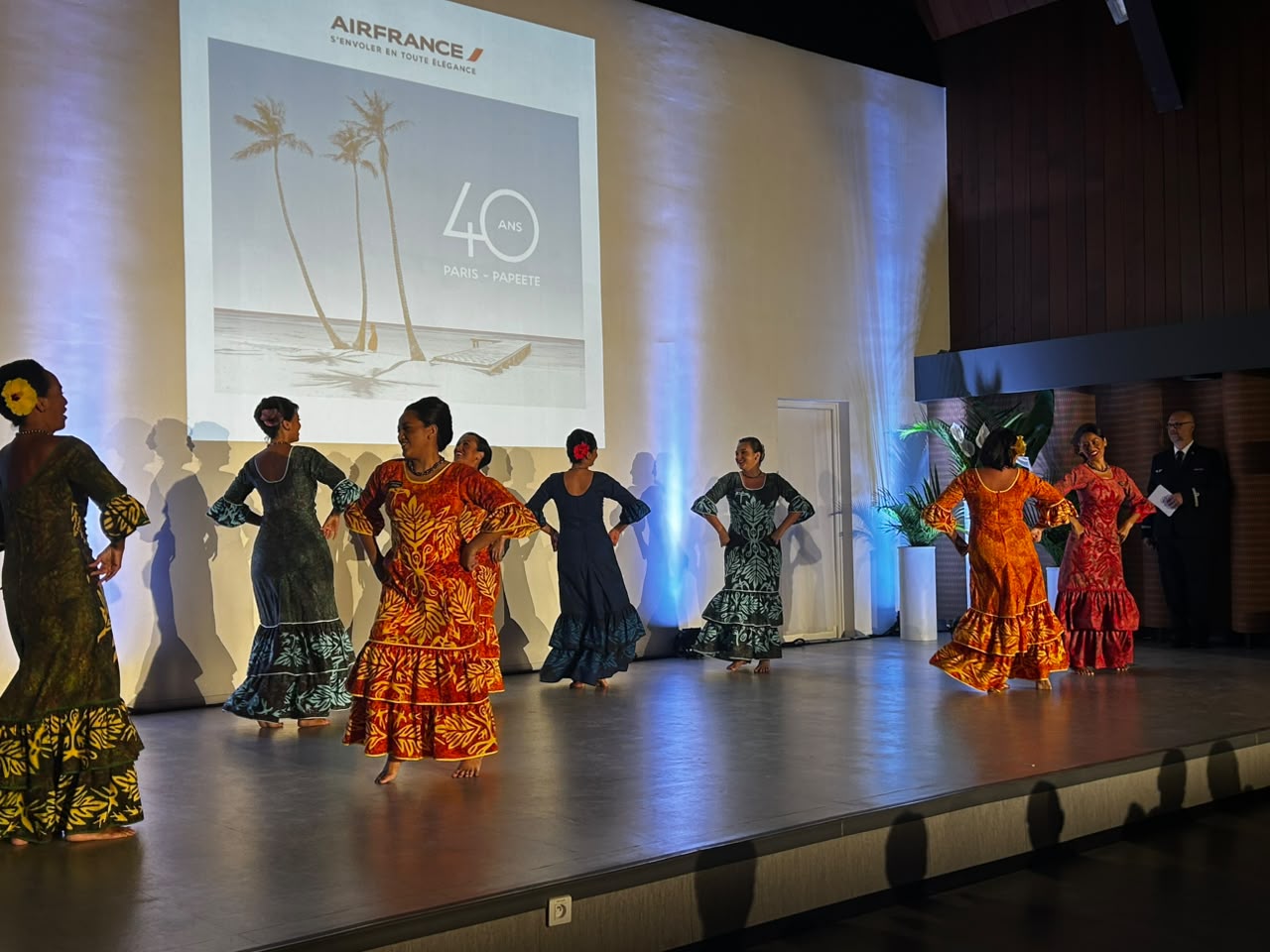
Air France’s Papeete-Paris route celebrated its 40th anniversary this Friday evening at the Musée des Îles. A lavish anniversary that allowed the unveiling of six new Purotu dresses, the iconic uniform of Air France Polynesia’s cabin crew. From design to tailoring, the 100% locally made bespoke pieces stole the show from the two leaders of the group who had traveled specifically to celebrate “a milestone in a magnificent story that will continue to be written, count on us.”
Lire aussi : Rava Ray relooke les robes purotu d’Air France
“ Forty years old is a good age,” rejoices Sébastien Guyot, head of France, international markets and global sales at Air France-KLM (AFKLM). “We are rich in experience, and we still have many projects in mind.” The representative of the commercial function of the Franco-Dutch company traveled specifically for the celebrations held Friday evening at the Musée des Îles, in the presence of the High Commissioner, Alexandre Rochatte, of Myriam Namri, deputy director of the Directorate of Civil Aviation (DAC) representing the country, and of Alexandra Martino-Roussel, regional director of Air France in Polynesia. He was accompanied by Nicolas Henin, general manager of the North America region, to which Papeete has belonged for four decades.
Since the arrival of the first Boeing 707 and its 184 passengers in 1966, the Papeete-Paris route has always stood out within the AFKLM ecosystem. Besides being the airline’s sole route split into two legs with a stop in Los Angeles, it is also the only exception to the standard uniform rules. Beyond takeoff and landing, where the cabin crew wear the blue uniform imagined by Christian Lacroix, Air France hostesses wear the purotu dress, with bright colors and floral patterns. For Nicolas Henin, these outfits are “an identity, an ADN.” “It’s what our customers endorse and that’s how we differentiate ourselves.”
Six new Purotu dresses presented in a dance
In use since 1992, the model keeps its shape, tailored for each cabin crew member. It’s the print, conceived by Rava Ray, a master artisan of tifaifai, that evolves starting this Friday. Air France thus ensures “creation and local manufacturing entirely.”
“The six colors will be made available to our cabin crew, who will be able to choose their preferred color. On the outbound Los Angeles–Papeete and in the opposite direction, they will give our passengers the opportunity to truly touch Polynesian culture as soon as they board,” says Sébastien Guyot, who is especially admiring of the presentation’s ‘aparima’ routine.
It was the hostesses, stewards and ground staff of the company who animated the evening by walking the runway, notably in collection uniforms, including three purotu dresses among creations by major houses such as Dior and Balenciaga. For Nicolas Henin, there is no question of not preserving and promoting this uniqueness: “I can assure you it makes a huge difference and the feedback from customers is ultra-positive.”
A ramp-up to stabilize
While the Paris–Los Angeles link has introduced the “La Première” cabin experience, the head of the Americas region says the airline is pulling out all the stops on improvements, notably the “connecting product” with a brand-new Los Angeles lounge, considered the most beautiful in the network today.
The aim is to attract Polynesians by ensuring their connectivity through KLM partners, such as Delta, including domestic U.S. flights. More importantly, it aims to respond to demand from the American continent, “it’s a market we have developed a lot in recent years, with all the connectivity we can offer with our partners to all American cities, and it’s true that we’ve noticed a growing appetite,” notes Nicolas Henin.
With a ramp-up since the end of the Covid period, the route to Paris has moved from three rotations in 2025 to five since mid-year and seven planned for 2027, including one operated by a French crew. “We continue to increase our capacity here, raise frequencies, and recruit staff on the ground as well.” In January 2026, 13 new cabin crew were hired for the summer-frequency expansion period, of which six signed on for the rest of the year. Nicolas Henin adds that the airline intends to continue this growth on routes to meet a “dynamic” demand, with full flights on the horizon.
A development strategy under kerosene pressure
However, this increase in frequency comes amid a challenging economic climate for air travel. Soaring kerosene prices weigh on Air France-KLM’s accounts. The group projects its fuel bill at nearly 996 billion CFP francs (9.2 billion dollars) for 2026, up from 747 billion CFP francs (7.0 billion dollars) in 2025, an increase of 249 billion CFP francs (2.3 billion dollars).
To curb this cost rise, the group has raised certain surcharges on tickets and tightened its expenditure controls. It has also cut its overall capacity-growth forecast for 2026, now set at 2%.
Yet, “the next step” for Sébastien Guyot “is to stabilize the program and above all to pursue every new feature we can bring to the customer experience, across all booking classes, whether economy, premium, business, or La Première.”
And despite the American airspace closure due to communication issues only a few hours before the celebrations, “it would have taken a lot more” to spoil the party, according to Nicolas Henin.