
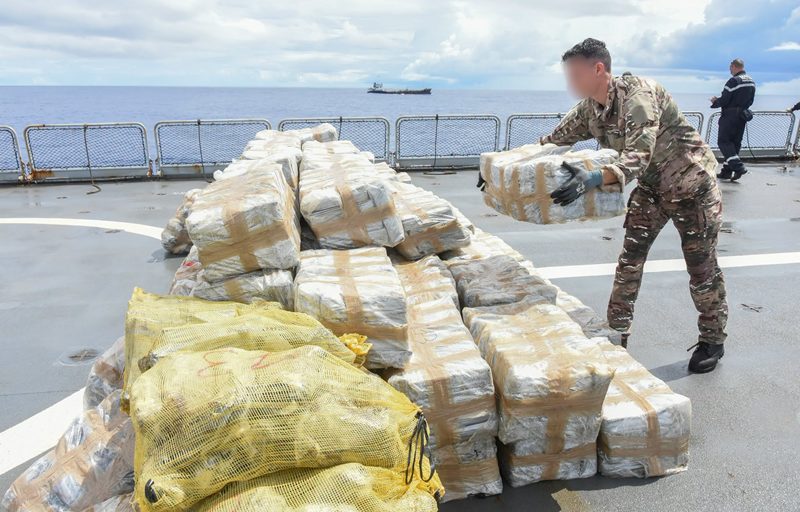
A phantom oil tanker, an interception far from the EEZ, and 3.4 tonnes of ice after a new weighing… Rear Admiral Yann Bied-Charreton and High Commissioner Alexandre Rochatte waited for the drug and the military personnel to return to shore to provide a few details about the high-seas operation of November 20. And to explain certain choices, notably the decision to allow the vessel and the traffickers to depart. The cargo will indeed be destroyed in Tahiti, where, in the absence of a sufficiently powerful waste incinerator, the State has resolved to order specialized equipment.
It took until the end of the operations at sea for Rear Admiral Yann Bied-Charreton and High Commissioner Alexandre Rochatte to speak about the drug seizure carried out on Friday, November 20, by the National Navy. But while the roughly 150 bundles of methamphetamine – for a total revised to 3.4 tonnes after a new weighing – have now been landed and are awaiting destruction in Tahiti, the two officials remain discreet on many aspects of this operation. We will thus only learn about the intercepted ship, “of tanker type,” as the state’s first communiqué described it, that it was spotted in the Clipperton zone (a French-ruled atoll off the coast of Central America), with a “suspicious behavior.”
A vessel without a flag, in a “shady” zone, with a trajectory “not coherent with commercial navigation,” yet it was still emitting a satellite AIS signal. “The boat had meetings, clearly sea meetings with boats that were masked, but it did not mask its intentions by trying to remain credible in its behavior,” explains the senior commander of the armed forces in Polynesia. “It was in the middle of the Pacific and it was heading west.”
A seizure, but no arrests: “the main objective is to take this drug off the market.”
The Navy therefore initiated discreet monitoring, waiting “to activate the various partner networks.” National partners, from internal security forces, customs, Ofast, but also international ones. The information lines converge: “we think it is probably loaded,” notes the Chief Commander, who thus activates “a procedure that we know well,” since it has already been used three times at the start of the year for three interceptions that led to the seizure and the destruction at sea of more than 11.5 tonnes of cocaine outside the EEZ. While aircraft – a Falcon 50 from the FAPF and another from the American Coast Guard – fly over the area “in complete discreetness as well,” the operation is launched from the naval base in Papeete, but also, in a “controlled legal framework,” as the senior officer welcomes, in “inter-ministeriality,” i.e., with various state services.
The exact location of this new operation is not specified: “far from the Polynesian EEZ,” north of the Equator. The vessel’s port of registry shown on the deck documents — which was anyway incorrect — is not specified either. Nor the nationality or the number of sailors, all of whom were free to return aboard the phantom tanker after the drugs were discovered and seized on board. This “dissociation” between the administrative handling of the illicit cargo and that of the ship and crew had already been the strategy chosen during the three cocaine interceptions earlier this year. A choice justified by the High Commissioner by the distance of the interception from Tahiti, the relatively limited value of arrests in terms of repression or intelligence, and the destination of the seized drugs. “They did not come to French Polynesia,” affirms Alexandre Rochatte. The quantity, anyway, is enough to demonstrate. Besides, it’s not exactly the same type of methamphetamine as the one found here. “Justice has a lot of work here, with traffickers bringing drugs into French Polynesia,” continues the State representative. “For us, the main objective is to remove this drug from the market.”
No destruction at sea… This time
So will sailors and a ship once again be able to participate in international trafficking operations? “We did not let them go just like that, into the blue,” replies the High Commissioner. “They are known, and we share these intelligence elements with all our partners.” Upstream partners in the zone mean, concretely, the delivery and loading area, and downstream partners are the areas interested in the ship’s arrival. “We activate our partners, we signal it, we let it depart.” “We can consider that the ship is neutralized,” insists Rear Admiral Bied-Charreton. Once it has been seized once, the ship will be hardly reusable. So it’s better to let it depart with the crew.
However, unlike the January interceptions – which were followed by multiple interventions in recent months but without the discovery of illicit cargo – the drugs were not destroyed at sea but brought ashore. Would local and international debates on these “oceanizations” and Tarahoi’s resolution on the subject have steered the authorities’ strategy? Not really. The State still does not rule out destroying the cargo at sea if the conditions demand it. Nature of the drug, place of interception, type and nationality of the vessel, operational needs, since an oceanization allows a patrol boat to remain on site… “Each case is unique,” reiterates the High Commissioner, but “the law authorizes us to do it, and so we can do it.” “And that’s precisely why I said that in each case we analyze things and we’ll see what the situations require.”
Ad hoc incinerators ordered
Not much more information about the operation itself, except that it was marked by a crew’s “surprise effect,” that there was no particular resistance… And that the Navy estimates “99% that there is nothing left on this vessel.” If the question arises, it is because one of the vessels intercepted in January, the MV Raider, on which nearly 5 tonnes of cocaine were found and immediately destroyed, was intercepted again, off Australia, a few weeks later… And with an additional tonne of drugs. When it was visited, there was nothing left on board, the High Commissioner confirms today. However, it was apparently reloaded before reaching Australian shores.
One question remains: how will the drugs be destroyed now that they are in Tahiti? Not surprisingly, given the quantities seized, the state authorities do not elaborate on the subject. Alexandre Rochatte nevertheless specifies that the destruction will be by incineration starting “from next week.” Where? The gendarmerie has a small-capacity incinerator, and the country has an incinerator at Nivee, intended for “hazardous infectious healthcare waste.” But given the record seizures in recent months, the High Commission has decided to equip itself. “We will soon be equipped with an incinerator we ordered and which will arrive in 5 to 10 days, enabling us to move to a higher pace in terms of incineration capacity,” explains the State representative, who adds that several equipment pieces could be installed. “I should note that in other French territories, it is household waste incinerators that are used. Here, there isn’t one. And that was also one of our reflections on cocaine at sea: we did not have the capacity here because there are no communities that have deployed household waste incinerators developed enough to destroy drugs.”
The details of this order—and of course the place where the cargo is stored—remain, for now, equally discreet, for security reasons. The 3.4 tonnes of ice seized last Friday represent at the very least 50 million doses of ice, with a market value—highly theoretical in this case—of more than 200 billion francs at Tahiti’s common price for a gram of methamphetamine.