
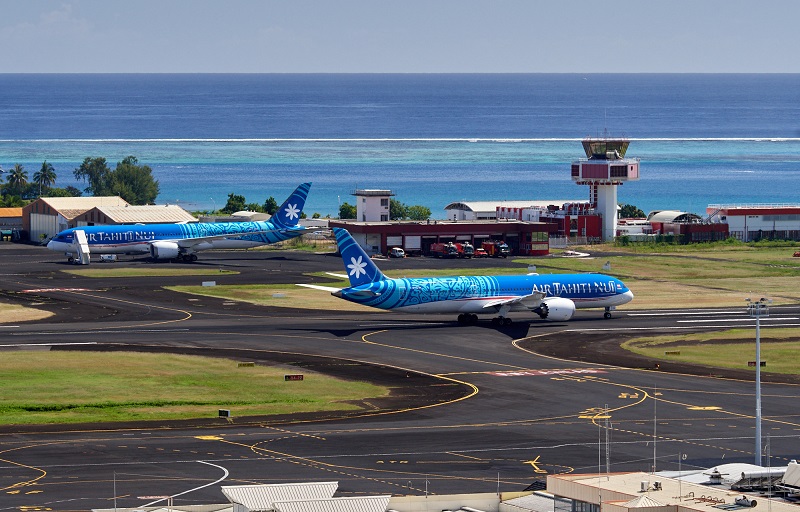
At midday on Friday (Tahiti time), the United States enacted a nationwide grounding of air traffic, citing “extraordinary circumstances.” Later in the day, officials attributed the move to the “instability” of the control system, believed to stem from the aging routers currently used by the Federal Aviation Administration, and this ground stop affected about 3,000 aircraft in just a few hours. Local carriers reassured passengers in the afternoon that flights “should not be affected,” though some delays were noted. The U.S. airspace was subsequently reopened around 4 p.m.
[Update: flights resumed Friday afternoon]
That Friday, November 13, just before noon (Tahiti time), the United States issued a ground stop at all airports nationwide. The FAA (Federal Aviation Administration) stated at the time that the move was due to “extraordinary circumstances” and “safety reasons,” following issues in communications within the regional air traffic control centers. The FAA added in a brief that an investigation conducted by FAA technicians was underway. At the time of the announcement, no aircraft could take off from U.S. airports, while incoming international flights were being handled on a case-by-case basis.
This rare event has occurred only twice in the past quarter-century, according to CNN: in 2023 after a failure in the pilot alert system and previously in 2001, after the September 11 attacks.
Flights to and from French Polynesia slip through the cracks
In a press release, Air Tahiti Nui informed passengers in the afternoon that its flights “should not be affected and are maintained according to the schedule for Friday.” Thus, TN2, departing Papeete at 21:30; TN8, departing Papeete at 23:45; and TN101, departing Los Angeles at 22:45, were listed as unaffected. Reached by phone, the Hawaiian Airlines office in Papeete issued a similar message, confirming that their international services were not impacted by the ground stop. Air France echoed the sentiment, with flight AF027 having left Papeete at 09:20 and en route to LAX at the time of the announcement. The Frenchbee flight, which departed at 07:35, was expected to arrive in San Francisco at 17:20. If it could continue its journey, it might incur a delay. The low-cost carrier had not yet provided further information regarding its other flights.
At 4 p.m. (Tahiti time), Sean Duffy, the United States Secretary of Transport, addressed the American press to announce the reopening of the airspace. “It will take us some time to return to normal operations,” the FAA noted on X. While the resumption of normal traffic “will not happen overnight” according to the official, he specified that priority would be given to the flights carrying the most passengers, a decision that should thus significantly favor services to and from Tahiti, which can carry nearly 300 passengers.
A system deemed antiquated by the U.S. transportation secretary
During a press conference, the American secretary explained this rare situation as due to an “instability” of the control system, which led to the decision to shut down the entire airspace. He stated that about 3,000 aircraft had reached U.S. tarmacs within a few hours. The priority flights related to health or the transport of essential medicines were able to continue flying. Sean Duffy noted that this instability was linked to aging FAA routers, criticizing a “system decades old” and “equipment not suited to the demands of the 21st century.” He appealed to Congress for an “emergency funding” of $50 billion to upgrade it.